History · Ch 6 — Displacing Indigenous Peoples
Mutual Perceptions
Mutual Perceptions
The idea of the “civilised” and the “savage”
In the eighteenth century, western Europeans measured civilisation by three yardsticks: literacy, an organised religion, and urban living. Measured against these, the native peoples of America appeared to them as “uncivilised”. But not everyone drew the same conclusion from this. The French philosopher Jean-Jacques Rousseau argued the opposite — that such people were to be admired precisely because they had not been touched by the corruptions of “civilisation”. This admiration found a popular label: “the noble savage”.
A different shade of the same European attitude appears in the poetry of William Wordsworth. Neither he nor Rousseau had ever met a native American, yet Wordsworth described them as living “amid wilds / Where fancy hath small liberty to grace / The affections, to exalt them or refine”. In plain words, he believed that people who lived close to nature had only limited powers of imagination and emotion. The poet was, in effect, pitying them for a deficiency he had simply assumed.
A much younger writer, Washington Irving, had actually met native people, and his account is strikingly different. He found the Indians in real life quite unlike the ones described in poetry. It was true that they were taciturn in the company of white men, whose goodwill they distrusted and whose language they did not understand — but, Irving noted, the white man was equally silent under the same circumstances. Among themselves, the Indians were great mimics and entertained themselves endlessly at the expense of the whites, who had flattered themselves into believing the natives were impressed with profound respect for their grandeur and dignity. Irving also recorded the other side of the encounter: white men, as he had witnessed, were prone to treat the poor Indians as little better than animals.
Two different economies, two different worlds
The mutual misunderstanding went deeper than manners — it reached into the very meaning of exchange. To the natives, the goods they traded with Europeans were gifts, given in friendship. To the Europeans, who dreamed of becoming rich, the fish and furs were commodities to be sold for profit back in Europe. The prices of these goods varied from year to year depending on supply, and the natives could not understand this. They had no sense of a “market” operating in faraway Europe, and they were puzzled that European traders sometimes gave them a great deal in exchange for their goods and sometimes very little.
They were also saddened by European greed. In their impatience to get furs, the Europeans had slaughtered hundreds of beavers, and the natives were uneasy, fearing that the animals would take revenge on them for this destruction. Many native folk tales mocked Europeans and described them as greedy and deceitful, but because these tales were told as imaginary stories, it was only much later that the Europeans understood the references.
Settlers, forests, and the idea of land
Following the traders came the settlers. From the seventeenth century, groups of Europeans who were being persecuted for their religion — Protestants living in predominantly Catholic countries, or Catholics where Protestantism was the official religion — left Europe for America to begin a new life. As long as vacant land was available, this caused no problem. But gradually the Europeans moved further inland, near native villages, and used their iron tools to cut down forests and lay out farms.
Natives and Europeans saw different things when they looked at a forest. The natives identified tracks that were invisible to the Europeans. The Europeans imagined the forests cut down and replaced by cornfields. Thomas Jefferson, third President of the USA and a contemporary of Wordsworth, dreamed of a country populated by Europeans with small farms.
Thomas Jefferson on the "unfortunate race". Thomas Jefferson, third President of the
USA and a contemporary of Wordsworth, spoke of the natives in words that would lead to a
public outcry today:
'This unfortunate race which we have been taking so much pains to civilise… have justified
extermination.'
— Thomas Jefferson
What it shows: A sitting US President could, in the same period the Romantic poets were
idealising the "noble savage," speak of native extermination as justified — a stark example …
The natives, who grew crops for their own needs rather than for sale and profit, and who thought it wrong to “own” the land, could not understand this dream. In Jefferson’s view, this made them “uncivilised”. His words about the natives would cause a public outcry today: “This unfortunate race which we have been taking so much pains to civilise… have justified extermination.”
The expansion of the USA and Canada
The countries now known as Canada and the United States of America came into existence at the end of the eighteenth century, occupying only a fraction of the land they cover today. Over the next hundred years they extended their control to reach their present size. Large areas were acquired by the USA by purchase
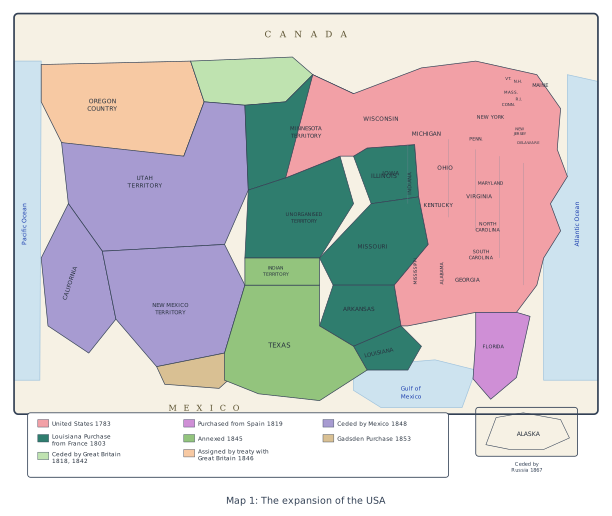
The map is a shaded political map of the continental United States, with a small inset showing Alaska in the lower corner. Its single purpose is to show how the country’s territory was assembled piece by piece between 1783 and 1867. The shading is keyed to a dated legend with nine categories, so each block of colour corresponds to a specific year or period in which that land was acquired.
Reading the map chronologically, the original thirteen colonies form the core, established by 1783 when Britain recognised American independence. The next major block is the Louisiana Purchase of 1803, a vast swath of land bought from France that doubled the size of the country. Further acquisitions follow: Florida, taken from Spain in 1819; the annexation of Texas in 1845; the Oregon Territory, gained by treaty with Britain in 1846; and the huge Mexican Cession of 1848, won after the Mexican-American War, which gave the USA California and the entire southwest. A smaller strip of land in southern Arizona and New Mexico, the Gadsden Purchase of 1853, rounds out the continental shape. Finally, the Alaska inset is shaded for 1867, the year the USA bought the territory from Russia.
The visual logic of the map is expansion outward from the Atlantic coast. The earliest acquisitions hug the eastern seaboard, and each successive shade pushes the frontier further west until the continent is filled. The legend’s nine categories force you to notice that the USA did not grow by a single mechanism — some land was purchased, some was won by war, some was annexed, and some was negotiated by treaty. The map itself does not label these methods, but the dates alone tell the story: 1803 and 1867 are purchases, 1848 is conquest. …
— the Louisiana Purchase from France in 1803, and Alaska from Russia — and by war, since much of southern USA was won from Mexico. It did not occur to anyone that the consent of the natives living in these areas should have been asked. The western “frontier” of the USA was a shifting one, and as it moved, the natives were forced to move back with it.
A few dates mark the political milestones of this period:
| Year | Event |
|---|---|
| 1701 | French treaty with natives of Quebec |
| 1763 | Quebec conquered by the British |
| 1774 | Quebec Act |
| 1781 | Britain recognises USA as an independent country |
| 1783 | British give Mid-West to the USA |
| 1791 | Canada Constitutional Act |
| 1803 | Louisiana purchased from France |
| 1832 | Justice Marshall’s judgement |
| 1837 | French Canadian rebellion |
| 1840 | Canadian Union of Upper and Lower Canada |
| 1849 | American Gold Rush |
| 1859 | Canada Gold Rush |
| 1861–65 | American Civil War |
| 1865–90 | American Indian Wars |
| 1867 | Confederation of Canada |
| 1869–85 | Red River Rebellion by the Metis in Canada |
| 1870 | Transcontinental railway in Canada |
| 1876 | Canada Indians Act |
| 1885 | Transcontinental railway links east and west coasts of Canada |
| 1890 | Bison almost exterminated in America |
| 1892 | “End” of American frontier |
The land transformed
The landscapes of America changed drastically in the nineteenth century because the Europeans treated the land differently from the natives. Some of the migrants from Britain and France were younger sons who would not inherit their fathers’ property, and were therefore eager to own land in America. Later came waves of immigrants from Germany, Sweden and Italy who had lost their lands to big farmers and wanted farms they could own. People from Poland were happy to work in the prairie grasslands, which reminded them of the steppes of their homes, and were excited at being able to buy huge properties at very low prices.
They cleared land and developed agriculture, introducing crops such as rice and cotton, which could not grow in Europe and could therefore be sold there for profit. To protect their huge farms from wild animals — wolves and mountain lions — these animals were hunted to extinction. The settlers felt totally secure only with the invention of barbed wire in 1873.
Slavery and the Civil War …
Washington Irving, who had actually met native people. Unlike Wordsworth, the writer
Washington Irving had met native Americans in person, and described them quite differently:
'The Indians I have had an opportunity of seeing in real life are quite different from those
described in poetry… Taciturn they are, it is true, when in company with white men, whose
goodwill they distrust and whose language they do not understand; but the white man is
equally taciturn under like circumstances. When the Indians are among themselves, they are
great mimics, and entertain themselves excessively at the expense of the whites… who have
supposed them impressed with profound respect for their grandeur and dignity… The white men
(as I have witnessed) are prone to treat the poor Indians as little better than animals.'
— Washington Irving
What it shows: Irving's first-hand account punctures both the Romantic myth of a silent,
simple "noble savage" and the settlers' own self-flattering assumption of being admired — …
MAP 1 — The expansion of the USA: how the territory was assembled. The map's legend sets
out, in nine dated categories, how the present-day USA was assembled from 1783 to 1867:
- United States, 1783
- Louisiana Purchase from France, 1803
- Ceded by Great Britain, 1818 and 1842
- Purchased from Spain, 1819
- Annexed, 1845
- Assigned by treaty with Great Britain, 1846
- Ceded by Mexico, 1848 …
| Canada | USA |
|---|---|
| 1701 French treaty with the natives of Quebec | |
| 1763 Quebec conquered by the British | 1781 Britain recognises the USA as an independent country |
| 1774 Quebec Act | 1783 Britain gives the Mid-West to the USA |
| 1791 Canada Constitutional Act | |
| 1803 Louisiana purchased from France | |
| 1825-58 Natives in the USA moved to reserves | |
| 1837 French Canadian rebellion | 1832 Justice Marshall's judgement |
| 1840 Canadian Union of Upper and Lower Canada | 1849 American Gold Rush |
| 1859 Canada Gold Rush | 1861-65 American Civil War |
| 1867 Confederation of Canada | 1865-90 American Indian Wars |
| 1869-85 Red River Rebellion by the Metis in Canada | 1870 Transcontinental railway |
| 1876 Canada Indians Act | 1890 Bison almost exterminated in America |