History · Ch 6 — Displacing Indigenous Peoples
Encounters with Europeans
Encounters with Europeans
The first thing to grasp about this section is that it is not a single story. It is a set of three distinct threads: the vocabulary used to name native peoples, a native account of first contact, and the actual mechanics of early trade between Europeans and the natives of North America. Each thread tells you something different about how the encounter was perceived and how it actually unfolded.
The Language of Naming
The book opens with a striking observation: names of native tribes have been borrowed for all sorts of unrelated things. Dakota is an aeroplane, Cherokee a jeep, Pontiac a car, Mohawk a haircut. This casual borrowing shows how deeply native names entered everyday life, even as the peoples themselves were being displaced.
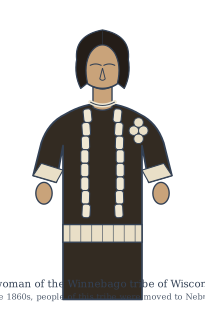
Drawn by us to help you understand the concept clearly, and verified to make sure it's accurate. For exams, practice from your NCERT textbook's own diagram.
The photograph is a portrait of a Winnebago woman, taken sometime in the 1860s. The Winnebago were a native tribe of Wisconsin, and the image captures her in a formal, posed style typical of studio photography of that era. The caption tells us the crucial historical fact: during that same decade, the tribe was forcibly moved from Wisconsin to Nebraska.
What makes this figure instructive is not the composition of the portrait itself, but the story it anchors. The Winnebago were among the many native peoples of North America who experienced displacement as European settlement expanded westward. The photograph freezes a moment just before that removal — a visual record of a person whose community was about to be uprooted from its homeland. The 1860s were a period of intense pressure on native lands, and the forced relocation of the Winnebago to Nebraska was part of a broader pattern of Indian removal that reshaped the map of the United States. …
But the more serious point is the confusion of terms used in English for the native peoples of the ‘New World’. Each term carries a different history and a different shade of meaning:
- Aborigine – from Latin ab (from) and origine (the beginning); refers to the native people of Australia.
- Aboriginal – an adjective, often misused as a noun.
- American Indian / Amerind / Amerindian – used for native peoples of North and South America and the Caribbean.
- First Nations peoples – the organised native groups recognised by the Canadian government. The Indian Act of 1876 used the term ‘bands’, but from the 1980s the word ‘nations’ came into use.
- Indigenous people – people belonging naturally to a place.
- Native American – the indigenous people of the Americas; this is the term now commonly used.
- ‘Red Indian’ – the brown-complexioned people whose land Columbus mistook for India.
The last term is a reminder of the original error: Columbus thought he had reached India, and the misnomer stuck. The shift from ‘bands’ to ‘nations’ in Canada is not trivial — it reflects a change in how these groups were officially recognised and, implicitly, in how their political status was understood.
A Native Account of First Contact
The book then gives you a native perspective, from a talk by Lee Brown in 1986, concerning the Hopis, a native tribe who now live near California. The Hopis had a prophecy recorded on stone tablets: the first brothers and sisters who would return to them would come as turtles across the land — human beings, but arriving like turtles.
When the time came close, the Hopis gathered at a special village to welcome these turtles. At sunrise they looked out across the desert and saw the Spanish conquistadors coming, covered in armour, moving like turtles across the land. So the Hopis went out to the Spanish man and extended their hand, hoping for a handshake. Instead, the Spanish man dropped a trinket into their open palm.
The Hopi prophecy of the turtles. From a talk given by the Native American speaker Lee
Brown in 1986:
'It was indicated on the stone tablets that the Hopis had that the first brothers and
sisters that would come back to them would come as turtles across the land. They would be
human beings, but they would come as turtles. So when the time came close the Hopis were at
a special village to welcome the turtles that would come across the land and they got up in
the morning and looked out at the sunrise. They looked out across the desert and they saw
the Spanish Conquistadores coming, covered in armour, like turtles across the land. So this
was them. So they went out to the Spanish man and they extended their hand hoping for the
handshake but into the hand the Spanish man dropped a trinket. And so word spread throughout
North America that there was going to be a hard time, that maybe some of the brothers and
sisters had forgotten the sacredness of all things and all the human beings were going to
suffer for this on the earth.'
— From a talk by Lee Brown, 1986 (the Hopis are a native tribe who now live near California)
What it shows: A Hopi prophecy of returning "brothers and sisters" was read onto the …
Word spread throughout North America that a hard time was coming — that some of the brothers and sisters had forgotten the sacredness of all things, and that all human beings would suffer for this on the earth.
The power of this account lies in the mismatch of expectations. The Hopis expected a return of kin, a handshake between equals. What they got was a trinket — a gesture of dismissal, not of greeting. The prophecy framed the coming disaster not as a military conquest but as a spiritual failure, a forgetting of the sacredness of all things.
The Early Trade
The third thread is the actual encounter as it happened in the seventeenth century. European traders who reached the north coast of North America after a difficult two-month voyage were relieved to find the natives friendly and welcoming. This was a sharp contrast with the Spanish in South America, who had been overcome by the abundance of gold. These later adventurers came instead to trade in fish and furs, and in this they got the willing help of the natives, who were expert hunters.
Further south, along the Mississippi river, the French found that the natives held regular gatherings to exchange handicrafts unique to a tribe, or food items not available in other regions. These gatherings were already a feature of native life before the Europeans arrived.
In exchange for local products, the Europeans gave the natives several things:
- Blankets
- Iron vessels – which the natives sometimes used in place of their clay pots
- Guns – a useful supplement to bows and arrows for killing animals
- Alcohol – something the natives had not known earlier
The alcohol was the destructive item. The natives became addicted to it, and this suited the Europeans, because it enabled them to dictate the terms of trade. The exchange was not one-sided in its addictions, though: the Europeans acquired from the natives an addiction to tobacco. …
Different terms are used in English for the native peoples of the 'New World'.
- aborigine — native people of Australia (in Latin, ab = from, origine = the beginning)
- Aboriginal — adjective, often misused as a noun
- American Indian/Amerind/Amerindian — native peoples of North and South America and the Caribbean
- First Nations peoples — the organised native groups recognised by the Canadian government (the Indians Act of 1876 used the term 'bands'; from the 1980s the word 'nations' is used)
- indigenous people — people belonging naturally to a place …
| Quebec | American colonies |
|---|---|
| 1497 John Cabot reaches Newfoundland | 1507 Amerigo de Vespucci's Travels is published |
| 1534 Jacques Cartier travels down the St Lawrence river and meets native peoples | |
| 1608 The French found the colony of Quebec | 1607 The British found the colony of Virginia |