History · Ch 6 — Displacing Indigenous Peoples
The Native Peoples Lose their Land
The Native Peoples Lose their Land
The story of how native peoples lost their land in the USA is not a story of simple conquest. It is a story of broken promises, legal trickery, forced marches, and a deep cultural clash over what land actually means. The textbook walks through this systematically: first the methods of dispossession, then the justifications offered, then the physical confinement, and finally the resistance — and the intellectual climate that predicted their disappearance.
How the Land Was Taken
As American settlement expanded westward, native peoples were induced or forced to move after signing treaties that sold their land. The word "induced" matters here — some signed under pressure, some under deception, and some were simply driven out by the army. The prices paid were very low, and there were outright instances of cheating: Americans (a term used in the book to mean the European people of the USA) took more land than agreed, or paid less than promised.
What is striking is that even high officials saw nothing wrong in depriving native peoples of their land. This was not a case of a few corrupt individuals acting against the law
Drawn by us to help you understand the concept clearly, and verified to make sure it's accurate. For exams, practice from your NCERT textbook's own diagram.
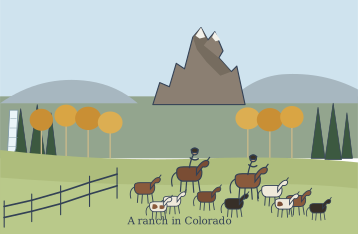
The photograph shows a ranch set in a Colorado mountain valley: a snow-capped peak rising above forested slopes of dark conifer and golden aspen, with a large herd of horses -- bay, chestnut, grey, and pinto -- being driven or grazed across an open pasture, a rider or two visible among them, and a wooden rail fence marking the edge of the property in the foreground. It is a scene of settled prosperity: fenced land, managed livestock, a family enterprise built to last.
That fence is the point. A ranch like this is privately titled land, surveyed, bounded, and legally the owner's alone -- the direct opposite of how native peoples had used this same kind of country for generations, moving with the seasons across open, unfenced range that belonged to no one individual. The horse herd itself is also a settler institution: native peoples of the plains and mountains had their own horse culture, built around hunting and mobility, while a ranch's herd exists to be bred, sold, and worked as property. …
— the law itself, and its highest interpreters, were part of the problem.
The Cherokee Case and the Trail of Tears
The textbook uses the Cherokee tribe of Georgia as its central example. The Cherokees had made the most effort of all native peoples to learn English and understand the American way of life. Yet officials argued that the tribe was governed by state laws while being denied the rights of citizens. They were subject to the state, but not part of it.
In 1832, US Chief Justice John Marshall delivered an important judgment. He ruled that the Cherokees were "a distinct community, occupying its own territory in which the laws of Georgia had no force," and that they had sovereignty in certain matters. This was a legal victory for the Cherokees
Chief Justice Marshall's 1832 ruling on the Cherokees. The Cherokees of Georgia had made
more effort than most native peoples to learn English and adopt American ways, yet were
denied citizens' rights. In 1832, US Chief Justice John Marshall ruled that the Cherokees
were:
'a distinct community, occupying its own territory in which the laws of Georgia had no
force'
President Andrew Jackson refused to honour this judgement and ordered the US army to evict
the Cherokees to the Great American Desert — of the roughly 15,000 people forced to go, over
a quarter died along the way, on what is remembered as the "Trail of Tears".
What it shows: Even a favourable ruling from the country's highest court could not protect …
— but it was never honoured.
President Andrew Jackson had a reputation for fighting against economic and political privilege. But when it came to the Indians, he was a different person. He refused to honour the Chief Justice's judgment and ordered the US army to evict the Cherokees from their land and drive them to the Great American Desert. Of the 15,000 people forced to go, over a quarter died along the "Trail of Tears." That is more than 3,700 deaths on a single forced march.
The Trail of Tears is the single most powerful example in this section: a legal ruling in favour of native rights was openly defied by the President, and the result was the death of over a quarter of 15,000 displaced Cherokees.
The Justifications for Taking Land
Those who took the land occupied by the tribes did not remain silent. They built a set of justifications, each of which the textbook lists:
- The natives did not deserve to occupy land they did not use to the maximum.
- They were lazy, because they did not use their craft skills to produce goods for the market.
- They were not interested in learning English.
- They did not dress "correctly" — which meant dressing like Europeans.
- Therefore, they deserved to "die out."
The logic is circular: native peoples were judged by European standards of productivity and culture, found wanting, and then punished for the failure. The prairies were cleared for farmland, and wild bison were killed off. A visiting Frenchman wrote: **"Primitive man will disappear with the primitive animal.
"Primitive man will disappear with the primitive animal." As prairies were cleared for
farming and bison hunted toward extinction, a visiting Frenchman wrote:
'Primitive man will disappear with the primitive animal.'
What it shows: Settlers who took native land often justified it by arguing that natives
did not use land "to the maximum" or produce for the market, and so deserved to lose it — this …
"** The extinction of the bison and the extinction of the native peoples were seen as part of the same natural process.
Reservations and Displacement
Meanwhile, the natives were pushed westward and given land elsewhere — land that was promised to be "theirs in perpetuity." But this promise meant little. If lead, gold, or oil was found on their lands, they were moved again. Many tribes were forced to share land originally occupied by one tribe, which led to quarrels between them. They were locked off in small areas called reservations, often on land with which they had no earlier connection.
The phrase "theirs in perpetuity" is a trap. It sounds like a permanent guarantee, but in practice it meant nothing — mineral discoveries led to repeated removals. Perpetuity lasted only until the next discovery.
Resistance and Its End
They did not give in without a fight. The US army crushed a series of rebellions from 1865 to 1890. In Canada, there were armed revolts by the Metis — people of native and European descent — between 1869 and 1885. But after that, the textbook says plainly: they gave up.
Anthropology and the Idea of "Dying Out"
It is significant that the subject of anthropology — developed in France — was introduced in North America from the 1840s, out of a curiosity to study the differences between native "primitive" communities and the "civilised" communities of Europe. Some anthropologists argued that just as there were no
Drawn by us to help you understand the concept clearly, and verified to make sure it's accurate. For exams, practice from your NCERT textbook's own diagram.
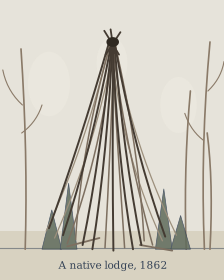
The photograph shows a single native lodge — a dwelling built by indigenous peoples of the Great Plains — as it stood in 1862. The structure itself is the entire subject: a conical, tipi-like shelter, likely made of wooden poles covered with animal hides, the kind of home used by nomadic hunting peoples who followed the bison herds. The caption tells us something remarkable about its fate: archaeologists physically moved this lodge from the mountains and re-erected it inside a museum in Wyoming. So the image is not just a record of native life — it is a record of how that life was being dismantled and turned into an exhibit.
What makes the figure powerful is the contrast between the two things it shows. On one hand, the lodge is a living object: a home, built from materials at hand, designed to be portable and practical for a people on the move. On the other, the caption reveals that by the time the photograph was taken, or shortly after, this very structure was being treated as a specimen — something to be dug up, transported, and displayed behind glass. The museum in Wyoming becomes a kind of final reservation: the natives were pushed onto confined land, and even their material culture was confined to display cases.
This connects directly to the chapter's argument about anthropology. The textbook notes that from the 1840s, anthropologists in North America studied native communities as "primitive" curiosities, expecting them to "die out" like the bison. The photograph embodies that attitude. The lodge is preserved precisely because the people who made it were assumed to be vanishing. It is treated as an artefact of a dying culture rather than the home of a living one. The fact that archaeologists moved it "from the mountains" — a phrase suggesting it was abandoned or forcibly removed — reinforces the point: the land itself was being taken, and what remained of native life was being collected, catalogued, and exhibited by the very society that was dispossessing them. …
"primitive" people to be found in Europe, the American natives too would "die out." The discipline that claimed to study native peoples was, in part, predicting their disappearance.
Chief Seattle's Letter
In 1854, the President of the USA received a letter from a native leader, Chief Seattle. The President had asked the chief to sign a treaty giving a large part of the land they lived on to the American government. The Chief's reply is quoted at length in the textbook, and it is worth reading carefully: …
A snapshot of the very different population balance the two colonial societies had produced
by the early nineteenth century:
| USA: 1820 | Spanish America: 1800 | |
|---|---|---|
| Natives | 0.6 million | 7.5 million |
| Whites | 9.0 million | 3.3 million |
| Mixed Europeans | 0.1 million | 5.3 million |
Chief Seattle's 1854 letter. In 1854, the President of the USA received a letter from a
native leader, Chief Seattle, after the president asked the chief to sign a treaty giving a
large part of the land his people lived on to the American government. The Chief replied:
'How can you buy or sell the sky, the warmth of the land? The idea is strange to us. If you
do not own the freshness of the air and the sparkle of the water, how can one buy them?
Every part of the earth is sacred to my people. Every shining pine-needle, every sandy
shore, every mist in the dark woods, every clearing and every humming insect is holy in the
memory and experience of my people. The sap which courses through the trees carries the
memories of the red man…
So, when the Great Chief in Washington sends word that he wishes to buy our land, he asks
much of us. The Great Chief sends word that he will reserve us a place so that we can live
comfortably. He will be our father and we will be his children. So we will consider your
offer to buy our land. But it will not be easy. For this land is sacred to us. The shining
water that moves in the streams and rivers is not just water but the blood of our ancestors.
If we sell you land, you must remember that it is sacred and you must teach your children
that it is sacred and that each ghostly reflection in the clear water of the lakes tells of
events and memories in the life of my people. The water's murmur is the voice of my father's
father…'
— Chief Seattle, 1854
What it shows: Chief Seattle answers a purely commercial proposal — buying land — in the …
Anthropology. It is significant that it was at this time (from the 1840s) that the
subject of 'anthropology' (which had been developed in France) was introduced in North
America, out of a curiosity to study the differences between native 'primitive' communities
and the 'civilised' communities of Europe. Some anthropologists argued that just as there were …