History · Ch 7 — Paths to Modernisation
Introduction
Introduction
China and Japan: Two Roads to the Modern World
At the start of the nineteenth century, East Asia was dominated by China. The Qing dynasty, heir to a long tradition, appeared secure in its power, while Japan, a small island country, seemed locked in relative isolation. Within a few decades, though, the picture had reversed: China was thrown into turmoil, unable to meet the colonial challenge as the imperial government lost control and the country was convulsed by civil war, while Japan succeeded in building a modern nation-state and an industrial economy, and even acquired a colonial empire of its own, taking Taiwan in 1895 and Korea in 1910. Japan went on to defeat China — the very country that had long been the source of its own culture and ideals — in 1894, and then defeated a European power, Russia, in 1905.
China’s path to a modern national strength was slower and harder-won, eventually achieved through revolution: the Chinese Communist Party emerged victorious from civil war in 1949. By the end of the 1970s, though, Chinese leaders judged that their ideological system was holding back economic growth, and pushed through sweeping reforms that reintroduced capitalism and the free market even as the Communist Party kept firm political control. Japan, meanwhile, became a major industrial power, but its own drive for empire led to war and eventual defeat by Anglo-American forces; the US Occupation that followed introduced a more democratic political system, and Japan rebuilt its economy to become a major economic power again by the 1970s. Japan’s own path to modernisation rested on capitalist principles pursued within a world still dominated by Western colonialism, and its expansion was justified at the time as resistance to Western domination and the ‘liberation’ of Asia — even as it underlined the strength of Japanese tradition, institutions and nationalism.
Both China and Japan have long traditions of historical writing — history mattered to their rulers because the past supplied the standards by which they expected to be judged, and both maintained official bureaus to keep records and write dynastic histories. Sima Qian (145–90 BCE) is regarded as the greatest historian of early China; in Japan, one of the first acts of the new Meiji government in 1869 was to set up a bureau to collect records and write its own official account of the Meiji Restoration. This deep respect for the written word means a vast range of material survives — official histories, scholarly writing, popular literature, religious tracts — much of it studied afresh by modern scholars such as Liang Qichao and Kume Kunitake (1839–1931), alongside earlier accounts left by European travellers such as Marco Polo (in China 1274–1290) and the Jesuit missionaries Matteo Ricci and Luis Frois. Later scholarship, from Joseph Needham’s work on the history of science in China to George Sansom’s histories of Japan, has built an immense and still-growing body of research — including, in recent decades, work by Chinese and Japanese scholars themselves, some writing in English and some, since the 1980s, working in Japan and publishing in Japanese.
China and Japan sit side by side in East Asia
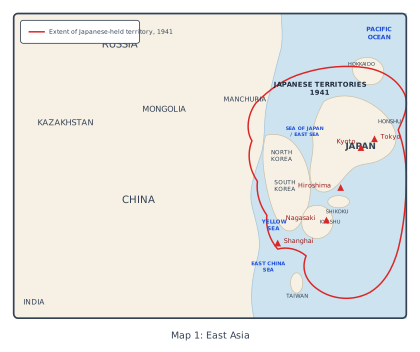
The map is a simple sketch of the East Asian landmass and its surrounding seas, drawn to show the region as a single strategic space in 1941. The mainland is dominated by China, a vast continental block, with Japan appearing as a chain of islands off its eastern coast. Korea sits as a peninsula jutting out from the Chinese mainland toward Japan, and Manchuria occupies the northeastern corner of China, bordering Korea. Taiwan lies off the southeastern coast of China, and the map also marks the seas that separate these landmasses — the Yellow Sea, the East China Sea and the Sea of Japan are implied by the geography, though the description does not name them individually.
The key feature is a marked line tracing the outer boundary of Japan's wartime territories in 1941. This line runs from Manchuria in the north, sweeps down through Korea, and then continues along the Chinese coast, enclosing the areas Japan controlled at the height of its imperial expansion. The map therefore does not show Japan's home islands alone; it shows an empire that stretched onto the Asian mainland, incorporating Korea as a colony and Manchuria as a client state, with military pressure extending deep into coastal China.
What the map teaches is the sheer scale of Japanese expansion before the Pacific War. Japan, a small island nation with limited natural resources, had built a continental empire by 1941 — a fact that explains both its military confidence and its strategic vulnerability. The boundary line is not a border between equal states; it is a snapshot of conquest, showing how far Japan's reach had extended and how close it had come to dominating the entire eastern seaboard of Asia. This territorial ambition is the backdrop for everything that follows in the chapter: the drive for autarky, the clash with Western powers, and ultimately the Pacific War itself. The map also makes the physical contrast between China and Japan visually concrete — the vast continental mass versus the island chain — reminding you that geography shaped not just their cuisines and architecture, but their very different paths to modernisation.
, yet their geographies could hardly be more different. That contrast shapes everything that follows in this chapter — how each society fed itself, built its homes, organised its people, and eventually faced the pressures of modernisation. So before any politics or economics, the book begins with the physical stage on which both histories unfold.
China: a vast continental land
China is a huge continental country, spanning several climatic zones. Its core is defined by three great river systems: the Yellow River (Huang He), the Yangtse River (Chang Jiang) — the third longest river in the world — and the Pearl River. Much of the country is mountainous, which has historically made movement and communication difficult and encouraged regional distinctiveness.
The dominant ethnic group is the Han, and the major language is Chinese, known as Putonghua. But China is far from uniform. There are many other nationalities — the Uighur, Hui, Manchu and Tibetan among them — and alongside regional dialects such as Cantonese (Yue) and Shanghainese (Wu), several minority languages are also spoken.
This regional diversity shows up most vividly in food. Chinese cuisine is usually divided into at least four distinct types. The best known internationally is southern, or Cantonese, cuisine — largely because most overseas Chinese originally came from the Canton area. Cantonese food includes dim sum, which literally means "touch your heart", an assortment of pastries and dumplings. In the north, wheat is the staple. In Szechuan, the cuisine is famously fiery: spices arrived with Buddhist monks along the silk route in the ancient period, while chillies were brought by Portuguese traders in the fifteenth century. In eastern China, both rice and wheat are eaten.
Japan: a string of islands
Japan presents the opposite picture. It is a string of islands, the four largest being Honshu, Kyushu, Shikoku and Hokkaido. The Okinawan chain is the southernmost, lying at roughly the same latitude as the Bahamas. More than half the land area of the main islands is mountainous, and Japan sits in a very active earthquake zone. These geographical conditions have directly influenced Japanese architecture, which had to be resilient to tremors.
The population is largely Japanese, but there is a small Ainu minority, along with Koreans who were forcibly brought to Japan as labour when Korea was a Japanese colony.
Japan lacks a tradition of animal rearing, so the diet developed differently from China's. Rice is the staple crop, and fish is the major source of protein. Raw fish — sashimi or sushi — has since become popular worldwide, prized as a healthy dish.
The book's geography is not decoration — it explains later contrasts: China's continental scale and diversity versus Japan's island compactness and relative homogeneity; China's varied cuisines versus Japan's rice-and-fish diet; and Japan's earthquake-prone terrain shaping its architecture.
Naito Konan (1866-1934)*
A leading Japanese scholar of China, Naito Konan's writings influenced scholars worldwide. Using the new tools of Western historiography Naito built on a long tradition of studying China as well as bringing his experience as a journalist there. He helped establish the Department of Oriental Studies in Kyoto University in 1907. In Shinaron [On China (1914)], he argued that republican government offered the Chinese a way to end aristocratic control and centralised power that had existed since the Sung dynasty (960-1279) – a way to revitalise local society where reform must begin. He saw in Chinese history strengths that would make it modern and democratic. Japan, he thought had an important role to play in China but he underestimated the power of Chinese nationalism.
*In Japan, the surname is written first.
What it shows: Naito Konan's own scholarship illustrates the chapter's larger point about the rich cross-national writing on China and Japan — a Japanese historian using Western historical method to study Chinese history, reaching real insight (on the Sung-dynasty roots of aristocratic control) while still, in hindsight, underestimating a force — Chinese nationalism — his own country would soon collide with.