History · Ch 6 — Displacing Indigenous Peoples
The Native Peoples
The Native Peoples
The story of the Native Peoples of North America begins long before any European set foot on the continent. The earliest inhabitants came from Asia over 30,000 years ago, crossing a land-bridge that then connected Asia and North America across the Bering Straits. During the last Ice Age, about 10,000 years ago, they moved further south. The oldest artefact found in America — an arrow-point — is 11,000 years old. The population began to increase only about 5,000 years ago, when the climate became more stable.
The word ‘native’ simply means a person born in the place where he or she lives. Till the early twentieth century, Europeans used this term to describe the inhabitants of the countries they had colonised. The historian William Macleish, in his book The Day before America, captures the richness of this world before European arrival: people spoke in more than a hundred tongues, and lived by every possible combination of hunting, fishing, gathering, gardening and farming.
"At sunset on the day before America…" An American historian describes the diversity
of native life before European contact:
'At sunset on the day before America [that is, before the Europeans reached there and gave
the continent this name], diversity lay at every hand. People spoke in more than a hundred
tongues. They lived by every possible combination of hunting, fishing, gathering, gardening,
and farming open to them. The quality of soils and the effort required to open and tend
them determined some of their choices of how to live. Cultural and social biases determined
others. Surpluses of fish or grain or garden plants or meats helped create powerful, tiered
societies here but not there. Some cultures had endured for millennia…'
— William Macleish, The Day before America
What it shows: Before any European map or census existed, North America already held an
enormous diversity of languages, subsistence strategies and social forms — a reminder that …
The quality of soils and the effort needed to open and tend them shaped some of their choices of how to live; cultural and social biases shaped others. Surpluses of fish, grain, garden plants or meats helped create powerful, tiered societies in some places but not in others. Some cultures had endured for millennia.
These peoples lived in bands, and in villages along river valleys. They ate fish and meat, and cultivated vegetables and maize. They often went on long journeys in search of meat, chiefly that of the bison — the wild buffalo that roamed the grasslands. This became easier from the seventeenth century, when the natives started to ride horses, which they bought from Spanish settlers. But they only killed as many animals as they needed for food.
They did not attempt extensive agriculture, and since they did not produce a surplus, they did not develop kingdoms and empires as in Central and South America. There were some instances of quarrels between tribes over territory, but by and large control of land was not an issue. They were content with the food and shelter they got from the land, without feeling any need to ‘own’ it.
An important feature of their tradition was making formal alliances and friendships, and exchanging gifts. …
'Native.' 'Native' means a person born in the place he/she lives in. Till the early
twentieth century, the term was used by Europeans to describe the inhabitants of countries
they had colonised. In this older, colonial usage it carried an implicit contrast with the
European settlers themselves, who were not called 'native' even after being born in the …
Drawn by us to help you understand the concept clearly, and verified to make sure it's accurate. For exams, practice from your NCERT textbook's own diagram.
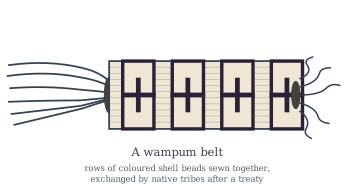
A wampum belt is not a map or a document in the modern sense — it is a physical object, a strip of fabric made from shells. The shells were ground, polished, and sewn together in a geometric pattern, with the colours and arrangement of the beads carrying meaning. The belt shown in the figure is of the kind that native tribes exchanged with one another after a treaty had been agreed to. So the image is not a scene of people or a landscape; it is a close view of the belt itself, its pattern of coloured shells laid out for the viewer to read.
The significance of the belt lies in what it represents. Among the native peoples of North America, formal alliances and friendships were made by exchanging gifts, and goods were obtained not by purchase but as gifts. A wampum belt was one such gift, but it was more than a token — it was a record. Since the languages of these peoples were not written down, the belt served as a physical memory of an agreement. The geometric pattern was a kind of code, and the belt was kept and displayed so that the terms of the treaty could be recalled and honoured by future generations. The act of giving the belt was itself part of the ceremony of making peace or forming an alliance. …
Names that live on. Names of native tribes are often given to things unconnected with
them: Dakota (an aeroplane), Cherokee (a jeep), Pontiac (a car), Mohawk (a haircut)!
The tribes themselves were displaced from their land, yet their names survive, disconnected
from their own history, as brand names and everyday words — a small but telling sign of how …