Political Science · Ch 2 — Rights in the Indian Constitution
Relationship between Fundamental Rights and Directive Principles
Relationship between Fundamental Rights and Directive Principles
Fundamental Rights and Directive Principles were meant to work together --
Fundamental Rights protect the individual's civil and political liberty against arbitrary state
power, while Directive Principles commit the state to building the social and economic conditions
in which that liberty becomes meaningful for everyone, not just those already well off. In practice,
however, the relationship between the two has also been the site of one of independent India's most
significant constitutional debates.
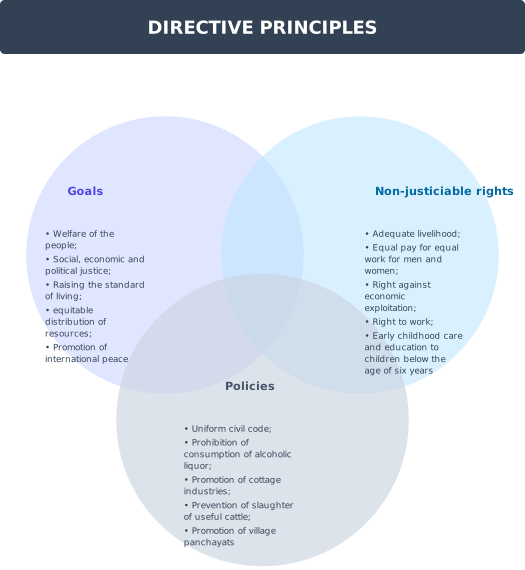
Drawn by us to help you understand the concept clearly, and verified to make sure it's accurate. For exams, practice from your NCERT textbook's own diagram.
Directive Principles of State Policy grouped into their Goals (welfare, justice, standard of living, international peace), the Non-justiciable rights they list (livelihood, equal pay, right to work), and the Policies they direct the State to pursue (uniform civil code, prohibition, village panchayats) Own-illustrated for this platform from the real NCERT page's own facts (composition, labels, and content are recreated; the specific artistic rend …
When Parliament amended Fundamental Rights in order to implement certain Directive Principles (for
instance, land-reform laws meant to reduce inequality in landholding), the courts had to decide how
far Parliament's amending power could go. In Golaknath (1967), the Supreme Court held Parliament
could not amend Fundamental Rights at all; in Kesavananda Bharati (1973), the Court modified this,
holding that Parliament could amend Fundamental Rights, including to implement Directive Principles,
but could never alter the Constitution's "basic structure"; in Minerva Mills (1980), the Court struck
down an attempt to give Directive Principles unconditional priority over Fundamental Rights, holding
instead that the balance between the two is itself part of the basic structure. Increasingly, courts …