Q.(a) Explain how the interaction between a fig tree and its tight one-to-one relationship with the pollinator species of wasp is one of the best examples of mutualism.
You're viewing a preview — the full solution, concept, methods & PYQ mapping are locked.
Start your 14-day free trial to unlock the full solution →Concept understanding — Ecological Interactions
Ecological Interactions: A First Look
Imagine a city. People live in apartments, work in offices, buy food from shops, and throw away garbage that someone else collects. Some people compete for the same job. Others help each other—a landlord provides space, a tenant pays rent. Now shrink that city to a forest, a pond, or even your backyard garden. Replace people with plants, animals, fungi, and bacteria. What you get is a web of relationships between living organisms—that is what ecologists call ecological interactions.
The Core Idea
Every living thing on Earth is connected to others. No organism exists in isolation. A tiger needs deer to eat; the deer needs grass; the grass needs sunlight and soil nutrients made available by bacteria and fungi. These connections are not random—they follow patterns. Some interactions help both partners, some help one at the expense of the other, and some harm both.
The NCERT textbook defines ecological interactions as the relationships between different species in a community. These interactions shape who lives where, how many of them exist, and how energy flows through an ecosystem.
Why Should a Commerce/Humanities Student Care?
You might think this is only for biology students. But consider this: every business operates within an ecosystem of suppliers, competitors, customers, and regulators. A startup that helps its suppliers grow (mutualism) survives longer than one that squeezes them dry (parasitism). A company that competes aggressively with rivals (competition) may drive prices down for consumers. The same logic that governs a forest governs a market—because both are systems of interacting agents.
Ecological interactions are not just "nature facts." They are a lens to understand any system where different entities depend on, compete with, or exploit each other—including economies, societies, and organizations.
The Main Types of Interactions
Ecologists classify interactions based on who benefits (+) and who is harmed (−). A zero (0) means no effect.
1. Mutualism (+ / +)
Both species benefit. Think of bees and flowers: bees get nectar (food), flowers get pollinated (reproduction). In human terms, this is a win-win partnership—like a coffee shop and a bookstore sharing the same space to attract more customers.
2. Competition (− / −)
Both species are harmed because they fight for the same limited resource—food, water, space, light. When two businesses open identical stores on the same street, both may earn less profit. In nature, two species of birds eating the same insect will both struggle if insects become scarce.
3. Predation (+ / −)
One species (predator) kills and eats the other (prey). The predator benefits; the prey is harmed. This is the tiger-deer example. In business, think of a large corporation acquiring a smaller competitor—the acquirer grows, the acquired loses independence.
4. Parasitism (+ / −)
One species (parasite) lives on or inside another (host) and feeds on it, usually without killing it immediately. The parasite benefits; the host is harmed. A tick on a dog, or a virus in a human. In economics, this resembles a monopolist that extracts value from suppliers without providing fair returns.
5. Commensalism (+ / 0)
One species benefits; the other is neither helped nor harmed. Barnacles attaching to a whale get a free ride to food-rich waters; the whale is unaffected. In a city, a street vendor setting up near a popular metro station benefits from foot traffic without affecting the station.
6. Amensalism (− / 0)
One species is harmed; the other is unaffected. A large tree casts shade that kills smaller plants beneath it—the tree does not care. In business, a giant retailer opening next to a small shop may drive the shop out of business without intending to.
| Interaction | Effect on Species A | Effect on Species B | Real-world analogy |
|-------------|---------------------|---------------------|---------------------|
| Mutualism | + | + | Joint venture |
| Competition | − | − | Price war |
| Predation | + | − | Acquisition |
| Parasitism | + | − | Exploitative contract |
| Commensalism | + | 0 | Free rider |
| Amensalism | − | 0 | Collateral damage |
The Bigger Picture
No interaction exists in isolation. A single species may be involved in multiple relationships simultaneously. A tree competes with other trees for sunlight, provides shelter for birds (commensalism), hosts fungi that help it absorb nutrients (mutualism), and is eaten by insects (predation). This complexity is what makes ecosystems resilient—or fragile. …
Part (a): the fig and its species-specific wasp both benefit (pollination for the fig; egg-laying site and larval food for the wasp) — obligate mutualism.
Part (b): 1 banyan tree → 20 insects → 32 birds is an inverted pyramid of numbers, since one large producer supports increasing numbers of consumers.
Mutualism is a positive interaction in which both partners benefit (+/+), and some mutualisms are so tight that neither species can survive or reproduce without the other (obligate mutualism). The fig–wasp relationship is the classic example.
The fig (Ficus) encloses its tiny flowers inside a fleshy receptacle (the syconium we call the fruit), inaccessible to ordinary pollinators. Each fig species is pollinated by its own single species of wasp. A pollen-laden female wasp enters a young fig through the ostiole, pollinates the flowers as she moves about, and lays her eggs in some of them. The fig, in return, offers the wasp larvae a protected nursery and food (they develop on some of the seeds). Emerging females, dusted with pollen, fly off to another fig, continuing the cycle.
Because the fig depends entirely on the wasp for pollination and the wasp depends entirely on the fig for breeding, and because the relationship is one-to-one and co-evolved, it is one of the best examples of mutualism.
This is co-evolution — over millions of years fig and wasp have become perfectly synchronised, each adapting to the other.
Concept understanding — Ecological Pyramid
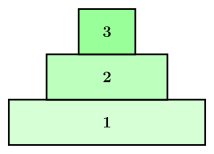
Picture a real pyramid -- wide at the base, narrowing all the way up to a single point at the top. Ecologists borrow exactly this shape to describe something that has nothing to do with stone: how numbers, weight (biomass), or energy are distributed across the feeding levels of a food chain. This visual model is called an ecological pyramid.
Every ecological pyramid works the same way. In your NCERT textbook (Class 12 Biology, Chapter 12, Ecosystem, section 12.5), the base always represents the producers -- the first trophic level -- and each successive tier above it represents the next trophic level up (herbivores, then primary carnivores, then secondary or top carnivores), with the apex representing the top-level consumer. Three distinct types are studied, because the same food-chain relationship can be measured in three different ways:
- Pyramid of numbers -- plots the count of individual organisms at each trophic level. NCERT's own grassland example is dramatic: nearly 6 million producer plants are needed to support just three top-carnivores at the apex.
- Pyramid of biomass -- plots the standing crop (usually expressed as dry weight, which is more accurate than fresh weight) of organisms at each level, rather than headcount.
- Pyramid of energy -- plots the amount of energy present at each trophic level, measured per unit area, usually annually.
In most ecosystems, all three pyramids come out upright -- producers are more numerous and have more biomass than herbivores, and herbivores more than carnivores -- because energy shrinks at every step up the food chain (the same 10 per cent law behind energy flow: only about 10 per cent of the energy at one trophic level is transferred to the next).
When a pyramid turns upside down -- numbers and biomass pyramids don't always come out upright, and NCERT points to genuine exceptions you're expected to reason through, not just memorise:
- A single large tree can support so many feeding insects that a pyramid of numbers built around it is inverted right at the base -- one producer, many primary consumers.
- The pyramid of biomass in the sea is commonly inverted: at any given moment the standing crop of tiny, fast-reproducing phytoplankton is small, yet it is turning over fast enough to support a much larger standing crop of the zooplankton feeding on it.
The pyramid of energy is the one type that is never inverted -- it is always upright, in every ecosystem, without exception. Energy is lost as heat at every transfer between trophic levels (unlike nutrients, it is never recycled back), so the level below always has to hold more usable energy than the level feeding on it. …
Part (a): the fig and its species-specific wasp both benefit (pollination for the fig; egg-laying site and larval food for the wasp) — obligate mutualism.
Part (b): 1 banyan tree → 20 insects → 32 birds is an inverted pyramid of numbers, since one large producer supports increasing numbers of consumers.
A pyramid of numbers plots the number of individual organisms at each trophic level. Here:
- Trophic level I — producer (banyan tree): 1
- Trophic level II — primary consumers (insects): 20
- Trophic level III — secondary consumers (birds): 32 …
Unlock everything free for 14 days
- Full step-by-step solutions
- Concept-first explanations
- Methods, shortcuts & mistakes
- PYQ mapping + timed mock tests
Full access for 14 days. No credit card required.