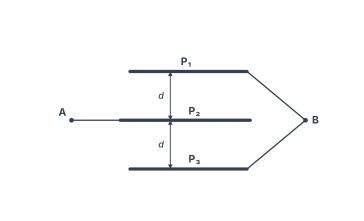
Q.A parallel plate capacitor consists of two conducting plates kept parallel to each other at a distance. When the capacitor is charged, the charge resides on the inner surfaces of the plates and an electric field is set up between them, storing electrostatic energy. Three identical conducting plates , and , each of area , are held parallel and equidistant (separation ) from each other. The space between and and between and is completely filled with mica sheets of dielectric constant . Plate is connected to point A and the other plates and are connected to point B. Point A is at a positive potential with respect to B, and the potential difference between A and B is .
You're viewing a preview — the full solution, concept, methods & PYQ mapping are locked.
Start your 14-day free trial to unlock the full solution →The three plates form two identical dielectric capacitors in parallel: (i) ; (ii) charge on is ; (iii) field ; (iv)(a) equivalent air-gap ; (iv)(b) net charge after shorting A–B .
Part (a)
Setting up the system
Plate is connected to A (potential ); plates and are connected to B (potential 0). Thus is the common positive plate of two capacitors, each with area , separation and mica of dielectric constant . Because and share node B, the two capacitors are in parallel.
Each individual capacitance:
(i) Capacitance between A and B
(ii) Charge on plate
is one plate of the – capacitor, across which the p.d. is :
(The magnitude of the charge on ; its sign is negative. carries twice this in total.)
(iii) Electric field between and
The gap has the full applied p.d. across it, so the uniform field is
directed from (high) to (low).
(iv)(a) Equivalent air capacitor
An air-filled () capacitor of area and separation equal in capacitance requires …
Unlock everything free for 14 days
- Full step-by-step solutions
- Concept-first explanations
- Methods, shortcuts & mistakes
- PYQ mapping + timed mock tests
Full access for 14 days. No credit card required.