Q.Draw a ray diagram showing the image formation when a concave mirror produces a real, inverted and magnified image of an object and hence obtain the mirror formula.
You're viewing a preview — the full solution, concept, methods & PYQ mapping are locked.
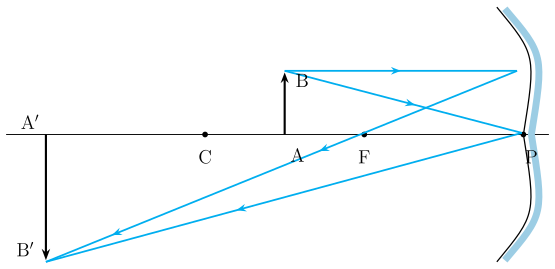
Start your 14-day free trial to unlock the full solution →For a concave mirror producing a real, inverted, and magnified image, the object lies between the centre of curvature and the focus . Using similar triangles from the ray diagram, we derive the mirror formula .
The Concept: Why Geometry Gives the Formula
A concave mirror's behaviour is governed by the law of reflection, but the relationship between object distance , image distance , and focal length comes from pure geometry. When we draw two characteristic rays from the object, their intersection after reflection locates the image. The triangles formed by these rays and the principal axis are similar, and that similarity yields the mirror formula.
For a real, inverted, and magnified image, the object must be placed between and . The image then forms beyond , is real (can be projected on a screen), inverted, and larger than the object. This is the classic case used in shaving mirrors or for projection.
A common mistake is to assume the object is at for a magnified image. At , the image is the same size. For magnification > 1, the object must be strictly between and .
Step-by-Step Derivation
1. Draw the ray diagram
Place a concave mirror with its pole , principal axis, focus , and centre of curvature . Let and .
Position the object (an upright arrow) between and , perpendicular to the principal axis. The tip is on the axis; the tip is above it.
Now draw two rays from point (the top of the object):
- Ray 1: A ray parallel to the principal axis. After reflection, it passes through .
- Ray 2: A ray passing through . Since it strikes the mirror normally (along the radius), it reflects back along the same path through .
These two reflected rays intersect at beyond , forming the real, inverted image . The image is larger than the object.
You can also use a ray through that emerges parallel to the axis — any two of the three standard rays work. The intersection point is the same.
2. Label distances on the diagram
Mark the following on the axis:
- : pole of the mirror
- : focus, at distance from
- : centre of curvature, at distance from
- : foot of the object, at distance from (so )
- : foot of the image, at distance from (so )
Here , and are treated simply as the lengths , and measured along the axis — this keeps the triangle geometry below clean. A real object and the real image it forms both actually lie in front of the mirror, so in the New Cartesian sign convention their signed values are both negative (, ), and the focal length of a concave mirror is negative too (). This does not change the derivation below: negating , and together leaves the relation exactly as it is (both sides simply pick up an overall minus sign, which cancels) — so the identical equation is obtained whether you work with these magnitudes first, or with their signed Cartesian values from the start.
3. Identify similar triangles
Look at two pairs of right-angled triangles in the diagram:
Pair 1: and
- (vertically opposite angles)
- Therefore (AA similarity)
From this similarity:
Pair 2: and (where is the point where the parallel ray hits the mirror)
- The ray parallel to the axis meets the mirror at , then passes through to .
- (common angle)
- So
From this similarity:
But , and (since the incident ray from is parallel to the axis, the segment on the mirror equals the object height ). Also .
Therefore:
4. Combine the two similarity relations
From Pair 1: , so .
From Pair 2: .
Equating the two expressions for :
5. Rearrange to get the mirror formula
Cross-multiply:
Bring terms involving to one side:
Factor :
…
Unlock everything free for 14 days
- Full step-by-step solutions
- Concept-first explanations
- Methods, shortcuts & mistakes
- PYQ mapping + timed mock tests
Full access for 14 days. No credit card required.