Q.(a)(i) Draw a ray diagram to show the image formation by a compound microscope. Obtain the expression for the total magnification of the microscope when the final image is formed at infinity.
🔒You're viewing a preview — the full solution, concept, methods & PYQ mapping are locked.
🔒 Start your 14-day free trial to unlock the full solution →Part (a)Concept understanding — Microscope Magnification
Microscope Magnification
A compound microscope views very small, nearby objects using two lenses in sequence: the objective (near the object) and the eyepiece (near the eye). Its total magnifying power is the product of what each lens contributes.
How the two lenses work together
- The object sits just beyond the focus of the short-focal-length objective (fo), which forms a real, inverted, magnified image inside the tube.
- That real image falls just inside the focus of the eyepiece (fe), which acts as a simple magnifier, producing a large virtual, magnified final image for the eye.
Because each stage magnifies, the effects multiply:
M=mo×me
The objective's magnification
mo=uovo≈foL
where L is the tube length (roughly the distance between the objective's second focal point and the eyepiece's first focal point). The object sits close to fo, so this approximation holds for a well-designed microscope.
The eyepiece's magnification
The eyepiece behaves as a simple magnifier:
- Final image at the near point (D=25 cm, largest magnification):
me=1+feD
- Final image at infinity (relaxed eye, "normal adjustment"):
me=feD
Total magnifying power
Image at the near point: M=foL(1+feD)
Image at infinity: M=foL⋅feD
High magnification needs short fo and fe (both sit in denominators) and a large tube length L — this is why a microscope objective is always a very short-focus lens.
Worked example
Objective fo=1.0 cm, eyepiece fe=2.5 cm, tube length L=20 cm, near point D=25 cm. Find M with the final image at the near point.
mo=1.020=20,me=1+2.525=11
M=20×11=220 …
Why this formula?
Microscope Magnification: Why the Formula Holds
Let's build the understanding from first principles — not just memorizing formulas, but seeing why they work.
1. What Does "Magnification" Mean in a Microscope?
A microscope creates a larger apparent image of a tiny object. The total magnification is the product of two stages:
- Objective lens — creates a real, enlarged, inverted image of the specimen.
- Eyepiece (ocular) — acts as a simple magnifier to view that real image.
So:
Total magnification = (magnification by objective) × (magnification by eyepiece)
2. The Key Formula
For a compound microscope in normal adjustment (final image at infinity, relaxed eye):
M=Mo×Me=(foL)×(feD)
Where:
- fo = focal length of objective
- fe = focal length of eyepiece
- L = tube length (distance between second focal point of objective and first focal point of eyepiece)
- D = near point distance of the eye (usually 25 cm)
3. Derivation of Objective Magnification Mo
Step 1: How the objective works
The objective lens forms a real, inverted, enlarged image of the specimen. The specimen is placed just outside its focal point (fo).
Step 2: Using the lens formula
For a thin lens:
vo1−uo1=fo1
(Using sign convention: uo is negative, vo is positive)
Step 3: The tube length approximation
In a standard microscope, the specimen is placed very close to fo, so:
- uo≈−fo (object just beyond focal point)
- The image is formed at the first focal point of the eyepiece, which is at a distance L from the second focal point of the objective.
Thus:
vo≈fo+L
Step 4: Magnification formula
Lateral magnification by objective:
Mo=∣uo∣vo≈fofo+L=1+foL
Since L≫fo in practice, 1 is negligible:
Mo≈foL
Why this makes sense: A shorter fo means the objective is more "powerful" — it bends light more sharply, creating a larger image at the fixed tube length.
4. Derivation of Eyepiece Magnification Me
Step 1: The eyepiece as a simple magnifier
The eyepiece takes the real image from the objective and acts like a magnifying glass. For relaxed eye (final image at infinity), the real image must be placed at the focal point of the eyepiece.
Step 2: Angular magnification
Angular magnification is defined as:
Me=angle subtended by object at near pointangle subtended by image at eye
For a simple magnifier with image at infinity:
Me=feD
Where D=25 cm (standard near point). …
Part (b)Concept understanding — Spherical Mirror Equation
The Spherical Mirror Equation: From Intuition to Formula
Imagine you're standing in front of a concave mirror — the kind that makes your face look bigger when you're close, but flips everything upside down when you step far back. That change isn't magic; it's geometry. The spherical mirror equation is the single relationship that predicts exactly where an image will form, and whether it's real or virtual, for any spherical mirror.
The Core Idea
Every point on an object sends out light rays in all directions. A mirror redirects those rays. The mirror equation tells you: given the mirror's curvature and the object's distance, where will those rays meet again (or appear to meet)?
There are only three quantities you need:
- u — object distance (from the mirror's pole)
- v — image distance (from the mirror's pole)
- f — focal length (a property of the mirror's curvature)
The equation is:
v1+u1=f1
The power is in the sign convention, because every distance can point in one of two directions.
The Sign Convention (New Cartesian Sign Convention)
This is where most students slip. The equation works for all spherical mirrors — concave and convex — only if you follow the convention used throughout NCERT and CBSE:
- All distances are measured from the mirror's pole.
- The incident light is taken to travel left to right, so distances measured in that same direction (to the right) are positive, and distances measured against it (to the left) are negative.
- Heights above the principal axis are positive; heights below are negative.
Because a real object is always placed in front of the mirror (to the left, where the incident light originates), its distance u is always negative.
Under this convention, the focal length of a concave mirror is negative (its focus F sits in front of the mirror, on the same side as the object), and the focal length of a convex mirror is positive (its focus lies behind the mirror). This is one of the most frequently tested facts in CBSE board exams.
A very common mistake is writing f as positive for a concave mirror because "it converges light." Convergence tells you the type of mirror, not the sign — the sign comes purely from where the focus physically sits relative to the pole, under the convention above.
Where Does the Formula Come From?
For a concave mirror, parallel rays from a distant object converge at the focus, a point at (signed) distance f from the mirror. The derivation uses similar triangles from a ray diagram.
›Proof
Consider an object of height ho in front of a concave mirror. Draw the ray parallel to the axis: it reflects through the focus F. Draw the ray through the centre of curvature C: it strikes the mirror normally and reflects straight back on itself. These two reflected rays cross to form the image, of height hi.
From similar triangles formed by the ray through C:
hiho=R−vu−R
where R=2f is the radius of curvature (with the same sign convention as f).
From similar triangles formed by the ray through F:
hiho=fu−f
Equating the two ratios and simplifying (using R=2f) gives:
v1+u1=f1
What the Equation Tells You
Rearranging for v:
v=u−fuf
Because u is negative for a real object, and v takes the sign the geometry dictates:
- v negative → the image forms in front of the mirror → real image (can be projected on a screen).
- v positive → the image forms behind the mirror → virtual image.
For a concave mirror (f negative), using the magnitude of the object distance ∣u∣ measured from the pole:
- ∣u∣>2∣f∣ → real, inverted, diminished image between f and 2f
- ∣u∣=2∣f∣ → real, inverted, same-size image at 2f
- ∣f∣<∣u∣<2∣f∣ → real, inverted, magnified image beyond 2f
- ∣u∣=∣f∣ → image at infinity …
Why this formula?
Spherical Mirror Equation: Why the Formula Holds
The spherical mirror equation — also called the mirror formula — relates the object distance (u), image distance (v), and focal length (f) of a spherical mirror. Let's build the reasoning step by step.
1. The Key Formula
For a spherical mirror (concave or convex):
f1=u1+v1
Where:
- f = focal length (positive for concave, negative for convex)
- u = object distance from pole (always negative by sign convention)
- v = image distance from pole (sign depends on image location)
2. Why This Formula Holds — The Derivation
Step 1: Start with a ray diagram
Consider a concave mirror with:
- Pole P
- Centre of curvature C (radius R)
- Focus F (midpoint of PC, so f=R/2)
Take an object placed beyond C. Draw two rays from the object's tip:
- A ray parallel to the principal axis → reflects through F
- A ray through C → reflects back along itself
These rays meet at the image point.
Step 2: Use similar triangles
Let the object height be ho and image height be hi.
From the geometry of the ray through C:
- Triangle formed by object, C, and axis is similar to triangle formed by image, C, and axis.
This gives:
hiho=R−vu−R
(Here u and v are distances from P, with sign conventions applied later.)
Step 3: Use the parallel ray
From the ray parallel to the axis:
- Triangle formed by object, F, and axis is similar to triangle formed by image, F, and axis.
This gives:
hiho=fu−f
Step 4: Equate the two ratios
Since both ratios equal ho/hi:
R−vu−R=fu−f
Step 5: Substitute R=2f
For a spherical mirror, the focal length is half the radius of curvature:
R=2f
Substitute:
2f−vu−2f=fu−f
Step 6: Cross-multiply and simplify
Cross-multiply:
f(u−2f)=(u−f)(2f−v)
Expand:
fu−2f2=2fu−uv−2f2+fv
Cancel −2f2 on both sides:
fu=2fu−uv+fv
Bring all terms to one side:
0=fu−uv+fv
Rearrange:
uv=fu+fv
Step 7: Divide by uvf
Divide both sides by uvf:
f1=v1+u1
This is the mirror formula.
3. Why the Sign Convention Matters
The derivation above used distances as positive magnitudes. In actual problem-solving, we use the Cartesian sign convention:
- Distances measured against incident light are negative
- Distances measured along incident light are positive
For a concave mirror:
- u is negative (object in front)
- f is negative (focus in front)
- v is negative for real images (in front) …
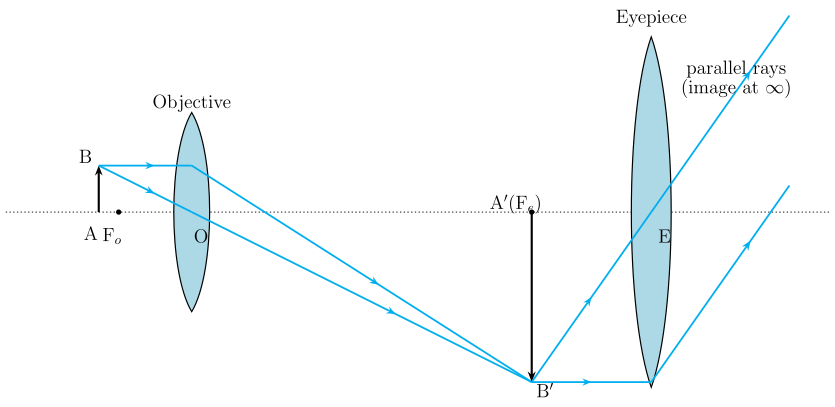
Part (a)
(i) Compound microscope, final image at infinity. The objective forms a real, inverted, magnified image of the object placed just beyond Fo; this intermediate image is set at the eyepiece focus so the final image is at infinity (relaxed eye). Total magnification is the product of the objective's linear magnification and the eyepiece's angular magnification:
M=mome=foL⋅feD
(magnitudes; L = tube length, D=25 cm).
(ii) Object: uo=−1.5 cm, fo=+1.25 cm. Lens formula vo1−uo1=fo1:
vo1=1.251−1.51=7.56−5=7.51⇒vo=7.5 cm.
For the final image at infinity the intermediate image is at the eyepiece focus, so the separation is …
- A compound microscope at infinity has M=foL⋅feD; for the given lenses the objective–eyepiece separation is 12.5 cm.
- Huygens' construction gives Snell's law n1sini=n2sinr, and the mirror formula shows a convex mirror always gives a virtual (v>0) image.
Part (a)
- Ray diagram and magnification. Place the object just beyond the objective focus Fo. The objective forms a real, inverted, magnified intermediate image A′B′. For the final image at infinity, A′B′ is placed exactly at the eyepiece's first focus, so parallel rays emerge and the eye views the image at infinity (relaxed).
The objective's linear magnification is mo=∣uo∣vo≈foL, where L is the tube length; the eyepiece's angular magnification (image at infinity) is me=feD with D=25 cm. Hence
M=mome=foL⋅feD.
- Numerical. Objective: fo=1.25 cm, object distance uo=−1.5 cm. Lens formula:
so vo=7.5 cm. For the final image at infinity the intermediate image lies at the eyepiece's focus, so the eyepiece is fe=5 cm beyond it. The objective–eyepiece distance is …
vo1−uo1=fo1 ⇒ vo1=1.251−1.51=7.56−5=7.51,
Showing the 12 most recent of 26 on this concept.
- CBSE 2026Set A1 markMCQQ.When the tube length of microscope is increased, its magnifying power (A) increases (B) decreases (C) becomes zero (D) remains unchanged
›Reveal solutionSolution
The magnifying power of a compound microscope is proportional to the tube length, so increasing L increases the magnification.
For a compound microscope the magnifying power is approximately
M=foL⋅feD …
- CBSE 2026Set ANNUAL1 markMCQQ.The image formed by a simple microscope is(a) imaginary and erect(b) imaginary and inverted(c) real and erect(d) real and inverted
›Reveal solutionSolution
A simple microscope is just a convex lens used with the object inside its focal length, which always produces a virtual, erect, magnified image.
A simple microscope is a single convex lens. When the object is placed BETWEEN the lens and its focal point (object distance less than f), the convex lens produces an image that is on the SAME side as the object, virtual (cannot be caught on a screen - here called 'imaginary'), erect (same orienta …
- CBSE 2026Set ANNUAL1 markMCQQ.Assertion (A): The magnifying power of a simple microscope is inversely proportional to the focal length of the lens. Reason (R): Power of a lens is inversely proportional to the focal length.(a) Both Assertion (A) and Reason (R) are true and Reason (R) is the correct explanation of Assertion (A).(b) Both Assertion (A) and Reason (R) are true, but Reason (R) is not the correct explanation of Assertion (A).(c) Assertion (A) is true, but Reason (R) is false.(d) Assertion (A) and Reason (R) both are false.
›Reveal solutionSolution
Both statements are true, and since M=D/f=D×P, the fact that power P∝1/f directly explains why magnifying power is inversely proportional to f.
For a simple microscope, magnifying power (image at infinity) is M=fD, where D is the least distance of distinct vision. This can be rewritten as M=D×f1=D×P, where P=f1 is the power of the lens. So M is directly proportional to the lens's power, and since power is inver …
- CBSE 2026Set ANNUAL1 markMCQQ.A 4.5 cm needle is placed 12 cm away from a convex mirror of focal length 15 cm. The location of the image is(a) formed at 6.67 cm behind the mirror.(b) formed at 67 cm behind the mirror.(c) formed at 70 cm same side of the mirror.(d) formed at 5.57 cm same side of the mirror.
›Reveal solutionSolution
Using the mirror formula with the correct sign convention, the convex mirror forms a virtual image 6.67 cm behind the mirror.
Given: Needle height h=4.5 cm, object distance u=−12 cm (object in front, so negative by convention), convex mirror so focal length f=+15 cm (behind the mirror, positive).
Mirror formula:
v1+u1=f1
v1=f1−u1=151−−121=151+121
Taking LCM (60): v1=604+605=609=203
v=320=6.67 cm …
- CBSE 2025Set 55/4/11 markMCQQ.The magnification produced by a spherical mirror is −2.0. The mirror used and the nature of the image formed will be: (A) Convex and virtual (B) Concave and real (C) Concave and virtual (D) Convex and real
›Reveal solutionSolution
A magnification of −2.0 means the image is inverted (negative sign) and magnified (magnitude > 1). Only a concave mirror can produce an inverted, magnified image, and such an image is always real. So the mirror is concave and the image is real — option (B).
Concept and Intuition
The magnification m of a spherical mirror tells you two things at once: the sign tells you orientation, and the magnitude tells you size.
- If m is positive, the image is virtual and erect (upright).
- If m is negative, the image is real and inverted (upside down).
The magnitude ∣m∣ tells you relative size:
- ∣m∣>1 → image is magnified (larger than object)
- ∣m∣<1 → image is diminished (smaller)
- ∣m∣=1 → same size
Here m=−2.0 means the image is inverted (negative) and twice as large as the object (∣m∣=2).
Now, which mirror can produce an inverted, magnified image? A convex mirror always gives a virtual, erect, and diminished image — so it can never produce a negative magnification. A concave mirror, however, can produce both real (inverted) and virtual (erect) images depending on where the object is placed. The real image from a concave mirror is always inverted, and when the object is between the centre of curvature and the focus, that real image is also magnified.
So the only mirror that fits m=−2.0 is a concave mirror, and the image must be real.
Step-by-step reasoning
-
Interpret the sign of m
m=−2.0 is negative. For spherical mirrors, a negative magnification always means the image is inverted relative to the object. An inverted image formed by a single mirror is always real (it can be projected on a screen). So the image is real.
-
Interpret the magnitude of m
∣m∣=2.0>1, so the image is magnified — larger than the object.
-
Eliminate convex mirror
A convex mirror always produces a virtual, erect, and diminished image for any real object. That means m is always positive and ∣m∣<1. Since our m is negative and ∣m∣>1, a convex mirror is impossible. This eliminates options (A) and (D).
-
Check concave mirror possibilities
A concave mirror can produce:
- A real, inverted, magnified image when the object is placed between F and C (focus and centre of curvature).
- A virtual, erect, magnified image when the object is placed between P and F (pole and focus). In that case m is positive.
Since our m is negative, the image cannot be virtual. So the only possibility is the real, inverted, magnified case — which is exactly what a concave mirror gives for an object between F and C. …
- CBSE 2025Set X11 markMCQQ.Final image of a real object formed by a compound microscope is __________ with respect to the object.(a) real, inverted and magnified(b) virtual, erect and magnified(c) virtual, erect and diminished(d) virtual, inverted and magnified
›Reveal solutionSolution
(d) virtual, inverted and magnified. In a compound microscope the objective forms a real, inverted, magnified image, which acts as the object for the eyepiece. The eyepiece then forms a final imag …
- CBSE 2025Set IMPROVEMENT1 markMCQQ.Assertion (A): The radius of curvature of a concave mirror is 20 cm. If an object is placed in front of the mirror at a distance of 10 cm from its pole, its image is formed at infinity. Reason (R): The image of an object placed at the focus of a spherical mirror is formed at infinity. Select the correct option.(a) Both A and R are correct and R is the correct explanation of A.(b) Both A and R are correct but R is not the correct explanation of A.(c) A is correct but R is incorrect.(d) Both A and R are incorrect.
›Reveal solutionSolution
Both statements are true, and the reason correctly explains why the assertion is true.
For a concave mirror of radius of curvature R=20cm, the focal length is f=R/2=10cm. In Assertion (A), the object is placed at a distance of 10 cm from the pole — exactly at the focus. Using the mirror formula v1+u1=f1, when u=f, we get v1=f1−f1=0, so v→∞ — the image is indeed formed at infinity. This is exactly the general principle stated in Reason (R): rays from an object placed at the f …
- CBSE 2025Set IMPROVEMENT1 markQ.Write the formula for the total magnification of a compound microscope when the final image is formed at infinity.
›Reveal solutionSolution
For a compound microscope with the final image at infinity, the total magnifying power is the product of the objective's linear magnification and the eyepiece's angular magnification.
In a compound microscope, the objective lens forms a real, magnified image of the object; this image acts as the object for the eyepiece, which forms the final image. When the eyepiece is adjusted so that the final image is formed at infinity (normal/relaxed-eye viewing), the total magnifying power is:
M=mo×me=foL×feD …
- CBSE 2024Set ANNUAL1 markMCQQ.Focal length of a concave mirror in air is 25 cm. Its focal length in water will be -(a) 50 cm(b) 12.5 cm(c) ∞(d) 25 cm
›Reveal solutionSolution
A mirror's focal length depends only on its radius of curvature, not on the surrounding medium.
For a spherical mirror, f=R/2, where R is the radius of curvature -- a purely geometrical quantity. Since reflection (unlike refraction) does not depend on the refractive index of the surrounding medium, the focal length …
- CBSE 2024Set A1 markMCQQ.Image formed in compound microscope is (A) real and erect (B) real and inverted (C) virtual and inverted (D) virtual and erect
›Reveal solutionSolution
A compound microscope forms a final image that is virtual, magnified and inverted → option (C).
In a compound microscope the objective lens first forms a real, inverted, magnified image of the object. This intermediate image acts as the object for the eyepiece, which is used as a simple magnifier and forms the **final image that is virtual, further magnifie …
- CBSE 2024Set A1 markMCQQ.The correct relationship between the radius of curvature (R) and focal length(f) of a spherical mirror is ______.(a) R = 2f(b) f = 2R(c) R = f/2(d) R = 1/f
›Reveal solutionSolution
For a spherical mirror, R = 2f because the focal point lies midway between the pole and the centre of curvature.
For a spherical mirror (concave or convex), a ray parallel to the principal axis, after reflection, passes through (or appears to diverge from) the focus F. Using the mirror geometry, for paraxial rays, the focal length f is related to the radius of curvature R by: …
- CBSE 2024Set ANNUAL1 markMCQQ.If the magnification of objective and eyepiece in a compound microscope is 'm_o' and 'm_e' respectively, then the total magnifying power (m) of the microscope will be -(a) m_o + m_e(b) m_o - m_e(c) m_o . m_e(d) m_o / m_e
›Reveal solutionSolution
In a compound microscope, the objective forms a magnified real image which the eyepiece further magnifies, so the two magnifications multiply.
In a compound microscope, the objective lens forms a real, magnified, inverted image of the object with magnification mo. This image acts as the object for the eyepiece, which further magnifies it (acting like a simple magnifier) with magnification me.
…
🎓Unlock everything free for 14 days
- ✓Full step-by-step solutions
- ✓Concept-first explanations
- ✓Methods, shortcuts & mistakes
- ✓PYQ mapping + timed mock tests
Full access for 14 days. No credit card required.