Biology · Ch 11 — Enhancement of Food Production
Hybridization and its Technique
Hybridization and its Technique
A. Hybridization and its technique : Hybridization is described as the single most productive method available for crop improvement, because it is the only reliable way to combine the desirable characters of two or more different varieties into one new plant, creating new genetic combinations and new variation that did not exist in either parent alone. A further, very practical payoff of hybridization is that it can exploit hybrid vigour (heterosis) — the tendency of a hybrid offspring to outperform both of its parents in vigour, size or yield.
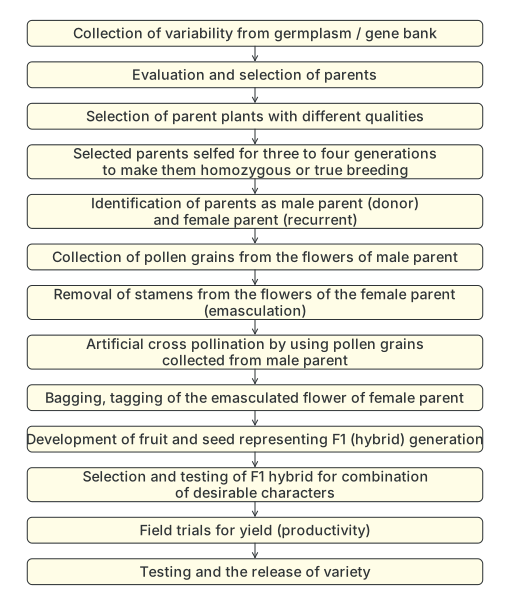
The hybridization programme, step by step
- Collection of variability. Breeders first collect and preserve wild relatives and other varieties of the crop that carry desirable but scattered traits. The complete collection of all the diverse alleles (variant forms of every gene) present in a crop species is called its germplasm collection, and this variability is the raw material every later step depends on. Germplasm is conserved either in situ (within forests and natural reserves, where the plants continue to grow and evolve in their natural setting) or ex situ (in botanical gardens, seed banks and similar controlled facilities).
- Evaluation and selection of parents. The collected germplasm is screened to identify individual plants with genuinely desirable characters. The two parents finally chosen must be healthy and vigorous, and should show complementary — not identical — desirable features, so that the cross can combine strengths that neither parent has alone. Each selected parent is then self-pollinated for three to four generations, to make it homozygous (a 'pure line'), because only pure, uniform parents give a predictable, uniform hybrid.
- Hybridization proper. The variety with the most desirable overall features is used as the female (recurrent) parent, and the other, which lacks some of those features but contributes something the first parent needs, is used as the male (donor) parent. The female flower is emasculated (its own anthers removed) so it cannot self-pollinate, pollen is collected from the male parent's anthers and dusted artificially onto the emasculated female's stigma, and the pollinated flower is bagged and tagged to keep out any unwanted stray pollen. Fertilisation then leads to fruit and seed formation, and the resulting seed represents the F1 hybrid generation. Depending on how closely related the parents are, hybridization may be intravarietal, intervarietal (between two varieties of the same species), interspecific (between two species of the same genus) or intergeneric (between two genera of the same family); interspecific and intergeneric crosses, between more distantly related plants, are also called wide or distant crosses and occur only rarely in nature.
- Selection and testing of superior recombinants. F1 hybrid plants that show clear superiority over both parents, and strong hybrid vigour, are selected and then self-pollinated for several further generations, until the desirable characters become homozygous and stop segregating — that is, until the new line 'breeds true'.
- Testing, release and commercialisation. The newly stabilised lines are evaluated under controlled conditions of water and fertiliser for productivity, disease resistance, pest resistance and quality, then grown in the open field for at least three seasons across different agro-climatic zones to confirm their performance is reliable and widespread, before finally being released as a new variety for farmers to grow.
Drawn by us to help you understand the concept clearly, and verified to make sure it's accurate. For exams, practice from your textbook's own diagram.
What this figure shows. This flow chart traces the complete hybridization pipeline used in plant breeding, starting from collecting variability through a germplasm or gene bank, followed by evaluating and selecting parent plants that show contrasting but complementary desirable qualities. It then shows the selfing of the chosen parents for several generations to make them homozygous (pure-breeding), the identification of one parent as the pollen-donating male and the other as the recurrent female, emasculation of the female flower to remove its own stamens, artificial cross-pollination using pollen collected from the male parent, and bagging and tagging of the pollinated flower so it is not accidentally cross-pollinated again. The lower part of the chart follows fruit and seed development into the F1 hybrid generation, selection and testing of that hybrid for the desired combination of characters, field trials to check yield and productivity across seve …
Know the Scientist
Dr. Norman E. Borlaug - an American biologist called the 'Father of the Green Revolution', 'Agriculture's greatest spokesperson' and 'The Man Who Saved a Billion Lives'. A 1970 Nobel Laureate, he was honoured for his Green Revolution work, which saved millions from famine in India, Mexico and the Middle East.
Dr. M. S. Swaminathan - called the 'Father of the Green Revolution in India' for introducing and further developing high-yielding wheat varieties here. He advocated moving India to sustainable development - environmentally sustainable agriculture, sustainable food security and the preservation of biodiversity - and is a pioneer of mutation breeding in India, developing wheat varieties such as Sonora, NP 165 and Sharbati.
Internet my friend
Try to know more about hybrid vigour.
Indian hybrid crops produced by this route
- Wheat and rice: In the 1960s wheat and rice yields rose dramatically in India. Norman E. Borlaug developed semi-dwarf wheat varieties, from which Sonalika and Kalyan Sona were bred and grown widely in India; semi-dwarf rice varieties trace back to IR8 (from the International Rice Research Institute) and Taichung Native-1 (from Taiwan), from which the better-yielding varieties Jaya, Padma and Ratna were later developed.
- Sugarcane: Saccharum barberi, native to North India, and S. officinarum, native to South India (with a thicker stem and higher sugar content, but poorly adapted to the North), were crossed to combine both parents' strengths — high sugar content, thick stem, and the ability to grow in North India. This produced the CO-419, CO-421 and CO-453 varieties, developed at Coimbatore, Tamil Nadu, all high-yielding and high in sugar content.
- Millets: Hybrid maize (Ganga-3), hybrid jowar (CO-12) and hybrid bajra (Niphad) have all been successfully developed in India, and are notably high-yielding and resistant to water stress.
The cultivation of these high-yielding hybrid varieties of rice, wheat, sugarcane and millets - developed through hybridization and supported by fertilizers, pesticides and proper irrigation - has let India's farming community achieve record agricultural production since 1961; this is what is meant by the Green Revolution. …