Biology · Ch 5 — Origin and Evolution of Life
f. Formation of Protobionts or Procells
f. Formation of Protobionts or Procells
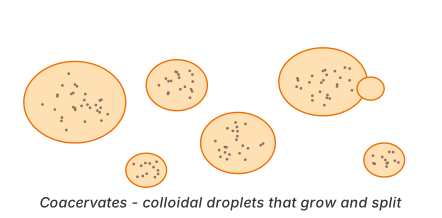
With nucleic acids now present alongside the surrounding inorganic and organic molecules, the first proper form of life-like matter could assemble: the protobiont. Protobionts are best described as prebiotic chemical aggregates — bundles of molecules that display some, though not all, of the properties of a true living system. Oparin (1924), describing this stage of his theory, called these aggregates coacervates: colloidal aggregations of hydrophobic proteins and lipids, essentially lipoid bubbles. A coacervate grew in size by absorbing material from the surrounding aqueous medium, and as it grew it became progressively more thermodynamically unstable, eventually splitting into smaller units in a manner loosely comparable to the budding of a daughter cell from its parent.
Drawn by us to help you understand the concept clearly, and verified to make sure it's accurate. For exams, practice from your textbook's own diagram.
What this figure shows. The same coacervate diagram referenced under 5.2 — colloidal, membrane-bound droplets of aggregated lipids and proteins that grew by taking up material from the surrounding aqueous medium and, on becoming thermodynamically unstable, split into smaller units in a manner loosely comparable to budding daughter cells, contrasted conceptually with Sidney Fox's more s …
…