Biology · Ch 5 — Origin and Evolution of Life
RNA World Hypothesis
RNA World Hypothesis
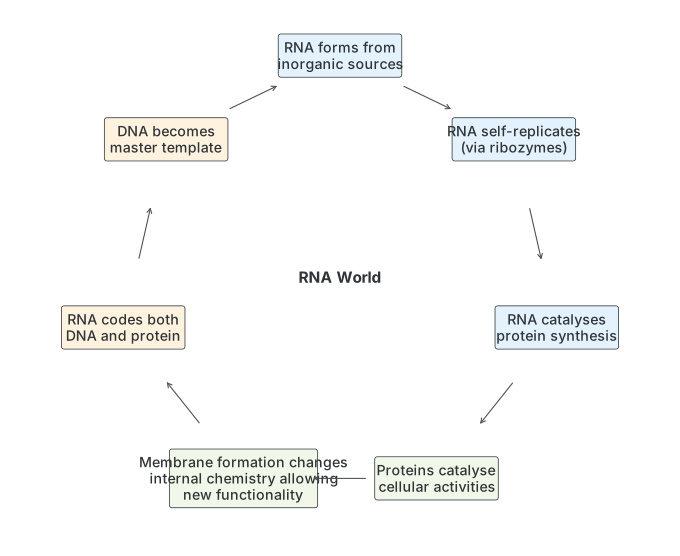
RNA World Hypothesis : The Oparin-Haldane theory and the Miller-Urey experiment together make the case that the pathway to life on Earth ran from non-living matter to living matter — but the principle 'like begets like' requires some stable genetic material and cellular machinery capable of carrying out the routine business of staying alive. It is well known that certain proteins, called enzymes, catalyse the chemical reactions occurring inside a cell; but in 1980, Sidney Altman and Thomas Cech independently discovered that RNA molecules can also act as biocatalysts, a property that earned these catalytic RNAs the name ribozymes and won Altman and Cech the Nobel Prize in Chemistry in 1989. This discovery gave important support to the RNA World hypothesis, which had actually been proposed decades earlier — by Carl Woese, Francis Crick and Leslie Orgel in 1960 — long before ribozymes were ever found. The hypothesis suggests that the very earliest life must have been based exclusively on nucleic acids, and most probably on RNA alone. Several independent facts support this idea: RNA is found abundantly in every living cell; it is structurally closely related to DNA; and chains of RNA are capable of evolving, undergoing mutation, replicating themselves, and catalysing reactions — abilities that, taken together, would have let a single RNA molecule act simultaneously as both the genetic material and the enzyme of a primitive proto-cell. Additional support comes from biomolecules such as Acetyl-Co-A, which carry a nucleotide within their own molecular structure, and from the ribosome itself — the cell's protein-assembly unit — in which the process of translation is catalysed by RNA rather than protein. According to the hypothesis, early RNA molecules underwent repeated cycles of replication and mutation, generating a variety of RNA molecules with differing sizes and catalytic abilities; over time, some of these RNAs are t …
Drawn by us to help you understand the concept clearly, and verified to make sure it's accurate. For exams, practice from your textbook's own diagram.
What this figure shows. A cyclic flow diagram tracing a proposed pathway from inorganic sources to modern cellular life: RNA first forming from inorganic starting materials, then self-replicating with the help of its own ribozyme activity, then RNA catalysing early protein synthesis, then a primitive membrane forming around the system and changing its internal chemistry to allow new functions, then RNA coding for both DNA and protein, then DNA taking over as the stable master template, and finally proteins catalysing the full range of cellular activities — closing the …