Biology · Ch 5 — Origin and Evolution of Life
Urey and Miller's Experiment
Urey and Miller's Experiment
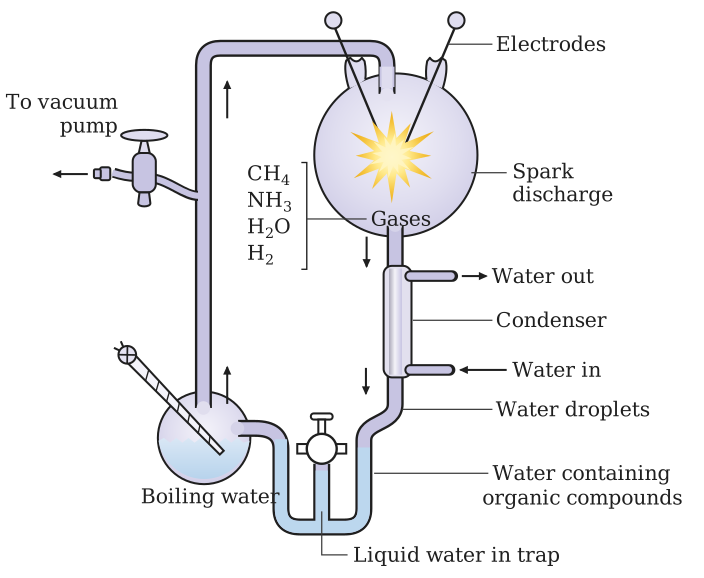
Urey and Miller's Experiment : The chemical-evolution theory proposed by Oparin remained a hypothesis until Stanley L. Miller, working together with his teacher Harold C. Urey, provided the first direct experimental evidence in its support. The two scientists built a sealed glass spark-discharge apparatus, first sterilising and evacuating it completely. Into the main glass chamber they pumped methane, ammonia and hydrogen gases in the proportion 1:2:2, while a separate tube carried in water vapour to simulate the primitive ocean's evaporation. Lightning was mimicked using an electric discharge — a carbon-arc spark — fired continuously across electrodes inside the chamber, while a heating mantle and a condenser reproduced the natural cycle of evaporation and precipitation. This mixture of CH4, NH3 and H2 was exposed continuously to the electric spark for several days, causing the gases to react with one another; the resulting products were then condensed and collected. The liquid that gathered in the apparatus's U-tube had turned distinctly brown, and chemical analysis of this liquid revealed the presence of simple organic compounds — including urea, amino acids and lactic acid. The experiment gave strong sup …
Drawn by us to help you understand the concept clearly, and verified to make sure it's accurate. For exams, practice from your textbook's own diagram.
What this figure shows. A schematic of the closed spark-discharge apparatus: a lower flask of boiling water sending water vapour up into a larger glass chamber holding methane, ammonia and hydrogen gas, where a pair of electrodes fires a continuous carbon-arc spark through the gas mixture; the reacted gases then pass into a water-cooled condenser (with separate water-in and water-out lines) that turns the vapour back into liquid droplets, which drain down through a U-shaped water trap collecting the newly formed organic compounds, with a vacuum-pump connection used to …