Chemistry · Ch 12 — Aldehydes, Ketones and Carboxylic Acids
Classification of carboxylic acids
Classification of carboxylic acids
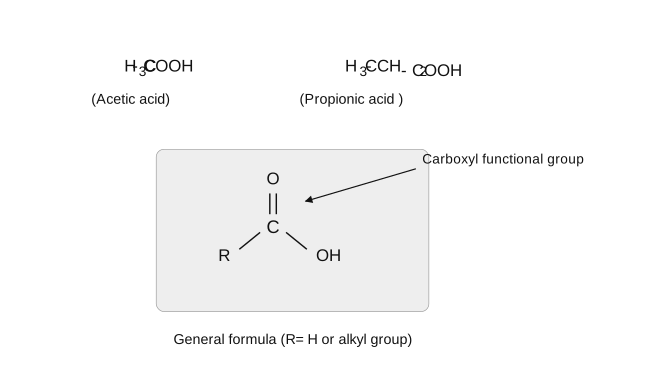
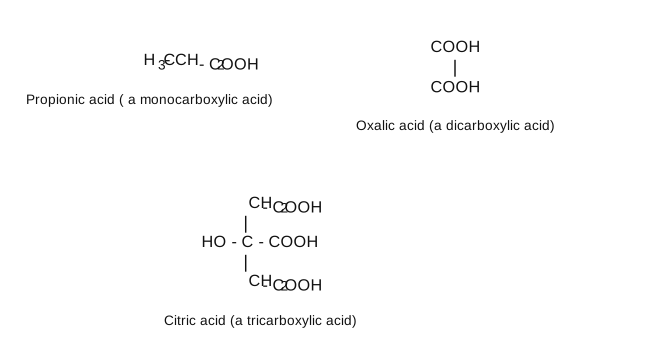
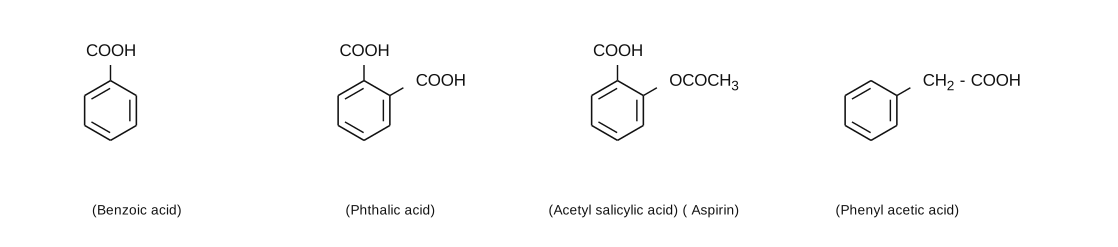
Carboxylic acids are classified as aliphatic or aromatic. ALIPHATIC CARBOXYLIC ACIDS (also called fatty acids) have the -COOH (carboxyl) group bonded to an alkyl group; general formula R-COOH, R = H or alkyl. As with formaldehyde among the aldehydes, there is one exception: formic acid, H-COOH, is still classed as an aliphatic carboxylic acid even though its -COOH is not attached to any carbon at all. Worked examples: acetic acid (CH3-COOH) and propionic acid (CH3-CH2-COOH), both MONOcarboxylic acids (one -COOH group); oxalic acid (HOOC-COOH), a DIcarboxylic acid (two -COOH groups bonded directly to each other); and citric acid (a central carbon bearing an -OH plus three -COOH-bearing arms), a TRIcarboxylic acid. Carboxylic acids are widely distributed in nature, in both plants and animals: L-lactic acid occurs in curd, citric acid in citrus fruit such as lemons, and acetic acid is the key ingredient of vinegar. AROMATIC CARBOXYLIC ACIDS have one or more -COOH groups attached DIRECTLY to the aromatic ring -- e.g. benzoic acid (one ring -COOH) and phthalic acid (two ring -COOH groups, at adjacent/ortho positions, i.e. benzene-1,2-dicarboxylic acid); aspirin (acetyl salicylic acid) is a further example, carrying a ring -COOH plus a ring -OCOCH3 ester group. A 'Remember' box draws an important distinction: if the -COOH group is NOT attached directly to the ring -- e.g. phenylacetic acid, C6H5-C …
Drawn by us to help you understand the concept clearly, and verified to make sure it's accurate. For exams, practice from your textbook's own diagram.
What this figure shows. A carbonyl carbon doubly bonded to O and singly bonded to -OH and to R (R = H or alkyl), i.e. the general skeletal formula R-COOH for any carboxylic acid, labelled the 'carboxyl functional group' -- the direct carboxylic-acid analogue of the aliphatic-aldehyde and aliphatic-ketone general-formula figures given earlier in 12.2.1 and 12.2.2, now with the -H or -R of a carbony …
Drawn by us to help you understand the concept clearly, and verified to make sure it's accurate. For exams, practice from your textbook's own diagram.
Worked out. Propionic acid (CH3-CH2-COOH, one -COOH, a monocarboxylic acid); oxalic acid (HOOC-COOH, two -COOH groups directly bonded to each other, a dicarboxylic acid); and citric acid (HO-C(COOH)(CH2-COOH)2, a central carbon bearing an -OH plus three -COOH-bearing arms, a tricarboxylic acid) -- illustrating that carboxylic acids are further classified by how many -COOH groups the mole …
Drawn by us to help you understand the concept clearly, and verified to make sure it's accurate. For exams, practice from your textbook's own diagram.
Worked out. Benzoic acid (a -COOH attached directly to the benzene ring) and phthalic acid (two -COOH groups directly attached to adjacent, ortho ring positions) as true aromatic carboxylic acids; aspirin/acetyl salicylic acid (a ring-COOH plus a ring-OCOCH3 ester substituent) as a further aromatic-acid example; contrasted with phenylacetic acid (C6H5-CH2-COOH), whose -COOH sits on a side-chain CH2 rather than directly on the ring, so the 'Remember' box classes it as a side-chain aromatic acid, …