Chemistry · Ch 12 — Aldehydes, Ketones and Carboxylic Acids
Classification of ketones
Classification of ketones
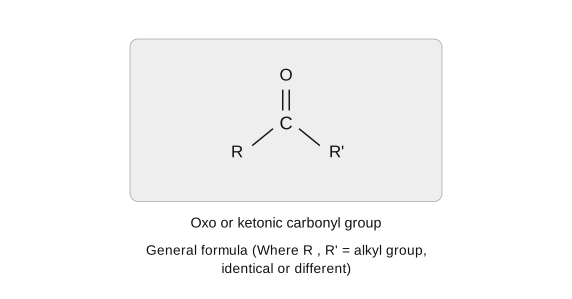
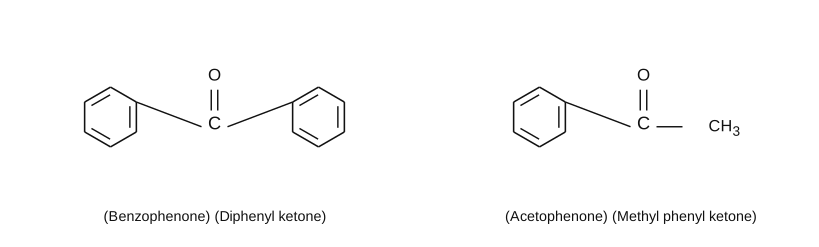
Ketones are likewise classified as aliphatic or aromatic. ALIPHATIC KETONES have the >C=O group attached to two alkyl groups; general formula R-CO-R', where R and R' may be identical or different. Based on whether those two alkyl groups are identical or different, aliphatic ketones split further into two types. SIMPLE (SYMMETRICAL) ketones have identical alkyl groups on both sides of the carbonyl carbon -- e.g. dimethyl ketone (acetone), H3C-CO-CH3, and diethyl ketone, H5C2-CO-C2H5. MIXED (UNSYMMETRICAL) ketones have two different alkyl groups -- e.g. ethyl methyl ketone, H5C2-CO-CH3, and ethyl n-propyl ketone, H5C2-CO-CH2-CH2-CH3. AROMATIC KETONES have the >C=O group attached to either two aryl groups, or one aryl and one alkyl group -- e.g. acetophenone (methyl phenyl ketone, C6H5-CO-CH3, one aryl + one alk …
Drawn by us to help you understand the concept clearly, and verified to make sure it's accurate. For exams, practice from your textbook's own diagram.
What this figure shows. A carbonyl carbon doubly bonded to O and singly bonded to two R groups (R, R' = alkyl, identical or different), i.e. the general skeletal formula R-CO-R' for any aliphatic ketone, labelled the 'oxo or ketonic carbonyl group'. …
Worked out. Simple (symmetrical) ketones -- H3C-CO-CH3 (dimethyl ketone, i.e. acetone) and H5C2-CO-C2H5 (diethyl ketone) -- both alkyl groups on the carbonyl carbon identical, contrasted with mixed (unsymmetrical) ketones -- H5C2-CO-CH3 (ethyl methyl ketone) and H5C2-CO-CH2-CH2-CH3 (ethyl n-propyl ketone) -- whose two alkyl gro …
Drawn by us to help you understand the concept clearly, and verified to make sure it's accurate. For exams, practice from your textbook's own diagram.
What this figure shows. Acetophenone (methyl phenyl ketone), a benzene ring bonded through its carbonyl carbon to a -CH3 group (one aryl + one alkyl group on the carbonyl carbon); and benzophenone (diphenyl ketone), a carbonyl carbon bonded to two separate benzene rings (two aryl groups on …
Drawn by us to help you understand the concept clearly, and verified to make sure it's accurate. For exams, practice from your textbook's own diagram.
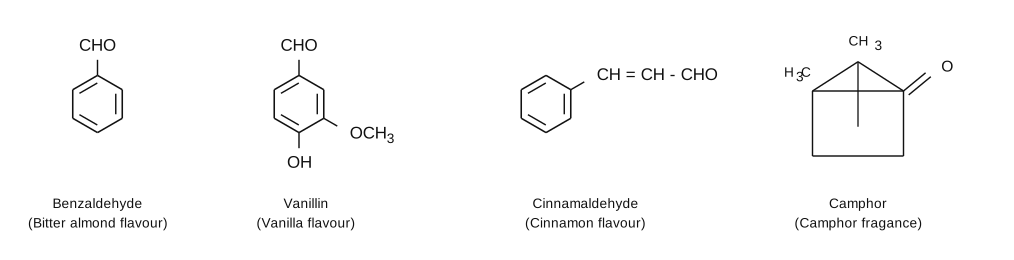
Chemistry you can smell. The textbook's flavour panel shows how often the carbonyl group appears in everyday sensations: benzaldehyde gives bitter almond, vanillin (4-hydroxy-3-methoxybenzaldehyde) gives vanilla, cinnamaldehyde gives cinnamon, and the caged bicyclic ketone camphor gives its familiar fragrance. Many biological molecules — progesteron …