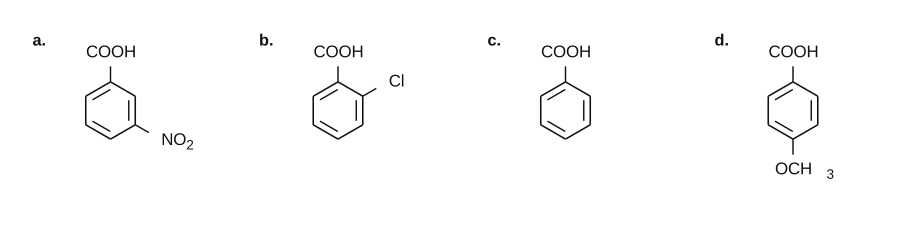
Q.Which one of the following has lowest acidity ?
You're viewing a preview — the full solution, concept, methods & PYQ mapping are locked.
Start your 14-day free trial to unlock the full solution →Step 1. Recall the governing rule (section 12.9.1). Electron-withdrawing ring substituents (-Cl, -CN, -NO2) stabilise the carboxylate conjugate base and so RAISE acidity; electron-donating ring substituents (-CH3, -OH, -OCH3, -NH2) instead destabilise the conjugate base and so LOWER acidity, even below plain benzoic acid's own pKa of 4.2.
Step 2. Classify each option's substituent. (a) -NO2 is strongly electron-withdrawing (both -I and -M/resonance) -- raises acidity, so NOT the lowest. (b) -Cl is electron-withdrawing (-I, dominating over its weak +M donation) -- raises acidity, so NOT the lowest. (c) -OCH3 is a strong electron DONOR by resonance (its oxygen lone pair conjugates into the ring, pushing electron density toward the -COOH and destabilising the negatively-charged carboxylate) -- this LOWERS acidity, making (c) the weakest acid of the group. (d) Plain benzoic acid (pKa 4.2) sits in betwee …
Unlock everything free for 14 days
- Full step-by-step solutions
- Concept-first explanations
- Methods, shortcuts & mistakes
- PYQ mapping + timed mock tests
Full access for 14 days. No credit card required.