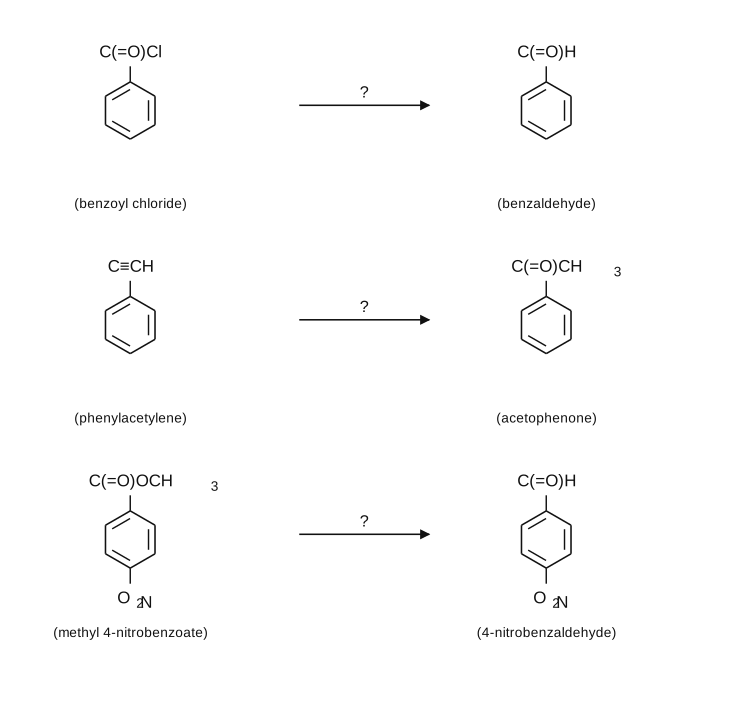
Q.Identify the reagents necessary to achieve each of the following transformation
🔒You're viewing a preview — the full solution, concept, methods & PYQ mapping are locked.
🔒 Start your 14-day free trial to unlock the full solution →Concept understanding — Preparation of Aldehydes and Ketones
General routes make both families together: oxidation of primary/secondary alcohols (to aldehydes/ketones respectively, with a mild oxidant needed to stop at the aldehyde stage) or dehydrogenation of alcohol vapour over hot copper; ozonolysis of an alkene (via its ozonide, decomposed with Zn dust/water); and acid-catalysed hydration of an alkyne. More specific routes start from other functional groups: an acyl chloride gives an ALDEHYDE by Rosenmund reduction (H2, Pd-BaSO4) or a KETONE via dialkyl cadmium; a nitrile gives an ALDEHYDE via the Stephen reaction (SnCl2/HCl to an imine, then acid hydrolysis) or via DIBAl-H, or a KETONE via a Grignard reagent followed by acid hydrolysis; a methylarene gives an aromati …
- H₂/Pd-BaSO₄ (Rosenmund) · 2. H₂O / 40% H₂SO₄ + 1% HgSO₄ (hydration of the alkyn …
- Benzoyl chloride → benzaldehyde: H₂ with Pd-BaSO₄ (Rosenmund reduction).
- Phenylacetylene → acetophenone: water with 40% H₂SO₄ / 1% HgSO₄ — Markovnikov hydration of the terminal alkyne gives the methyl ketone. …
- CBSE 2024Set ANNUAL1 markMCQQ.The product of hydrolysis of propyne in the presence of 1% HgSO4 and 40% H2SO4 is _____.(a) methanal(b) ethanal(c) propanal(d) propanone
›Reveal solutionSolution
Hg2+/H2SO4 hydration of propyne (Markovnikov) gives propanone via the enol.
Terminal alkynes undergo Markovnikov (mercuric-ion catalysed) hydration with dilute H2SO4 in presence of 1% HgSO4, adding water across the triple bond to give an enol which tautomerises to a ketone (following Markovnikov's rule).
…
- CBSE 2023Set ANNUAL1 markMCQQ.Ozonolysis of 2, 3 dimethyl but-2-ene, followed by decomposition by Zn dust and water gives _______.(a) acetaldehyde(b) propionaldehyde and acetone(c) acetone(d) acetaldehyde and butyraldehyde
›Reveal solutionSolution
2,3-Dimethylbut-2-ene, (CH3)2C=C(CH3)2, is symmetric, so ozonolysis cleaves it into two identical acetone molecules.
2,3-Dimethylbut-2-ene has the structure (CH3)2C=C(CH3)2 — both carbons of the double bond bear two identical methyl substituents. Ozonolysis (formation of the ozonide, followed by reductive cleavage with Zn dust/water) cleaves the C=C bond, converting each doubly-bonded carbon into a carbonyl carbon:
…
- CBSE 2022Set E1 markMCQQ.When acetylene is passed through dil. H2SO4 in the presence of HgSO4, the compound formed is(a) Ethyl alcohol(b) Acetone(c) Acetaldehyde(d) Carbide of Hg
›Reveal solutionSolution
Hydration of acetylene over HgSO4/dil. H2SO4 gives acetaldehyde.
When acetylene (HC≡CH) is passed through dilute sulphuric acid in the presence of mercuric sulphate as catalyst, water adds across the triple bond (Markovnikov):
HC≡CH + H2O --(HgSO4/dil.H2SO4)--> [CH2=CH-OH] -> CH3-CHO
…
- CBSE 2022Set ANNUAL1 markQ.Write the reagent required (denoted '?') for the following reaction: benzonitrile (ring-CN) --?--> benzaldehyde (ring-CHO).
›Reveal solutionSolution
A nitrile can be reduced selectively to an aldehyde by the Stephen reduction (SnCl2/HCl) or by DIBAL-H, both followed by hydrolysis of the intermediate imine.
Identifying the reaction: Nitrile (-CN) converting to aldehyde (-CHO) is a partial (controlled) reduction — the nitrile must be stopped at the imine stage rather than going all the way to the primary amine.
Method 1 — Stephen reduction: Benzonitrile is treated with stannous chloride (SnCl2) and HCl gas, which reduces it to an imine-stannic chloride complex; this is then hydrolysed with water to release the aldehyde.
C6H5CNSnCl2/HClC6H5CH=NH⋅HClH2OC6H5CHO
…
- CBSE 2021Set A1 markMCQQ.Dry distillation of calcium formate gives(a) HCHO(b) HCOOH(c) CH3COOH(d) CH3CHO
›Reveal solutionSolution
Dry distillation of the calcium salt of formic acid (calcium formate) yields formaldehyde, HCHO.
Dry distillation of the calcium salt of a carboxylic acid is a classic route to aldehydes/ketones. Calcium formate, (HCOO)2Ca, on dry distillation gives formaldehyde:
(HCOO)2Ca ---> HCHO + CaCO3
…
- CBSE 2016Set ANNUAL1 markMCQQ.Which of the following compounds is obtained when calcium acetate is dry distilled?(a) Formic acid(b) Formaldehyde(c) Acetone(d) Butanone
›Reveal solutionSolution
Dry distillation of the calcium salt of a carboxylic acid is a classic laboratory route to a ketone — for calcium acetate, this gives acetone.
When the calcium salt of acetic acid (calcium acetate) is heated strongly in the absence of air (dry distillation), it undergoes ketonic decarboxylation: two acetate groups combine, releasing calcium carbonate and forming a ketone — in this case, the simplest ketone, acetone (propan-2-one):
Ca(CH3COO)2Δ,dry distillationCaCO3+CH3COCH3 (acetone)
…
🎓Unlock everything free for 14 days
- ✓Full step-by-step solutions
- ✓Concept-first explanations
- ✓Methods, shortcuts & mistakes
- ✓PYQ mapping + timed mock tests
Full access for 14 days. No credit card required.