Chemistry · Ch 8 — Transition and Inner Transition Elements
Atomic and ionic radii (Lanthanoid Contraction)
Atomic and ionic radii (Lanthanoid Contraction)
As we move along the lanthanoid series, there is a decrease in atomic and ionic radii (Fig. 8.6). This steady decrease in the atomic and ionic radii is called Lanthanoid contraction. As we move from one element to another, the nuclear charge increases by one unit and one electron is added. The new electrons are added to the same inner 4f subshell. Thus the 4f electrons shield each other from the nuclear charge poorly, owing to their diffused nature. With increasing atomic number and nuclear charge, the effective nuclear charge experienced by each 4f electron increases. As a result, the whole of the 4f electron shell contracts at each successive element.
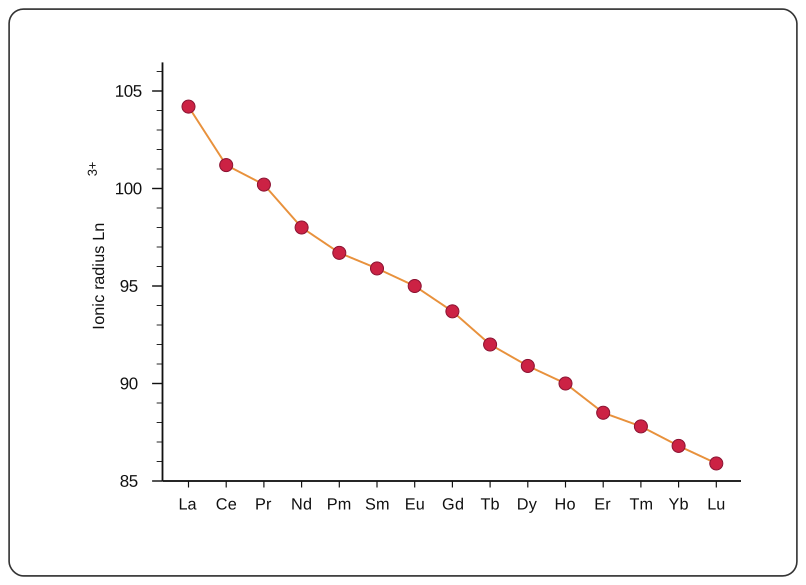
Drawn by us to help you understand the concept clearly, and verified to make sure it's accurate. For exams, practice from your textbook's own diagram.
Fig. 8.6 : Ionic radii of lanthanoids in +3 oxidation state. One unbroken slide: starts at 103 pm and every succeeding lanthanoid sits a little lower, down to at 86.1 pm - the lanthanoid contraction drawn as data. Each step adds one proton and one 4f electron, and because the diffuse 4f electrons shield one another so poorly, the effective nuclear charge - and the pull on the whole shell - grows at …
In section 8.6.4 we have learnt about the magnetic behaviour of transition metal complexes.
Table 8.13: Effective magnetic moments of lanthanoids in +3 oxidation state
| Ln | oxidation state | No. of unpaired electrons | Observed magnetic moment, B.M |
|---|---|---|---|
| La | 0 | 0 | |
| Ce | 1 | 2.3-2.5 | |
| Pr | 2 | 3.4-3.6 | |
| Nd | 3 | 3.5-3.6 | |
| Pm | 4 | -- | |
| Sm | 5 | 1.4-1.7 | |
| Eu | 6 | 3.3-3.5 | |
| Gd | 7 | 7.9-8.0 | |
| Tb | 6 | 9.5-9.8 | |
| Dy | 5 | 10.4-10.6 | |
| Ho | 4 | 10.4-10.7 | |
| Er | 3 | 9.4-9.6 | |
| Tm | 2 | 7.1-7.6 |