Chemistry · Ch 8 — Transition and Inner Transition Elements
Extraction of Iron from Haematite ore using Blast furnace
Extraction of Iron from Haematite ore using Blast furnace
Do you know ? Iron is the fourth most abundant element in the earth's crust.
Iron is extracted from haematite by its reduction using coke and limestone. Carbon in the limestone is reduced to carbon monoxide. Carbon and carbon monoxide together reduce to metallic iron. Limestone acts as flux: it combines with the gangue material to form molten slag.
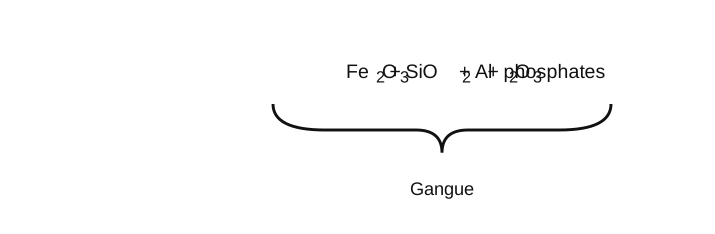
Composition of Haematite ore :
Drawn by us to help you understand the concept clearly, and verified to make sure it's accurate. For exams, practice from your textbook's own diagram.
What this line shows (uncaptioned in the book). Mined haematite is never pure - it comes mixed with silica (), alumina () and phosphates. The brace gathers those three under the name Gangue - the unwanted impurities that concentration (and later the flux in the blast furnace) must remove, while the itself is the ore being extracted. *(In the print the heavy brace sits loosely centred under the whole line; it is drawn here under the …
Extraction of iron from haematite ore involves the following steps.
i. Concentration : The powdered ore is washed in a powerful current of water introduced into the hydraulic classifier. The lighter gangue particles are separated, and the concentrated ore is collected at the bottom.
ii. Roasting : The concentrated ore is heated in a current of air. The sulfur and arsenic impurities present in the ore get converted into their oxides and escape as vapour. Ferrous oxide in the ore is converted to .
The roasted ore is converted into lumps by sintering.
iii. Reduction (Smelting) : This step is carried out in a blast furnace. The blast furnace is a tall cylindrical steel tower which is lined with refractory bricks. The height of a typical blast furnace is 25 m, and its diameter varies between 5 and 10 m. The furnace works on the counter current principle, where the charge comes down and hot gases move up the tower. The furnace is comprised of 3 parts - 1. Hearth, 2. Bosh and 3. Stack.
The charge containing ore and limestone is introduced into the furnace through a cup and cone arrangement. In this arrangement the cone enables uniform distribution of charge, and the cup prevents the loss of gases. A blast of preheated air is introduced into the furnace below the bosh (the book prints "furnance"). The charge and hot air come in contact with each other, and various reactions take place.
Drawn by us to help you understand the concept clearly, and verified to make sure it's accurate. For exams, practice from your textbook's own diagram.
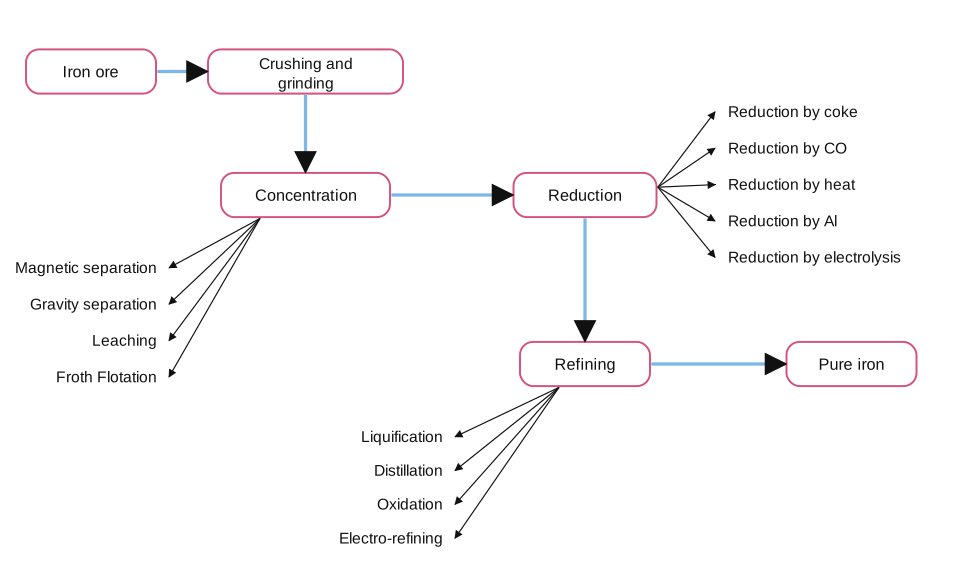
What this flow chart shows (uncaptioned in the book). The pink pipeline is the whole journey: Iron ore → Crushing and grinding → Concentration → Reduction → Refining → Pure iron. Under each middle stage fan out the methods to choose from - concentration by Magnetic separation, Gravity separation, Leaching or Froth Flotation; reduction by coke, by CO, by heat, by Al or by electrolysis (the blast furnace of Fig. 8.5 is the coke/CO route); refining by Liquification, Distillation, Oxidation or Electro-refining *("Liquification" as the book …
Drawn by us to help you understand the concept clearly, and verified to make sure it's accurate. For exams, practice from your textbook's own diagram.
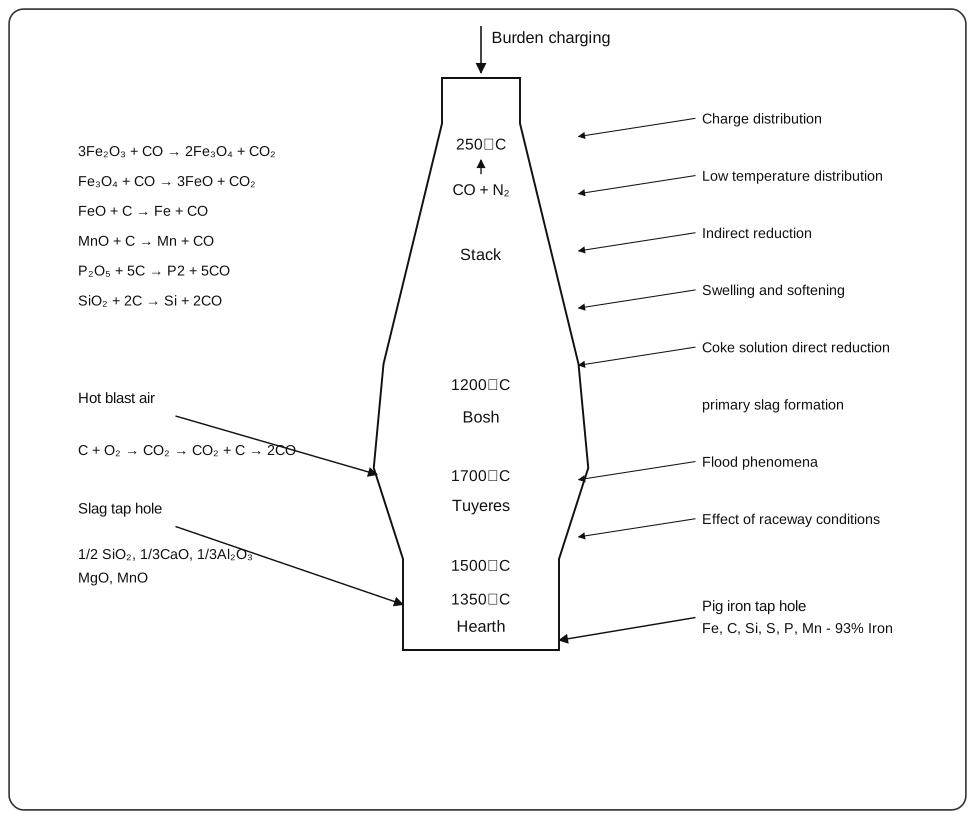
Fig. 8.5 : Blast furnace. Follow the counter-current: the charge (Burden charging) descends from 250⁰C at the throat through the Stack, the 1200⁰C Bosh and the 1700⁰C Tuyeres belt to the 1350⁰C Hearth, while the hot reducing gas (, arrow) climbs the other way. The left-hand ladder of equations is the descent chemistry - , , , with MnO, and reduced lower down - fed by the Hot blast air burning coke (, then ). Slag (roughly 1/2 SiO₂, 1/3 CaO, 1/3 Al₂O₃ with MgO and MnO) leaves by the Slag tap hole; molten pig iron - Fe with C, Si, S, P, Mn, about 93% Iron - taps from the hearth. The right-hand labels name what each level is doing, from Charge distribution down t …
Reactions in the blast furnace : There are different temperature zones in the blast furnace. The temperature goes on increasing from top to bottom in the furnace. At the top the temperature is 500 K; the maximum temperature of the furnace is 2000 K, above the tuyers (the figure labels them "Tuyeres", the prose "tuyers" — both the book's own spellings). There are 3 temperature zones in the furnace.
- Zone of combustion - Combustion of coke with in the air.
- Zone of reduction - Reduction of to metallic iron
- Zone of slag formation - Formation of slag by reaction of gangue with limestone
Chemical reactions taking place in different zones of the blast furnace
1. Zone of combustion : This is 5 - 10 m from the bottom. The hot air blown through the tuyers reacts with coke from the charge to form CO.
The reaction is highly exothermic; thus the temperature of this zone is around 2000 K. Some of the CO formed dissociates to form finely divided carbon.
The hot gas rich in CO rises upwards in the blast furnace. The charge coming down gets heated and reacts with CO. Thus CO acts as a fuel and also a reducing agent.
2. Zone of Reduction (22-25 m near the top) (no colon in the print's heading) — Here the temperature is around 900 K. is reduced to spongy iron by CO.
Some amount of is reduced to iron by carbon.
3. Zone of slag formation (20 m unit) : The gangue present in the ore is converted to slag. This slag can be used for making road foundation. The temperature of this zone is 1200 K. The gangue contains silica, alumina and phosphates. Removal of this gangue is effected by adding lime-stone in the charge, which acts as flux. Limestone decomposes to give CaO (quick lime).
CaO combines with gangue to form molten slag of calcium silicate and calcium aluminate.
4. Zone of fusion (15 m ht) : and present in the iron ore are reduced to Mn and P. Some of the silica is also reduced to Si. The spongy iron coming down in the furnace melt absorbs impurities like C, Si, Mn, P and S. This molten iron collects at the bottom of the furnace. The slag, which is lighter, floats on the surface of the molten iron. Molten slag and iron are collected through separate outlets. Molten iron is poured into moulds; these solid blocks are called pigs. This iron contains about 4% of carbon. When pig iron is remelted, run into moulds and cooled, it becomes cast iron. The waste gases containing , CO and escape through the outlet at the top; these hot gases are used for preheating the blast of air.
Table 8.10 : Summary of reactions taking place in blast furnace at different temperature zones
| Temp K | Changes taking place | Reaction |
|---|---|---|
| 500 | loss of moisture from ore | — |
| 900 | Reduction of ore by CO | |
| 1200 | Decomposition of lime | |
| 1500 | Reduction of ore by C | |
| 2000 | Slag formation | ; |
5. Refining : Pure iron can be obtained by electrolytic refining of impure iron, or other methods given in the flow chart. The choice of extraction technique is governed by the following factors. 1. Nature of ore. 2. Availability and cost of reducing agent — generally cheap coke is used. 3. Availability of hydraulic power. 4. Purity of product (metal) required. 5. Value of byproducts — for example, obtained during roasting of sulphide ores is vital for manufacture of . Knowledge of the electrochemical series provides solutions to many problems. …
Drawn by us to help you understand the concept clearly, and verified to make sure it's accurate. For exams, practice from your textbook's own diagram.
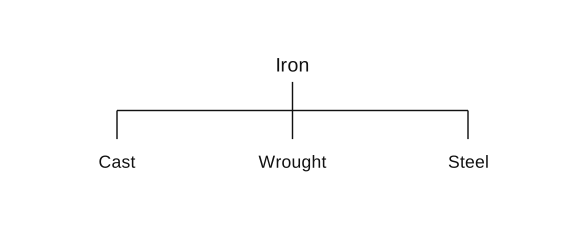
What this tree shows (uncaptioned in the book). Commercial iron comes in three forms - Cast iron (hard, brittle, about 4% carbon - pig iron remelted and moulded), Wrought iron (very soft, under 0.2% carbon) and Steel (0.2-2% carbon, neither too hard nor too soft). The comparison table just below this tree in the …