Mathematics · Ch 6 — Line and Plane
Equation of Plane Passing through a Point and Perpendicular to a Vector
Equation of Plane Passing through a Point and Perpendicular to a Vector
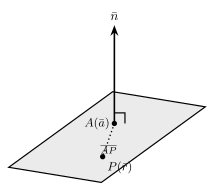
Theorem 6.8 (vector form). The plane through the point that is perpendicular to a fixed non-zero vector has the equation , where denotes an arbitrary point of the plane.
Why this is true: if lies on the plane, the chord lies entirely in the plane, so it must be perpendicular to the normal . Writing this perpendicularity as a dot product, . Since , this becomes , and expanding the dot product over the subtraction gives , i.e. . This is called the vector equation of a plane in scalar product form (Fig. 6.8 shows the point , a general point on the plane, the chord lying flat in the plane, and standing perpendicular to it). If the fixed number is called , the equation shortens further to .
Theorem 6.9 (Cartesian form). If is a point of the plane and are the direction ratios of the normal, the same idea translated into coordinates gives . Here is a general point of the plane, so are the direction ratios of ; because is perpendicular to the normal, the sum of the products of corresponding direction ratios must vanish, which is exactly this equation. Multiplying out gives the familiar linear form .
Ex.(1): the plane through the point with position vector that is perpendicular to . Here , so by Theorem 6.8 the required equation is .
Ex.(2): the plane through whose normal has direction ratios . By Theorem 6.9, , which simplifies to . …
Drawn by us to help you understand the concept clearly, and verified to make sure it's accurate. For exams, practice from your textbook's own diagram.
What this figure shows. A shaded parallelogram-shaped plane carries a marked point A with position vector a-bar and a second point P with position vector r-bar on the same plane, connected by a dotted segment labelled AP. A vertical arrow labelled n-bar rises from the plane at A, meeting the plane at a right angle (shown by the small square corner mark) to show that the fixed vector n-bar is normal to the plane while AP lies flat within it, which is exactly the perpendicularity AP . n-bar = 0 that the proof of Theorem 6.8 turns in …