Mathematics · Ch 6 — Line and Plane
The Vector Equation of the Plane Passing through Point A(a-bar) and Parallel to b-bar and c-bar
The Vector Equation of the Plane Passing through Point A(a-bar) and Parallel to b-bar and c-bar
Theorem 6.10. The plane through the point that is parallel to two given non-zero, non-parallel vectors and has the equation , equivalently .
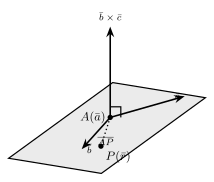
Why this is true: because and both lie parallel to the plane (rather than in some other orientation), their cross product is perpendicular to both of them and therefore perpendicular to the whole plane — it is a normal vector, even though and individually are not. For a general point of the plane, lies in the plane, so must be perpendicular to : . Substituting gives the stated equation (Fig. 6.9 shows and as two arrows lying flat in the plane from , and standing up perpendicular to the plane).
A useful alternative comes from noticing that , and are all parallel to the same plane, so they are coplanar; hence can always be written as a linear combination for some scalars . This gives , i.e. — the vector equation of a plane in parametric form, with and free real parameters that sweep out every point of the plane.
Ex.(4): the plane through parallel to and . Here , and . Then , so the plane's equation is . …
Drawn by us to help you understand the concept clearly, and verified to make sure it's accurate. For exams, practice from your textbook's own diagram.
What this figure shows. A shaded plane shows point A (with position vector a-bar) as the vertex of two arrows drawn inside the plane, labelled b-bar and c-bar, meeting at a right angle mark, with a second point P (position vector r-bar) on the plane joined to A by a dotted segment marked AP. Directly above A, a vertical arrow labelled b-bar x c-bar rises perpendicular to the plane, illustrating that although b-bar and c-bar themselves only lie in the plane (they do not have to be perpendicular to each other), their cross product is the true normal direction used to test …