Mathematics · Ch 6 — Line and Plane
The Normal Form of Equation of Plane
The Normal Form of Equation of Plane
Theorem 6.12 (normal form). If is the (non-negative) distance of a plane from the origin and is the unit vector along the perpendicular dropped from the origin onto the plane, the plane's equation is simply .
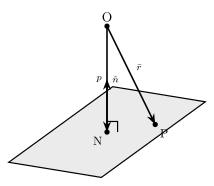
Why this is true: let be the foot of that perpendicular, so in length; since is the unit vector along , this means . For any point of the plane, lies in the plane and is therefore perpendicular to (the perpendicular to the plane), so . Writing turns this into , i.e. ; since is a unit vector, , leaving (Fig. 6.11 shows the axes, the foot , the segment of length , the unit vector along it, and a general point of the plane with position vector ).
Several useful facts follow immediately. If are the direction cosines of the normal, then , and the coordinates of the foot itself are — a shortcut used repeatedly below. In Cartesian coordinates the normal form reads . Finally, because a unit normal can point either way, there are always two planes at a given distance from the origin with the same underlying normal direction, namely .
Ex.(7): the plane at distance from the origin, normal to . Here , so , and becomes , i.e. .
Ex.(8): the perpendicular distance of the origin from . The normal has direction ratios , so ; dividing through converts to normal form , so the distance is . …
Drawn by us to help you understand the concept clearly, and verified to make sure it's accurate. For exams, practice from your textbook's own diagram.
What this figure shows. A 3-D sketch shows the coordinate axes X, Y, Z meeting at the origin O, with a shaded plane cutting across the picture; N is the foot of the perpendicular dropped from O onto the plane, and P is a general point of the plane. The segment ON is labelled with its length p, the unit vector n-hat is drawn along ON with a right-angle mark showing NP perpendicular to n-hat, and the position vector r-bar of P is drawn from O to P, together giving the picture behind the normal-form equation r …