Mathematics · Ch 6 — Line and Plane
Equation of Plane Passing through the Intersection of Two Planes
Equation of Plane Passing through the Intersection of Two Planes
If two planes and actually intersect (i.e. their normals are not parallel), then for every real value of the equation represents some plane passing through their common line of intersection. As runs over all real numbers, this single formula sweeps out the whole pencil (family) of planes hinged along that line — Fig. 6.12 pictures the two given planes as two sheets meeting along a shared line, with every other plane through that line being one more sheet through the same hinge.
The same idea in Cartesian coordinates: if and intersect, then for every real , represents a plane through their line of intersection.
This is useful precisely because it turns "find the plane through this line and satisfying one more condition" into a one-parameter search: write down the family, plug in the extra condition (typically a third point the plane must pass through), solve for the single unknown , and substitute back. …
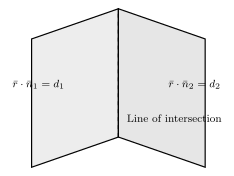
Drawn by us to help you understand the concept clearly, and verified to make sure it's accurate. For exams, practice from your textbook's own diagram.
What this figure shows. Two flat sheets are drawn opening away from each other like the pages of a book, one labelled with the equation r-bar . n1-bar = d1 and the other with r-bar . n2-bar = d2, hinged along a common dashed vertical line marked "Line of intersection". An arrow from outside the sketch points at the hinge line and is labelled with the family-of-planes equation (schematically written near the arrow as r-bar . (n1-bar + n2-bar) + lambda(d1 + d2) = 0), conveying that every plane through that hinge line is obtained for some real value of lambda, matching the r-bar . (n1-bar + la …