Mathematics · Ch 6 — Line and Plane
The Vector Equation of Plane Passing through Three Non-collinear Points
The Vector Equation of Plane Passing through Three Non-collinear Points
Theorem 6.11. The plane through three non-collinear points , and has the equation .
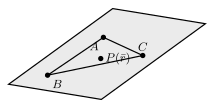
Why this is true: for a general point of the plane, the three chords , and all lie in the plane, so they are coplanar, which means the scalar triple product is zero. Writing , and turns this into the stated equation (Fig. 6.10 shows all three points, the chords and drawn from , and their cross product standing perpendicular to the plane as its normal). In effect, plays the role that or played in the previous two theorems — three points automatically supply two directions lying in the plane, namely and , and any two non-parallel directions in a plane fix its normal by taking their cross product.
Expressed in coordinates, with , , and a general point , the same statement becomes the determinant equation
…
Drawn by us to help you understand the concept clearly, and verified to make sure it's accurate. For exams, practice from your textbook's own diagram.
What this figure shows. A shaded plane displays three marked points, A (position vector a-bar), B (position vector b-bar) and C (position vector c-bar), with arrows drawn from A to B (labelled AB) and from A to C (labelled AC), plus a further point P (position vector r-bar) joined to A by a dotted arrow labelled AP. A vertical arrow labelled AB x AC rises from the plane at a right angle to it, showing that this cross product of the two chords from A is the normal used to force AP, AB and AC to be coplanar, which is the geometric content behind Theorem 6.11's equation (r-b …