Q.Explain with a neat circuit diagram how will you determine unknown resistance 'X' by using meter bridge.
You're viewing a preview — the full solution, concept, methods & PYQ mapping are locked.
Start your 14-day free trial to unlock the full solution →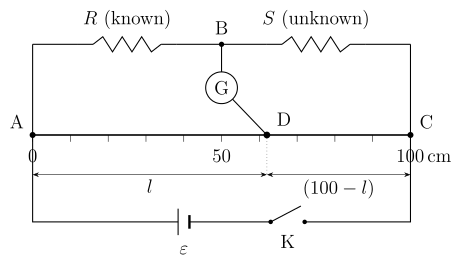
A meter bridge is a practical Wheatstone bridge built on a 1-metre resistance wire; a sliding jockey finds the null (balance) point, from which the unknown resistance is calculated by the wire's length ratio.
Construction: A meter bridge consists of a uniform manganin (or constantan) resistance wire, exactly 1 metre long, stretched along a metre scale and fixed at its ends to two thick copper strips on a wooden board, forming a Wheatstone-bridge arrangement together with two resistance boxes/gaps. The unknown resistance is connected in one gap, and a known resistance box in the other gap. A cell (with a key) is connected across the two ends of the wire, and a galvanometer (with a jockey that can touch any point on the wire) is connected between the junction of and a sliding contact on the wire.
…
Unlock everything free for 14 days
- Full step-by-step solutions
- Concept-first explanations
- Methods, shortcuts & mistakes
- PYQ mapping + timed mock tests
Full access for 14 days. No credit card required.