Physics · Ch 14 — Dual Nature of Radiation and Matter
Einstein's Postulate of Quantization of Energy and the Photoelectric Equation
Einstein's Postulate of Quantization of Energy and the Photoelectric Equation
Building directly on Planck's idea that energy comes in discrete packets, Einstein proposed in 1905 that under certain conditions light itself behaves as if made of localized PARTICLES of energy, which he called PHOTONS. Each photon of light of frequency carries a fixed energy
where h is Planck's constant, with the now precisely known value J s. Equation (14.1), called EINSTEIN'S RELATION, is remarkable for linking a PARTICLE-like property (the photon's energy E) to a WAVE-like property (the radiation's frequency ); since , it equally tells us that shorter-wavelength (higher-frequency) radiation carries more energetic photons -- so ultraviolet photons are more energetic than red-light photons, which in turn are far more energetic than radio-wave photons (see Example 14.2).
Einstein used this photon picture to explain every one of the photoelectric observations of section 14.2.2, point by point:
-
When a photon strikes the metal surface and collides with a free electron, it transfers ALL of its energy to that one electron in a single event, and ceases to exist. The electron escapes if and only if the energy it gains is at least equal to the work function: . This immediately explains the THRESHOLD FREQUENCY: is the minimum frequency at which a single photon carries enough energy to free an electron at all. Below no single photon -- however many arrive -- can do the job; above , even one photon suffices, however weak the overall beam.
-
Since the whole energy exchange happens in one instantaneous collision (not a gradual accumulation), there is no time lag: emission starts the instant light strikes the surface, and stops the instant it is switched off -- there being no photons left to transfer energy.
-
Increasing the intensity of light at a fixed wavelength increases the NUMBER of photons arriving per unit area per unit time, while the energy of EACH photon () stays exactly the same. More photons means more electrons knocked out per second, hence a larger photocurrent -- exactly the linear intensity dependence of observation 3, correctly explained without any change in each electron's individual energy.
-
Once free, a photoelectron is accelerated towards the collector if C is at a higher potential; a larger accelerating potential draws in more of the emitted electrons, until ALL of them are being collected -- beyond that point, raising V further cannot increase the current, which explains the saturation current of observation 4. Since intensity fixes the total number of photons (and hence the maximum possible number of ejected electrons) per second, saturation current scales proportionately with intensity, exactly as in observation 5.
-
Because all electrons in the metal do not have identical starting energies, and some lose energy through collisions on their way out, the ejected electrons have a SPREAD of kinetic energies, not a single value. The MAXIMUM kinetic energy among them is what remains after the minimum energy needed to escape is subtracted from the absorbed photon energy :
This is EINSTEIN'S PHOTOELECTRIC EQUATION, arguably the single most important result of the chapter. It depends on the emitter material (through ) and on the incident frequency, but has NO dependence on intensity at all -- exactly matching observation 6.
- When the collector is held at a RETARDING (negative) potential V, an electron loses kinetic energy overcoming the opposing field; the most energetic electron (with at the emitter surface) just fails to reach the collector when , defining the stopping potential . Substituting this into Eq. (14.2) gives
This is exactly the straight-line relationship of Fig. 14.6: varies linearly with , with slope -- a UNIVERSAL constant, the same for every metal, since it depends only on h and e -- while the intercept depends on the material through its work function . This single equation explains both why all the lines in Fig. 14.6 are PARALLEL (same slope h/e) and why they are shifted horizontally from one metal to another (different , hence different threshold frequency ). …
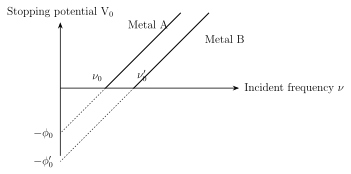
Drawn by us to help you understand the concept clearly, and verified to make sure it's accurate. For exams, practice from your textbook's own diagram.
What this figure shows. A graph with incident frequency on the horizontal axis and stopping potential on the vertical axis, showing SEVERAL straight lines, one for each of several different emitter metals. Every line has exactly the SAME slope (equal to h/e, a universal constant independent of the material), but each intersects the horizontal () axis at a DIFFERENT point -- its own threshold frequency -- and correspondingly has a different (negative) intercept on the vertical axis related to . A metal with a larger work function has its line shifted further to the right (larger threshold frequency) while remaining parallel to all the others. This is the graphical form of Einstein's relation and is the figure directly used by Numerical qu …
Observation | Wave theory | Photon picture
Electrons are emitted as soon as light is incident on the metal surface. | Very intense light is needed for instantaneous emission of electrons. | Only one photon is needed to eject one electron and the energy exchange between electron and photon is instantaneous on collision.
Very low intensity of incident light is also sufficient to generate photocurrent. | Low intensity should not give photocurrent. | Low intensity means fewer photons, not low-energy photons; hence a (smaller but non-zero) current is still produced.
High intensity gives larger photocurrent, i.e. higher rate of release of electrons. | High intensity means higher-energy radiation, so more electrons are emitted. | Higher intensity means more photons incident per unit time, so more electrons are emitted per unit time and photocurrent is larger.
Increasing the intensity has no effect on the electron energy. | Higher intensity should mean electrons emitted with higher energies. | Higher intensity means more incident photons per unit time; the energy of each photon is unchanged since it does not depend on intensity.
A minimum threshold frequency is needed for photocurrent to start. | Low-frequency light should still release electrons, only more slowly. | A photon of low-frequency light lacks the energy to release an electron from the surface at all, however long one waits. …
Worked out. Using , the energy of a single photon is computed for three very different parts of the electromagnetic spectrum to illustrate the huge range photon energies span: (a) ultraviolet light of wavelength 3000 Å gives J eV, while red light of wavelength 7000 Å gives a smaller J eV (shorter wavelength/higher frequency UV photons carry more energy than longer-wavelength red photons); (b) a typical FM radio broadcast at 98.3 MHz gives an extremely tiny photon energy of about J eV -- many orders of magnitude smaller than a visible-light photon, illustrating why radio-frequency quanta are never noticed individually. The example also notes, as an aside, that photons themselves are not literally 'coloured' -- c …
Worked out. For light of wavelength 4000 Å and power 0.1 W, the energy of a SINGLE photon (the smallest possible 'jump' in the beam's energy, since energy can only be absorbed/emitted in whole quanta) works out to about J -- vanishingly small on any everyday energy scale, which is why the beam's energy appears to change continuously even though it is really always an integer multiple of this quantum. Dividing the given 0.1 W of power by this per-photon energy gives the number of photons arriving per second, about photons/s -- so enormous a rate that the human eye cannot resolve individual photons; the example notes that even counting at a rate of ten photons per second, it would take roughly years to count them all, underscoring why light's p …