Physics · Ch 14 — Dual Nature of Radiation and Matter
Experimental Set-up of Photoelectric Effect
Experimental Set-up of Photoelectric Effect
To study the photoelectric effect quantitatively, experimenters built an evacuated glass tube fitted with a quartz window (quartz, unlike ordinary glass, transmits ultraviolet light without absorbing it). Inside this vacuum sit two metal plates: the EMITTER E, a photosensitive plate that acts as the cathode, and the COLLECTOR C, a second plate that acts as the anode. A source S of MONOCHROMATIC light -- light of one single, sufficiently high frequency (correspondingly short wavelength, typically less than about m) -- shines through the quartz window onto E.
The two plates are connected to an external circuit containing a variable voltage source and a voltmeter (to set and measure the potential difference V between C and E) together with an ammeter (to measure the resulting current). Normally C is kept at a positive potential relative to E: this ACCELERATES the photoelectrons emitted from E towards C, so this direction of V is called the ACCELERATING POTENTIAL. But the polarity can also be reversed, making C negative relative to E; this RETARDS the photoelectrons on their way to C, and this direction of V is correspondingly called the RETARDING POTENTIAL. …
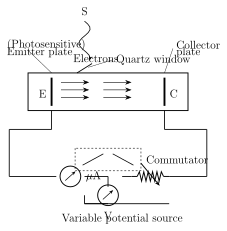
Drawn by us to help you understand the concept clearly, and verified to make sure it's accurate. For exams, practice from your textbook's own diagram.
What this figure shows. An evacuated glass tube (or bulb) with a quartz window on one side, through which a beam from a monochromatic light source S (of sufficiently high frequency / short wavelength, drawn outside the tube as a small lamp or arrow labelled S) enters and strikes a flat metal plate E (the emitter, acting as the cathode), mounted inside the tube. Facing E, at some distance inside the same evacuated tube, is a second metal plate C (the collector, acting as the anode), onto which the ejected photoelectrons travel. Both E and C are wired to an external circuit containing: a variable voltage source (battery with a sliding/reversible contact, so the potential difference V between C and E can be set positive -- accelerating -- or negative -- retarding), a voltmeter V connected across E and C to read this potential difference, and a microammeter (μA) in series in the circuit to record the resulting photocurrent I. The figure establishes the complete measurement chain: light in through t …