Physics · Ch 8 — Electrostatics
Energy Stored in a Capacitor
Energy Stored in a Capacitor
CHARGING a capacitor physically means transferring electrons from one of its plates to the other. Doing so requires the charging battery to do WORK against opposing Coulombic forces at every stage: electrons are pushed onto the plate that ALREADY repels them (since it is growing steadily more negative as charging proceeds), and simultaneously pulled away from the plate that already ATTRACTS them (growing steadily more positive) -- and this opposition only grows STRONGER as more and more charge accumulates on the plates. This work done during charging is not lost; it is stored as genuine electrostatic energy in the field occupying the space between the plates, fully recoverable later simply by discharging the capacitor through some external circuit.
To find exactly how much energy is stored, consider the charging process at an intermediate moment, when the charge already on the plates is (still building up toward its eventual final value Q) and the corresponding potential difference at that instant is . Transferring one further small increment of charge at this stage requires a small amount of work . Integrating this expression from (the fully uncharged starting state) up to the final charge gives the TOTAL work done over the entire charging process: .
This total work IS the electrical potential energy U now stored in the charged capacitor. Using the basic relation , this single result can be re-expressed in three completely equivalent, interchangeable forms, each convenient in different problems depending on which two of happen to be known: . …
Drawn by us to help you understand the concept clearly, and verified to make sure it's accurate. For exams, practice from your textbook's own diagram.
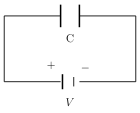
What this figure shows. A capacitor of capacitance connected across a DC source of volts, mid-way through the charging process, with the instantaneous charge on the plates labelled and the instantaneous potential difference across the capacitor labelled (or a lower-case v to distinguish it from the source's own fixed V) -- the set-up used to integrate the small work from zero charge up to the final charge and arrive at …
Worked out. A parallel plate AIR capacitor has F; a dielectric slab of constant and thickness 3 cm completely fills the gap, and the PD is held constant at V throughout. Energy stored WITH the slab (capacitance raised to F): J. Energy that WOULD be stored with just air (no slab), at the SAME constant voltage: J. Change in energy on REMOVING the slab (going from back to ) is J -- i.e. the energy DECREASES by J when the slab is removed (equivalently, energy INCREASES by this amount when the slab is i …