Physics · Ch 8 — Electrostatics
Displacement Current
Displacement Current
Ordinary direct current in a DC circuit is understood as a genuine flow of free electrons through the conducting material. But in the GAP between a capacitor's own plates, there are, by definition, NO free electrons available for conduction in the dielectric occupying that space -- so how can current appear to flow continuously all the way around a circuit that contains such a gap?
As a circuit containing a capacitor is closed, a CONDUCTION current builds up through the conducting leads (identical in magnitude everywhere in those leads, since charge cannot pile up anywhere along a simple wire, but necessarily and strictly zero right inside the capacitor's own gap, where no free charge carriers exist at all). As this conduction current flows through the leads and delivers charge onto the plates, the field E between the plates steadily INCREASES, and this growing field, in turn, progressively POLARISES the dielectric occupying the gap (section 8.8) -- and this steadily changing polarisation is itself, in every physical sense that matters, a genuine current: it involves the continuous, small-scale MOTION of BOUND charges within the dielectric, even though no charge actually crosses the gap as a whole. This current, due entirely to bound-charge motion inside the dielectric, is called the DISPLACEMENT CURRENT (also called the charge-separation current).
The precise relationship between and follows from the charge-on-the-plates formula already derived in section 8.10.2, (with A the plate area and k the dielectric constant). Differentiating both sides with respect to time gives . The left side, , is exactly the conduction current flowing in the leads (the rate at which charge is being delivered to the plates), so : the rate of change of the field between the plates is directly proportional to the conduction current flowing everywhere else in the circuit. The quantity on the right-hand side has the dimensions of an electric current and arises entirely from the displacement of bound charge within the dielectric under the influence of the changing field -- this IS the displacement current, and it is numerically EQUAL, at every instant, to the conduction current flowing in the rest of the circuit, so the two together give the circuit a single, well-defined, unbroken current everywhere: conduction current in the wires, displacement current in the gap. For air or vacuum between the plates (), this simplifies to . …
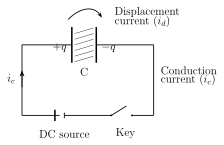
Drawn by us to help you understand the concept clearly, and verified to make sure it's accurate. For exams, practice from your textbook's own diagram.
What this figure shows. A simple circuit consisting of a DC source connected through conducting leads to a parallel plate capacitor with a dielectric between its plates; arrows along the conducting leads are labelled (conduction current, shown flowing continuously through the wires on both sides of the capacitor), while the gap between the plates itself -- where no free charge can physically cross -- is labelled instead with (displacement current), of the SAME magnitude as , visually completing the circuit's current path through the dielectric even though no actual charge …