Physics · Ch 8 — Electrostatics
Electric Potential and Potential Energy
Electric Potential and Potential Energy
Just as a raised mass has gravitational potential energy that depends on its position, a charge has ELECTROSTATIC potential energy that depends on its position relative to other charges -- the stored energy representing the work an external agent must do against the electrostatic (Coulomb) force to bring the charges into a given configuration. Since a system always tends toward its own lowest-energy configuration, work always has to be supplied by an outside agent to move it AWAY from that natural configuration; equivalently, work done AGAINST the electrostatic force always shows up as an INCREASE in the system's potential energy: .
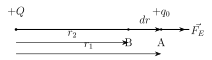
To make this concrete, fix a source charge at the origin O, and consider bringing a small test charge from a point at distance to a point at distance from O, working against the Coulomb repulsion at every step. Integrating the work along this path gives -- and crucially, because the integral only involves the START and END distances , this change in PE is completely independent of whatever PATH was actually taken between them: the electrostatic force is CONSERVATIVE, exactly like gravity.
Since the force -- and hence the PE -- naturally goes to zero as the separation , it is conventional (and always allowed, since only PE DIFFERENCES are ever physically meaningful) to fix the zero of potential energy AT infinity. With that convention, the PE of two point charges a distance apart is simply . Its SI unit is the joule; the more convenient practical unit at the atomic scale is the electron-volt, J (the kinetic energy an electron gains crossing a 1 V potential difference), with J and J as its own sub- and super-multiples. …
Drawn by us to help you understand the concept clearly, and verified to make sure it's accurate. For exams, practice from your textbook's own diagram.
What this figure shows. A fixed positive source charge at the origin O, with a small positive test charge shown at an intermediate point along the line from O, being displaced by a small further step toward (i.e. against the outward-pointing repulsive Coulomb force that exerts on it). An arrow for is drawn pointing away from O (repulsive, outward), while the displacement arrow points the opposite way, toward O -- visually setting up why the work done against this displacement is negative, i.e. the work done ON the system (against the field) to bring closer is positive, exactly the i …
Worked out. Potential at point A is given as V. (i) Work done bringing a charge C from infinity to A is J. (ii) This work does NOT depend on the path taken to reach A, since the electrostatic force is conservative and potential is a function of position alone -- a direct illustration of the path-independence property derived in this sectio …
Worked out. A charge is carried from a point at potential V to another point at unknown potential , doing J of work. Using : , so volt -- a direct rearrangement of the potential-difference = work-per-unit-charge relation to solve for an unknown potential. …