Physics · Ch 8 — Electrostatics
Van de Graaff Generator
Van de Graaff Generator
The VAN DE GRAAFF GENERATOR, designed by Van de Graaff in 1931, is a device engineered to build up extremely high electrostatic potentials -- of the order of volts -- whose resulting very large electric fields are then used to accelerate charged particles (electrons, protons, or heavier ions) to the high energies needed both to probe the fine-scale structure of matter and for a wide range of experiments in Nuclear Physics.
Its operating PRINCIPLE rests on three established physical facts, brought together in one device: (i) the phenomenon of CORONA DISCHARGE -- the concentrated, continuous leakage of charge from sharply pointed conductors into a surrounding gas, exploited here to spray charge deliberately onto a moving belt; (ii) the property (already derived as property 3 of conductors in section 8.7.1) that any charge given to a HOLLOW conductor migrates entirely to, and spreads uniformly over, its OUTER surface, regardless of how much charge is already there; and (iii) the fact that if charge is supplied CONTINUOUSLY to an insulated conductor, its potential simply keeps rising, without any upper limit set by the conductor itself, for as long as fresh charge keeps arriving and the conductor stays properly insulated.
CONSTRUCTION: an endless conveyor BELT, labelled BB and made of an insulating material such as reinforced rubber or silk, runs continuously over two pulleys, (driven by an electric motor, keeping the belt in constant motion) and . Near the lower pulley, a SPRAY BRUSH A -- made of a large number of fine pointed wires, to encourage corona discharge -- is connected to the POSITIVE terminal of a high-voltage DC power supply P, and continuously sprays positive charge onto the moving belt as it passes. This charge is carried upward by the belt's own motion and collected, near the top, by a second, similarly pointed COLLECTOR BRUSH C, which is connected onward to a large, DOME-shaped, HOLLOW metallic conductor D, mounted on tall insulating support pillars. Since D is hollow, every bit of collected charge migrates immediately to D's outer surface (principle (ii) above), and its potential climbs to a very high value purely through this continuous accumulation. An EVACUATED accelerating tube, labelled E, runs down from an electrode I at its upper end -- I itself is directly connected to the dome D, and so rises to the very same high potential as D. Positive ions (typically protons or deuterons), generated from a small source of ionised hydrogen or deuterium gas near the top of tube E, are introduced into the top of this evacuated tube.
To prevent the accumulated charge from leaking away into the surrounding air -- which would defeat the whole purpose -- the dome, the belt-and-pulley assembly, and part of the evacuated tube are all enclosed together inside one large outer STEEL VESSEL, labelled S, filled with nitrogen gas at high pressure (with a small admixture of freon gas added purely to improve the insulating quality of the gas mixture further). An earthed metal plate M is positioned directly opposite spray brush A, on the belt's far side, and is itself connected to the earthed steel vessel S. …
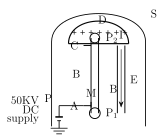
Drawn by us to help you understand the concept clearly, and verified to make sure it's accurate. For exams, practice from your textbook's own diagram.
What this figure shows. A labelled schematic with the following elements exactly as identified in the text: = the two pulleys carrying the endless belt; = the conveyor belt itself, running vertically between the pulleys; = the spray brush (pointed wires) near the bottom pulley, connected to the positive terminal of a DC power supply ; = the collector brush near the top, positioned close to (but not touching) the belt; = the large dome-shaped hollow metallic conductor at the top, mounted on insulating pillars and connected to brush C; = an evacuated accelerating tube running down from an electrode (the ion source region) at the dome's level; the whole dome, belt/pulley assembly and part of tube E are enclosed within a large outer steel vessel filled with nitrogen (plus a little freon) gas; and an earthed metal plate is positioned opposite brush A, on the far side of the belt, wired to the earthed vessel S -- this single figure is the construction diagram t …