Physics · Ch 3 — Kinetic Theory of Gases and Radiation
Diatomic Molecules
Diatomic Molecules
A monatomic gas such as helium consists of single atoms, and a He atom -- being, for these purposes, effectively a point mass -- has only 3 translational degrees of freedom, and no others.
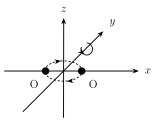
A diatomic molecule such as O or N, with its two atoms lying along (say) the -axis, also has these same 3 translational degrees of freedom for the motion of its centre of mass. But it can, in addition, rotate: about the -axis and about the -axis, both of which pass through the centre of mass perpendicular to the molecular axis (Fig. 3.3). Rotation about the molecule's own axis (the -axis, along the bond) is not counted, because spinning the two point-like atoms about the line joining them produces no change in either atom's position -- there is no meaningful rotational motion to speak of about that axis. So a diatomic molecule, treated as a rigid rotator, has 2 additional rotational degrees of freedom, for a total of 5 (3 translational + 2 rotational).
Drawn by us to help you understand the concept clearly, and verified to make sure it's accurate. For exams, practice from your textbook's own diagram.
What this figure shows. A diatomic molecule (such as O₂) with its two atoms on the x-axis. It can rotate about the z-axis (shown by the dashed loop) and equally about the y-axis — two independent rotational degrees of freedom. Rotation about the x-axis itself is not counted, since …
If and are the moments of inertia about the - and -axes, and , the corresponding angular speeds, the two rotational kinetic energy terms are and . So the total energy of a rigid diatomic molecule is
Each of these five quadratic terms contributes by the law of equipartition, for a total average energy of per molecule.
Vibration in non-rigid molecules. The "rigid rotator" assumption is itself an idealisation. Real diatomic molecules such as O, N and CO contain covalent bonds and can additionally vibrate, with the atoms oscillating about their mean separation along the internuclear axis, behaving like a one-dimensional harmonic oscillator:
…