Physics · Ch 3 — Kinetic Theory of Gases and Radiation
Ferry's Blackbody
Ferry's Blackbody
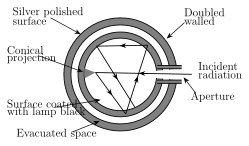
A simple, practical laboratory arrangement for realising a near-perfect blackbody was designed by Ferry. It consists of a double-walled hollow sphere with a tiny hole or aperture through which radiant heat can enter (Fig. 3.4). The space between the two walls is evacuated (to prevent conductive/convective heat loss across the gap), the outer surface of the sphere is silvered (to minimise radiative losses to the surroundings), and the inner surface of the sphere is coated with lamp-black (to maximise absorption of any radiation that gets inside).
Drawn by us to help you understand the concept clearly, and verified to make sure it's accurate. For exams, practice from your textbook's own diagram.
What this figure shows. Ferry's practical realisation of a perfect blackbody: radiation entering the small aperture suffers multiple internal reflections on the lamp-black-coated inner sphere and is almost completely absorbed. The conical projection opposite the aperture ensures no ray is reflected straight back out; the evacuated gap and silvered outer wall stop heat exchange with t …
A small conical projection is built onto the inner surface, positioned directly opposite the aperture. Its purpose is to ensure that a ray travelling straight in along the axis of the aperture does not strike any surface at normal (perpendicular) incidence -- if it did, it would simply reflect straight back out along the same path it came in on, defeating the whole purpose of the design. With the conical projection in place, any incoming ray is deflected off-axis on its first internal reflection, and then undergoes many further reflections around the inside of the sphere, losing a fraction of its energy to absorption at each bounce, so that by the time (if ever) it might find its way back out through the tiny aperture, it has effectively been completely absorbed. In other words, radiation entering through the small hole has a negligible chance of ever escaping back through that same hole -- the aperture itself therefore behaves like a perfect blackbody, even though the material of the sphere is not literally black. …