Physics · Ch 11 — Magnetic Materials
Diamagnetism
Diamagnetism
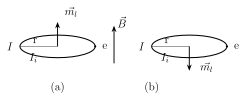
A diamagnetic material is one whose atoms/molecules already have a zero net magnetic dipole moment (every electron orbit is paired, as described in section 11.3.1) even before any field is applied. When such a material is placed in an EXTERNAL magnetic field, the changing flux through each paired electron orbit induces an additional circulating current, by Lenz's law, in a sense that OPPOSES the applied field. Because the two orbits of a pair are affected slightly unequally by this induction (Fig. 11.5) -- one loop's induced current adds to its own orbital current (increasing that orbit's moment), while the other loop's induced current subtracts from its own orbital current (decreasing that orbit's moment) -- the pair no longer cancels exactly, and the atom is left with a small net induced magnetic moment pointing OPPOSITE to the applied field.
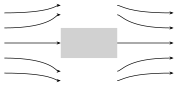
Because this induced moment always opposes the field (regardless of the field's direction), diamagnetic materials are always REPELLED by a magnet -- the opposite of how ordinary magnets attract magnetic material -- and, in a non-uniform field, they always move from the stronger part of the field toward the weaker part (Fig. 11.6 shows the field lines being partially excluded from the material's interior as a result). If a diamagnetic liquid is placed in one arm of a U-tube with a magnet brought near that arm, the liquid is pushed OUT of that arm, into the field-free arm. A diamagnetic rod, if suspended freely in a magnetic field, aligns itself PERPENDICULAR to the field, because that is the orientation of least magnetic potential energy for an induced dipole that always points opposite to the local field (recall from section 11.2 that a dipole antiparallel to the field has the highest, most unstable potential energy, so the rod avoids that alignment by turning until it is at instead, where the induced moment's energy is minimized given its opposing sense). …
Drawn by us to help you understand the concept clearly, and verified to make sure it's accurate. For exams, practice from your textbook's own diagram.
What this figure shows. Two paired electron current loops belonging to the same atom, of otherwise equal and opposite circulating current, are shown as they are brought into an external magnetic field. In part (a), the loop whose induced current opposes its own original loop current is shown with the induced current subtracting from the loop current, reducing that loop's net current and hence its magnetic dipole moment. In part (b), the other loop of the pair, whose induced current happens to reinforce its own loop current, is shown with the induced current adding to the loop current, increasing that loop's magnetic dipole moment. Since the two loops of the pair are affected unequally in opposite senses, the pair's net induced moment does not cancel but points opposite to the applied external field, which is th …
Drawn by us to help you understand the concept clearly, and verified to make sure it's accurate. For exams, practice from your textbook's own diagram.
What this figure shows. A block of diamagnetic material is placed inside a region of uniform external magnetic field lines drawn as parallel lines running left to right. The field lines are shown bending and thinning out as they pass through the material's interior compared with outside it, illustrating that the induced magnetic field inside a diamagnetic substance is opposite to the applied field and so partially repels/excludes the external field lines, reducing the net field magnitude found inside the material relative to th …
Worked out. A small glass test tube with a cork, partially filled with water, is fixed onto a piece of wood (acting as a float) so the whole assembly floats in a tray or bath of water. A pole of a bar magnet is brought close to the floating, water-filled test tube, and the resulting motion is observed and recorded; the experiment is then repeated with the test tube empty of water, for comparison. Since water is diamagnetic, the filled tube should be gently repelled/pushed away from the magnet's pole (moving toward the weaker-field region), a subtle effect that becomes noticeable only because the float removes ordinary friction -- while the empty tube (with only the diamagnetic glass and wood, whose diamagnetism is even weaker per unit volume) shows a much smaller or n …
Worked out. A superconductor is the extreme, idealised case of diamagnetism: its susceptibility is exactly , so from its permeability is exactly zero, meaning literally no magnetic field lines can pass through it at all -- an external field placed near a superconductor is completely expelled from its interior. This complete, perfect diamagnetism found only in superconductors is called the Meissner effect, and it is qualitatively different from an ordinary electrical conductor (a good but non-superconducting metal) placed in a magnetic field, where the applied field does penetrate some distance into the s …