Physics · Ch 11 — Magnetic Materials
Paramagnetism
Paramagnetism
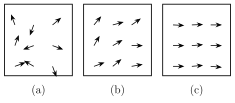
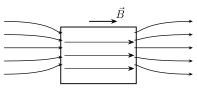
A paramagnetic material is one whose atoms/molecules DO carry a nonzero net magnetic dipole moment individually (an unpaired-electron atom, as in section 11.3.1), but, in the absence of an external field, thermal agitation keeps these moments randomly oriented, so their vector sum -- the material's net magnetization -- is zero (Fig. 11.7(a)). When a sufficiently strong external field is applied, especially at low temperature (which reduces the randomising effect of thermal motion), a growing fraction of the atomic moments align themselves along the field direction (the orientation of lower potential energy), producing a net magnetization; Fig. 11.7(b) and (c) show this progression from a weak to a strong applied field, and Fig. 11.8 shows the resulting concentration of field lines drawn into the material.
Because an aligned paramagnetic material reinforces rather than opposes the applied field, paramagnetic materials are ATTRACTED toward the stronger part of a non-uniform field -- the opposite of diamagnetic behaviour. If a paramagnetic liquid is placed in a U-tube manometer with a magnet near one arm, the liquid RISES into that arm (again, the opposite of the diamagnetic case). Metals such as magnesium, lithium, molybdenum and tantalum, and compounds such as MnSOHO and oxygen gas, are examples of paramagnetic materials. When the external field is removed, thermal agitation once again randomises the moment directions and the net magnetization returns to zero -- unlike ferromagnetism (section 11.5.3), paramagnetism leaves no memory of the applied field. …
Drawn by us to help you understand the concept clearly, and verified to make sure it's accurate. For exams, practice from your textbook's own diagram.
What this figure shows. Three panels show a collection of atomic magnetic dipole arrows (each representing one atom/molecule's net moment) within a paramagnetic sample. In panel (a), with no external field applied, the arrows point in completely random directions, so their vector sum -- and hence the material's net magnetization -- is zero. In panel (b), with a weak external field applied (direction indicated), the arrows are shown mostly still random but with a slight statistical bias toward the field direction, giving a small nonzero net magnetization. In panel (c), with a strong external field (and, implicitly, at correspondingly low temperature to limit thermal randomisation), most of the arrows are shown aligned along the field direction, giving a much larger net magnetization …
Drawn by us to help you understand the concept clearly, and verified to make sure it's accurate. For exams, practice from your textbook's own diagram.
What this figure shows. A block of paramagnetic material is placed in a region of external magnetic field lines drawn as parallel lines. Inside the material, the field lines are drawn crowding closer together than they are outside it, showing that the field lines are pulled inward and concentrated by the paramagnetic material's own aligned moments reinforcing the applied field, in direct visual contrast to Fig. 11.6's diamagnetic case, where the field lines were instead thinned out and pushed apart ins …