Physics · Ch 11 — Magnetic Materials
Ferromagnetism
Ferromagnetism
A ferromagnetic material's atoms/molecules, like a paramagnetic material's, individually possess nonzero magnetic moments; the crucial difference is a strong quantum-mechanical coupling between NEIGHBOURING atomic moments, called exchange coupling or exchange interaction, which is much stronger (by roughly an order of magnitude) than an ordinary dipole-dipole interaction between two atomic magnets. This exchange coupling locks the moments of all the atoms within a small region into a single, common direction; such a region is called a domain, and its common moment direction is called the domain axis. A domain is typically a fraction of a millimetre across ( to m) and contains anywhere from to atoms (Example 11.3 works out these numbers for a specific case); the boundary separating two adjacent domains with different axis directions is called a domain wall. Iron, cobalt, nickel, and certain rare-earth and transition-metal alloys show this strong ferromagnetic behaviour.
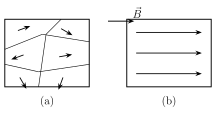
In the material's UNMAGNETISED state, although every individual domain has a large, nonzero moment along its own axis, the different domains' axes are oriented essentially randomly relative to each other (Fig. 11.9(a)), so the vector sum over the whole material -- its net magnetic moment -- comes out to zero. When an external field is applied, domains whose axis already lies close to the field direction grow at the expense of their neighbours, and other domains rotate (a process called flipping or domain rotation) to align with the field; as the field is increased further, more and more domains join this alignment, until at a sufficiently high field essentially all the domains have coalesced into one single, giant aligned domain (Fig. 11.9(b)) -- the saturation state. …
Drawn by us to help you understand the concept clearly, and verified to make sure it's accurate. For exams, practice from your textbook's own diagram.
What this figure shows. Two panels show the same block of ferromagnetic material subdivided into several small domains, each drawn with its own internal arrow indicating that domain's common magnetic-moment direction (the domain axis). In panel (a), the unmagnetised state, the domain arrows point in a variety of different, unrelated directions across the block, so the vector sum of all domain moments -- the material's net moment -- is zero, even though every individual domain arrow shown is itself nonzero. In panel (b), the magnetised state (after a sufficiently strong external field has been applied and then, implicitly, the domains have coalesced), nearly all the arrows point in the same single direction, representing the domains having grown/rotated/merged into one large alig …
Worked out. A cubic ferromagnetic-iron domain of side (volume m cm) is considered, given iron's molecular mass 55 g/mol, density 7.9 g/cm, and each iron atom's dipole moment A m. The domain's mass is g, so the number of atoms in it (using Avogadro's number per 55 g) is atoms. If every atomic moment were perfectly aligned (the idealised maximum, not realised in practice), the maximum possible dipole moment is A m, giving a magnetization A m -- an estimate of the enormous magnetization scale possible wi …
Worked out. The exchange interaction, responsible for locking all the atomic dipole moments within a single ferromagnetic domain into alignment with each other, is stronger than an ordinary dipole-dipole interaction between two atomic magnets by roughly an order of magnitude -- it is this unusually strong coupling (a genuinely quantum-mechanical effect, arising from the overlap of electron wavefunctions and the Pauli exclusion principle, rather than a classical magnetic force) that makes domains form and persist at all, and distinguishes ferromagne …