Physics · Ch 11 — Magnetic Materials
Effect of Temperature
Effect of Temperature
Ferromagnetism is fundamentally a temperature-dependent phenomenon, because it rests entirely on the exchange coupling between neighbouring atomic moments described in section 11.5.3, and that coupling itself weakens as temperature rises. As a ferromagnetic material is heated, this weakening exchange coupling progressively distorts the domain structure -- domains that were sharply aligned along a single axis become less perfectly ordered -- until, at a material-specific temperature, the domain structure collapses ENTIRELY, and the material's magnetic behaviour turns paramagnetic. This transition temperature is called the Curie temperature, , of the material.
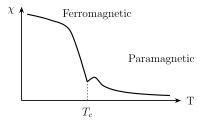
Above the Curie temperature (), the material's susceptibility follows the Curie-Weiss law, , a direct extension of the ordinary paramagnetic Curie's law () with the temperature T replaced by , so that formally diverges as T approaches from above (Fig. 11.10) and falls off with further heating beyond that, exactly as an ordinary paramagnetic material's susceptibility does with temperature. …
Drawn by us to help you understand the concept clearly, and verified to make sure it's accurate. For exams, practice from your textbook's own diagram.
What this figure shows. A graph plots the susceptibility (or its inverse) of a ferromagnetic material against absolute temperature T. For the material behaves ferromagnetically (the domain structure is intact); at , marked on the temperature axis, a sharp change/divergence in the curve's behaviour is shown; for the curve follows the Curie-Weiss law , decreasing as T increases further beyond , visually showing the transition from ferromagnetic to ordinary paramagnetic behaviour occurring precisely a …
Material | (K)
Metallic cobalt | 1394
Metallic iron | 1043
FeO | 893
Metallic nickel | 631
Metallic gadolinium | 317
These values, all well above room temperature except gadolinium's (317 K, just above 300 K), show why iron, cobalt and nickel remain solidly ferromagnetic under everyday conditions, while gadolinium's Curie point lying so close to room temperature makes its magnetic behaviour notic …