Physics · Ch 2 — Mechanical Properties of Fluids
Capillary Action
Capillary Action
A tube with a very fine bore (of order about 1 mm) and open at both ends is called a capillary tube. If one end of a capillary tube is dipped into a liquid that wets the tube's surface, partially or completely (such as water in glass), the level of that liquid inside the capillary is observed to rise above the level of the liquid outside; conversely, if the capillary is dipped into a liquid that does not wet its surface (such as mercury in glass), the level inside the capillary falls below the level outside. This phenomenon — the rise or fall of a liquid inside a fine tube dipped into it — is called capillarity. Capillarity is at work in many everyday situations: oil rising up the wick of a lamp, a cloth rag sucking up water, water rising through fine crevices in rock, sap and water rising all the way up to the topmost leaves of a tall tree, and blotting paper absorbing ink.
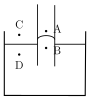
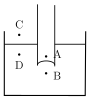
a) Capillary fall. Consider a capillary tube dipped into a liquid that does not wet its surface — mercury, for example — so its meniscus inside the tube is upper-convex. Mark four points: A, just above the convex meniscus, inside the capillary; B, just below that meniscus, also inside the capillary; C, just above the plane mercury surface outside the capillary, at the same horizontal level as A; and D, just below that outer plane surface, at the same horizontal level as B. Since the points A and C are both at the same level and both exposed to the atmosphere, (--- 2.25); and between C and D the surface outside the capillary is plane, so (--- 2.26). But because the pressure is always greater on the concave side of any curved surface than on the convex side (section 2.4.5), and the meniscus here is convex as seen from inside the capillary, — hence . Yet B and D sit at exactly the same horizontal level. For the pressure to be equal at the same level (as equilibrium demands), mercury must rush out of the capillary tube until its internal level drops enough to bring back down to match — this is exactly the mechanism behind the observed drop in mercury's level inside a capillary tube.
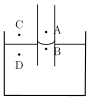
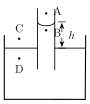
b) Capillary rise. By the mirror-image version of exactly this same argument — but now for a liquid such as water, whose meniscus inside the capillary is concave rather than convex — the pressure just below the meniscus inside the tube works out lower than the pressure at the same level outside, and liquid is correspondingly drawn up into the capillary from outside until equilibrium is restored — producing the observed rise of water's level inside a capillary tube.
Expression for capillary rise or fall.
Method I (using pressure difference). Let r be the radius of the capillary tube and θ the angle of contact of the liquid with the tube. The radius of curvature R of the meniscus is related to r and θ by . The pressure difference across the curved meniscus, , must equal the hydrostatic pressure of the liquid column that has risen (or fallen) by height h:
This gives the expression for capillary rise (or fall) of a liquid: the narrower the tube, the greater the height to which the liquid rises (or falls). If the tube is held in a liquid whose meniscus is convex, the angle of contact θ is obtuse, so is negative, and hence h itself comes out negative — meaning the liquid actually suffers a capillary fall (depression) rather than a rise, exactly matching the mercury-in-glass case worked through above.
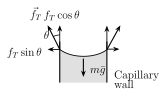
Method II (using forces directly). Water rising up a capillary rises against gravity, so the weight of the risen liquid column must be exactly balanced by the vertical component of the surface-tension force acting at the point of contact. The length of liquid actually in contact with the tube wall, around its inner circumference, is ; so the total force due to surface tension is , acting along the tangent to the meniscus at the wall. Its vertical component is:
…
Drawn by us to help you understand the concept clearly, and verified to make sure it's accurate. For exams, practice from your textbook's own diagram.
What this figure shows. Two-part figure: (a) a capillary tube just immersed in a dish of mercury, its cross-section drawn with four labelled points — A just above the (upper-convex) mercury meniscus inside the tube, B just below that meniscus inside the tube, C just above the plane mercury surface outside the tube in the dish (at the same horizontal level as A), and D just below that plane surface outside the tube (at the same horizontal level as B) — used to show that, because the meniscus is convex, pB works out greater than pD even though B and D sit at the same horizontal level, a situation inconsistent with equilibrium unless mercury flows out of the tube; (b) the same capillary tube shown after mercury has consequently dropped to a lower level inside the tube than in the dish outside, its convex …
Drawn by us to help you understand the concept clearly, and verified to make sure it's accurate. For exams, practice from your textbook's own diagram.
What this figure shows. The equilibrium state after immersion in mercury: because the pressure just below the convex meniscus (B) exceeded the pressure at the same level outside (D), mercury is pushed OUT of the capillary until the extra column outside balances the excess — the level inside the tu …
Drawn by us to help you understand the concept clearly, and verified to make sure it's accurate. For exams, practice from your textbook's own diagram.
What this figure shows. Two-part companion figure to Fig. 2.23, but for a wetting liquid: (a) a capillary tube just immersed in a dish of water, drawn at the very first instant of contact, before any rise has yet occurred, with the water level inside the tube still roughly level with the free surface outside; (b) the same tube shown after water has risen inside it to its final equilibrium height, its concave meniscus now sitting visibly above the flat free surface of the water in the dish outside — the mirror-image outcome to mercury's capillary fall in Fig. 2.23, a …
Drawn by us to help you understand the concept clearly, and verified to make sure it's accurate. For exams, practice from your textbook's own diagram.
What this figure shows. The equilibrium state in water: the pressure just below the concave meniscus (B) was LESS than at the same level outside (D), so water is pushed INTO the capillary and rises through height h until the weight of the raised column balances the pressure dif …

Drawn by us to help you understand the concept clearly, and verified to make sure it's accurate. For exams, practice from your textbook's own diagram.
What this figure shows. Two-part figure showing the two independent methods used to derive : (a) forces at the point of contact — a capillary tube of radius r is shown with the liquid's meniscus meeting the tube wall at the angle of contact θ, and the meniscus's radius of curvature R related to the tube radius by ; used in Method I, which equates the pressure difference across the curved meniscus, , to the hydrostatic pressure of the risen column, giving ; (b) forces on the risen liquid column — the surface-tension force (surface tension times the circumference of contact) is shown acting along the tangent to the meniscus at the tube wall, with its vertical component supporting the weight of the risen column of liquid directly below it; used in Method II, which equates this vertical force component to the column's we …
Drawn by us to help you understand the concept clearly, and verified to make sure it's accurate. For exams, practice from your textbook's own diagram.
What this figure shows. The force bookkeeping for the risen column: at each contact point the surface tension f_T acts along the tangent at angle θ to the wall; its vertical component f_T cos θ (around the full circumference 2πr) supports the weight mg = πr²hρg of the lifted liquid, while the horizontal components …