Physics · Ch 2 — Mechanical Properties of Fluids
Terminal Velocity
Terminal Velocity
Consider a spherical object falling under gravity through a viscous fluid. Three separate forces act on it during this downward fall: (1) the viscous force , directed upward, whose magnitude keeps increasing as the object's downward velocity increases; (2) the gravitational force, or weight, , directed downward, and constant throughout; and (3) the buoyant force, or upthrust, , directed upward, and also constant throughout.
The net downward force is , and it is this net force that is responsible for the object's initial increase in speed as it starts falling. Since and stay fixed while keeps growing as the speed builds up, a stage is eventually reached at which the net force f becomes exactly zero, i.e. . From that point onward, the object's downward velocity remains constant — this constant downward velocity is called the terminal velocity, and, since the speed no longer changes beyond this point, the viscous force itself also stays constant from here on. (This entire discussion necessarily applies only to a streamline flow around the falling object.)
Let the falling sphere have radius r, mass m and density ρ, and let the surrounding medium have density σ and coefficient of viscosity η. Once the sphere has reached its terminal velocity, the total downward force on it exactly balances the total upward force:
This is the expression for the terminal velocity of the falling sphere. From Eq. (2.37), the same relation can equally be rearranged to give the coefficient of viscosity of the medium:
— a form especially useful for measuring a fluid's coefficient of viscosity experimentally, simply by dropping a sphere of known radius and density into it and timing its terminal (constant) fall speed. …
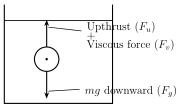
Drawn by us to help you understand the concept clearly, and verified to make sure it's accurate. For exams, practice from your textbook's own diagram.
What this figure shows. A sphere of radius r, mass m and density ρ is shown falling through a surrounding fluid medium of density σ and coefficient of viscosity η, with three labelled force arrows: the weight pointing straight down, and both the viscous drag force and the buoyant force (upthrust) pointing straight up — together forming the three-force balance, , that holds once the sphere reaches its terminal (consta …