Q.Semi-vertical angle of the conical section of a funnel is 37°. There is a small ball kept inside the funnel. On rotating the funnel, the maximum speed that the ball can have in order to remain in the funnel is 2 m/s. Calculate inner radius of the brim of the funnel. Is there any limit upon the frequency of rotation? How much is it? Is it lower or upper limit? Give a logical reasoning. (Use g = 10 m/s² and sin 37° = 0.6)
You're viewing a preview — the full solution, concept, methods & PYQ mapping are locked.
Start your 14-day free trial to unlock the full solution →Resolving N for a ball on the funnel wall gives ; as , with frequency INCREASING, so only a lower limit on n exists — reached at the brim.
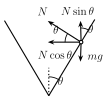
A conical funnel of semi-vertical angle holds a small ball that can rotate along the inside surface of the funnel; the MAXIMUM speed the ball can have while still remaining inside the funnel is given as 2 m/s (use g = 10 m/s^2, ). Since a rotating ball inside a funnel behaves exactly like a conical pendulum with the normal reaction N playing the role of the string tension, gives the inner radius r at the brim (where the maximum speed is reached) as m. The example's discussion then notes that as the ball approaches the (narrower) base of the funnel its linear speed decreases but its angular speed/frequenc …
Unlock everything free for 14 days
- Full step-by-step solutions
- Concept-first explanations
- Methods, shortcuts & mistakes
- PYQ mapping + timed mock tests
Full access for 14 days. No credit card required.