Q.A merry-go-round usually consists of a central vertical pillar. At the top of it there are horizontal rods which can rotate about vertical axis. At the end of this horizontal rod there is a vertical rod fitted like an elbow joint. At the lower end of each vertical rod, there is a horse on which the rider can sit. As the merry-go-round is set into rotation, these vertical rods move away from the axle by making some angle with the vertical. The figure shows vertical section of a merry-go-round in which the 'initially vertical' rods are inclined with the vertical at θ = 37°, during rotation. Calculate the frequency of revolution of the merry-go-round. (Use g = π² m/s² and sin 37° = 0.6)
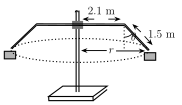
The rider's circle has radius m; resolving the rod tension like a conical-pendulum string gives .
A merry-go-round has a horizontal rod of length H = 2.1 m from the central axle to an elbow joint, from which a vertical rod of length V = 1.5 m hangs down to a horse; during rotation these 'initially vertical' rods swing out to make angle with the vertical (use m/s^2 and ). The effective radius of the rider's circular path is m. Treating the inclined rod exactly like a conical-pendulum string (tension T along the rod, , ), dividing the two equations gives , which rearranges to the frequency , evaluating to 1/2 rev/s.
Ex.1.4: Frequency of a merry-go-round from the angle its rods incline at.
m and rev s⁻¹ ( rev/s), using m/s².
Unlock everything free for 14 days
- Full step-by-step solutions
- Concept-first explanations
- Methods, shortcuts & mistakes
- PYQ mapping + timed mock tests
Full access for 14 days. No credit card required.