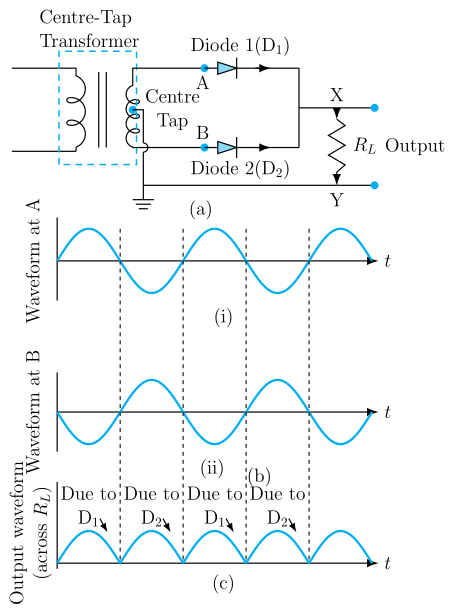
Q.Draw a neat diagram of a full wave rectifier and explain it's working.
Circuit diagram: the transformer's secondary winding has three connection points -- end A, end B, and a CENTRE-TAP P exactly midway between them (Fig. 16.4). The anode of diode connects to end A, and the anode of diode connects to end B; the cathodes of both diodes are joined together at a common node Q, from which the load resistor is connected back down to the centre-tap P, completing the circuit. Working: during the POSITIVE half cycle of the input (A at higher potential than P), is forward biased and conducts, sending current along the path A-P...--Q (through ); during the NEGATIVE half cycle (B at higher potential than P), is forward biased instead and conducts, sending current along the path B-P...--Q (through ). In BOTH cases, the current flows through in the SAME direction -- because the two diodes are wired so that whichever one is conducting always feeds the load the same way -- so unlike the half wave rectifier, no half-cycle of the input is wasted; every half cycle, positive or negative, produces one output pulse. The result is a continuous, unbroken train of output pulses across (Fig. 16.5, bottom trace), with no zero-output gaps at all between consecutive pulses. Since two pulses (one from , one from ) are produced per full input cycle, the output/ripple frequency of a full wave rectifier is DOUBLE the input frequency (100 Hz for a 50 Hz mains input, per Example 16.1), and its theoretical maximum efficiency (81.2%) is exactly twice that of a half wave rectifier (40.6%). [!ANSWER] Circuit: centre-tapped secondary AB (centre-tap P), diode from A and diode from B, both feeding (returned to P). conducts on the positive half cycle, on the negative half cycle, both driving current through in the same direction -- giving an unbroken train of output pulses.
Unlock everything free for 14 days
- Full step-by-step solutions
- Concept-first explanations
- Methods, shortcuts & mistakes
- PYQ mapping + timed mock tests
Full access for 14 days. No credit card required.