Q.Which property of light does not change when it travels from one medium to another?
(A) velocity
(B) wavelength
(C) amplitude
(D) frequency
Concept understanding — Refraction of Light Using Huygens' Principle
The identical Huygens' construction, but now applied across a boundary between two media of different wave speeds v1 (medium 1) and v2 (medium 2): the secondary wavelet from the first point to cross the boundary grows at the NEW speed v2 while the rest of the wavefront is still travelling at v1, and the resulting refracted wavefront's geometry gives sini/sinr=v1/v2=n2/n1 -- Snell's law, derived from wave geometry rather than assumed. Since light genuinely travels slower in a denser medium, a wave bends TOWARDS the normal entering a denser medium (and away from it leaving one) -- correctly matching experiment, unlike the corpuscular theory's wrong prediction.
A companion result follows for WAVELENGTH: since frequency stays exactly constant across the boundary (a genuinely fundamental, unchanging property of the wave) while speed changes, wavelength must change too, in direct proportion to speed: λ2=λ1(v2/v1)=λ1(n1/n2), i.e. wavelength shrinks in a denser medium (and λ=λ0/n relative to vacuum).
[!TLDR] Frequency is the one wave property that stays exactly fixed as light crosses from one medium to another -- speed and wavelength both change (inversely with the medium's refractive index), and amplitude is unrelated to which medium the light is in. [!ANSWER] (D) frequency
As derived in Section 7.6, when light crosses a boundary between two media, its speed changes (from v1 to v2, governed by the two refractive indices) and its wavelength changes correspondingly (λ2=λ1v2/v1), since both are tied to the medium's own optical properties. But taking the ratio of frequencies in the two media, ν1/ν2=(v1/λ1)/(v2/λ2), this ratio comes out to exactly 1 -- frequency is unchanged. Physically, this must be true: the number of wave crests arriving at the boundary from medium 1 per second must exactly equal the number of crests leaving into medium 2 per second (crests cannot pile up or vanish at the boundary), and that crossing rate is exactly the frequency, so it cannot change. Velocity clearly changes (that IS refraction). Wavelength changes (shown directly above). Amplitude is a separate physical quantity altogether, generally reduced somewhat by partial reflection at the boundary, and was never claimed to be constant across a medium change in the first place -- so by elimination and by the direct derivation, frequency is the answer. [!ANSWER] (D) frequency
Recall that the number of wave crests crossing any point per second (the frequency) must stay the same on both sides of a boundary, since crests can neither be created nor destroyed there -- unlike speed and wavelength, which both change according to the medium's refractive index.
Confusing wavelength with frequency and assuming both must behave the same way (both change, or both stay fixed) -- in fact it is specifically wavelength (and speed) that change together while frequency alone stays fixed.
- CBSE 2026Set ANNUAL2 marksQ.Derive Snell's law for refraction of light from Huygen's wave theory.
›Reveal solutionSolution
Applying Huygens' principle at a refracting surface and using simple triangle geometry directly yields sin(i)/sin(r) = v1/v2, i.e. Snell's law.
Let XY be a plane interface separating medium 1 (wave speed v1) from medium 2 (wave speed v2). Let a plane wavefront AB be incident on XY, touching it first at A, with angle of incidence i (the angle between the incident wavefront's normal, i.e. the ray, and the normal to XY).
Let the wavefront take time t to travel from B to a point C on the surface, so BC = v1 t.
During this same time t, the secondary wavelet from A (now already in medium 2) spreads out with radius AD = v2 t.
The new refracted wavefront is the common tangent CD to these secondary wavelets, making angle of refraction r with the normal to XY.
In right triangle ABC (right angle at B): sin(i) = BC / AC = v1 t / AC
In right triangle ADC (right angle at D): sin(r) = AD / AC = v2 t / AC
Dividing:
sin(i) / sin(r) = v1 / v2
Since absolute refractive index n = c/v, we have v1 = c/n1 and v2 = c/n2, so v1/v2 = n2/n1. Substituting:
sin(i)/sin(r) = n2/n1
n1 sin(i) = n2 sin(r)
which is Snell's law of refraction.
✓Final answern1 sin(i) = n2 sin(r), derived from sin(i)/sin(r) = v1/v2 using Huygens' wavelet construction at the interface.
- CBSE 2025Set ANNUAL2 marksQ.Explain the laws of refraction of light using Huygen's principle.
›Reveal solutionSolution
By constructing the secondary wavelets from a plane wavefront as it crosses a boundary into a medium of different speed, simple triangle geometry reproduces Snell's law of refraction.
Consider a plane wavefront AB incident on a plane interface XY separating medium 1 (wave speed v1) from medium 2 (wave speed v2), with angle of incidence i. By Huygens' principle, every point on the wavefront acts as a source of secondary wavelets.
Let the time taken for the wavelet from B to reach the interface at C be t: BC=v1t. During the same time t, the wavelet from A (which reached the interface first) spreads into medium 2 with radius AD=v2t. The new wavefront in medium 2 is the tangent CD from this secondary wavelet.
From the geometry, in right triangle ABC: sini=ACBC=ACv1t
In right triangle ADC: sinr=ACAD=ACv2t
Dividing:
sinrsini=v2v1
Since refractive index n=c/v, this ratio v1/v2=n2/n1, giving:
n1sini=n2sinr — Snell's law.
(Also, since A, D, C, B all lie in the same plane, the incident ray, refracted ray, and normal are shown to lie in one plane — the first law of refraction.)
✓Final answerHuygens' construction gives sinrsini=v2v1=n1n2, i.e. n1sini=n2sinr — Snell's law of refraction.
- CBSE 2024Set ANNUAL2 marksQ.Derive Snell's law for refraction of light by Huygen's wave theory.
›Reveal solutionSolution
By constructing the refracted wavefront geometrically from Huygens' principle and comparing the two right triangles formed at the interface, the ratio sin i / sin r reduces to a constant, giving Snell's law.
Consider a plane wavefront AB incident on a plane refracting surface XY (separating medium 1, speed v1, from medium 2, speed v2), making angle of incidence i with the normal.
By Huygens' principle, every point on the wavefront AB acts as a source of secondary wavelets. Let the wavefront take time t to travel from B to C in medium 1 (so BC = v1·t), while the secondary wavelet from A spreads into medium 2, covering a distance AD = v2·t in the same time t. The new refracted wavefront is the tangent CD to this secondary wavelet, making angle of refraction r with the surface.
From right triangle ABC: sini=ACBC=ACv1t
From right triangle ADC: sinr=ACAD=ACv2t
Dividing:
sinrsini=v2v1
Since v1 and v2 are constants for the two given media, this ratio is a constant, denoted n21 (refractive index of medium 2 with respect to medium 1):
sinrsini=n21=constant
This is Snell's law of refraction, derived purely from the wave picture of light.
✓Final answersin i / sin r = v₁/v₂ = n₂₁ = constant — Snell's law, derived from Huygens' wavefront construction at the interface.
- CBSE 2024Set ANNUAL2 marksQ.Using Huygen's principle, derive the laws of refraction for a plane wave propagating from a rarer to denser medium. Draw the necessary ray diagram.
›Reveal solutionSolution
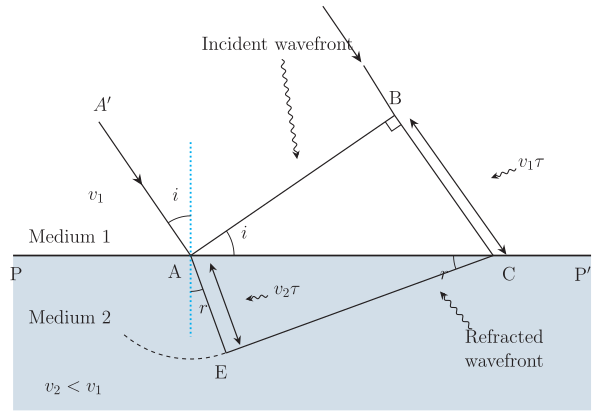
Figure — The stem asks to draw the ray diagram for Huygens refraction from rarer to denser medium; the NCERT figure wit Comparing wavefronts of an incident and refracted plane wave via Huygens' construction gives sini/sinr=v1/v2, a constant — the law of refraction.
Let a plane wavefront AB be incident on a plane interface XY separating a rarer medium (speed v1) from a denser medium (speed v2<v1), the wavefront making angle of incidence i with the interface's normal. By Huygens' principle, every point on a wavefront is a source of secondary wavelets; the new wavefront is the common tangent (envelope) to these wavelets.
Let the time taken for the disturbance from B (on the interface) to reach C (on the interface, at the far end of the incident wavefront's footprint) be τ, so BC=v1τ. In the same time τ, the secondary wavelet from A (which reaches the interface first) spreads out into the denser medium with radius AD=v2τ. The refracted wavefront is the tangent CD drawn from C to this wavelet.
From the geometry, in triangle ABC: sini=ACBC=ACv1τ.
In triangle ACD: sinr=ACAD=ACv2τ.
Dividing:
sinrsini=v2v1
Since v1 and v2 are constants for a given pair of media, this ratio is a constant, 1n2 — this is Snell's law: sinrsini=1n2=constant. Also, since i (in the incident medium) and r (refracted ray) lie in the plane of incidence, along with the normal, this proves the incident ray, refracted ray and normal are coplanar (the second law of refraction). Since the wave is going from a rarer to a denser medium (v1>v2), r<i — the ray bends towards the normal.
(Ray diagram: draw interface XY horizontal; incident wavefront AB tilted at angle i to XY with A touching XY; normal at A drawn vertical; refracted wavefront CD tilted at angle r to XY on the other side, with the arc of radius v2τ centred at A tangent to CD.)
✓Final answersinrsini=v2v1=1n2=constant — Snell's law of refraction, derived from Huygens' wavefront construction.
- CBSE 2020Set 55/1/12 marksQ.Define wavefront of a travelling wave. Using Huygens principle, obtain the law of refraction at a plane interface when light passes from a denser to rarer medium.(OR)Using lens maker's formula, derive the thin lens formula v1−u1=f1 for a biconvex lens.
›Reveal solutionSolution
Part (a): A wavefront is a surface of constant phase; Huygens' construction gives Snell's law sinrsini=v2v1=n1n2, with the ray bending away from the normal on going from a denser to a rarer medium.
Part (b): Applying the refraction-at-a-surface relation at both faces of a thin biconvex lens and adding yields the thin-lens formula v1−u1=f1, with f1=(μ−1)(R11−R21).
Part (a)
Wavefront. A wavefront is the continuous surface joining all points of a wave that vibrate in the same phase (e.g. spherical wavefronts near a point source, plane wavefronts far away). The direction of propagation (ray) is always normal to the wavefront. By Huygens' principle, each point of a wavefront is a source of secondary spherical wavelets, and the envelope of these wavelets after time t is the new wavefront.
Law of refraction (denser → rarer).
- A plane wavefront AB in the denser medium (speed v1) is incident on the plane interface XY at angle of incidence i. Point A touches the surface first while B is still a distance away.
- Let t be the time for B to travel to the interface at B′: BB′=v1t. During this time the secondary wavelet from A advances into the rarer medium (speed v2>v1) to radius v2t.
- The refracted wavefront is the tangent from B′ to the sphere of radius v2t about A, meeting it at C with AC=v2t; it makes angle of refraction r.
- In right triangles ABB′ and AB′C sharing hypotenuse AB′:
sini=AB′BB′=AB′v1t,sinr=AB′AC=AB′v2t.
- Dividing:
sinrsini=v2v1.
Using n=c/v, v2v1=n1n2, so
sinrsini=n1n2=constant (Snell’s law).
Because n1>n2 here, sini/sinr<1, i.e. r>i: the ray bends away from the normal, consistent with the faster speed in the rarer medium.
✓Final answersinrsini=v2v1=n1n2; passing from a denser to a rarer medium the refracted ray bends away from the normal.
Part (b)
For a thin biconvex lens of material index μ (in air) with surface radii R1 and R2, apply the single-surface refraction formula vn2−un1=Rn2−n1 at each face.
- First surface (air → glass, radius R1): an object at u forms an intermediate image at v1:
v1μ−u1=R1μ−1.
- Second surface (glass → air, radius R2): the intermediate image acts as object (distance v1) to give the final image at v:
v1−v1μ=R21−μ=−R2μ−1.
- Add the two equations (the μ/v1 terms cancel):
v1−u1=(μ−1)(R11−R21).
- For an object at infinity the image forms at the focus (v=f, u→∞), so the right-hand side equals 1/f — this is the lens maker's formula:
f1=(μ−1)(R11−R21).
Substituting back gives the thin-lens formula:
v1−u1=f1.
✓Final answerv1−u1=(μ−1)(R11−R21)=f1.
🎓Unlock everything free for 14 days
- ✓Full step-by-step solutions
- ✓Concept-first explanations
- ✓Methods, shortcuts & mistakes
- ✓PYQ mapping + timed mock tests
Full access for 14 days. No credit card required.