Q.Explain refraction of light on the basis of wave theory. Hence prove the laws of refraction. Two coherent sources of light having intensity ratio 81 : 1 produce interference fringes. Calculate the ratio of intensities at the maxima and minima in the interference pattern. OR State Brewster's law and show that when light is incident at polarizing angle the reflected and refracted rays are mutually perpendicular to each other. Monochromatic light of wavelength 4300 Å falls on a slit of width 'a'. For what value of 'a' the first maximum falls at 30°?
You're viewing a preview — the full solution, concept, methods & PYQ mapping are locked.
Start your 14-day free trial to unlock the full solution →Huygens' wave theory derives Snell's law of refraction from wavefront geometry; separately, two coherent sources of given intensity ratio give a computable interference max:min ratio.
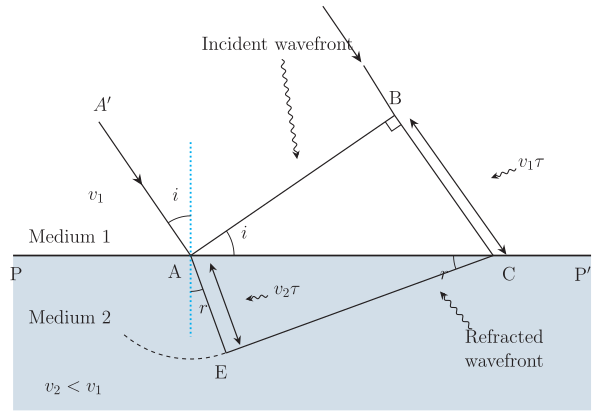
Option — Refraction on the wave theory (Huygens' construction) and laws of refraction
Consider a plane wavefront in a rarer medium (speed ) incident obliquely on a plane interface with a denser medium (speed ), making angle of incidence with the normal. Let be the time for the disturbance to travel from to a point on the interface (so ); in this same time, the secondary wavelet from spreads into the second medium with radius . The refracted wavefront is the common tangent , making angle of refraction with the interface's normal.
From the right triangles and (sharing hypotenuse ):
This is Snell's law: (i) the incident ray, refracted ray, and normal all lie in the same plane (evident from the construction), and (ii) is a constant for a given pair of media, equal to the ratio of wave speeds in the two media — proving the laws of refraction from the wave (Huygens) theory.
Option — Numerical
Two coherent sources with intensity ratio . Since (amplitude squared),
At a point of maximum interference, amplitudes add; at minimum, they subtract:
— OR (alternative) —
Brewster's law: When unpolarised light is incident on a transparent medium at a particular angle — the polarising angle (Brewster's angle) — the reflected light is completely (linearly) polarised, with
( being the refractive index of the medium).
Proof that reflected and refracted rays are mutually perpendicular at this angle: By Snell's law, where is the angle of refraction. From Brewster's law, . Substituting:
…
Unlock everything free for 14 days
- Full step-by-step solutions
- Concept-first explanations
- Methods, shortcuts & mistakes
- PYQ mapping + timed mock tests
Full access for 14 days. No credit card required.