Q.Derive the laws of refraction of light using Huygens' principle.
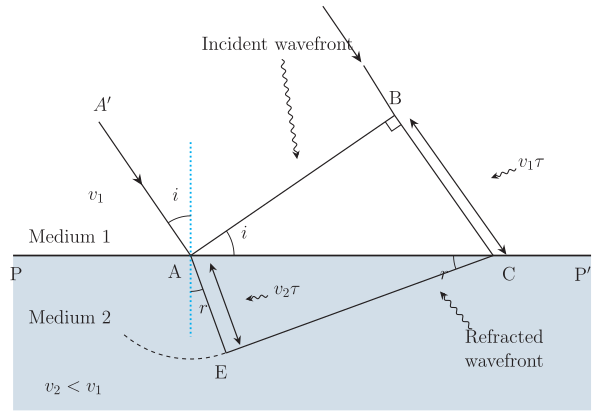
Consider a plane wavefront AB incident on a plane boundary MN separating medium 1 (wave speed ) from medium 2 (wave speed ), at angle of incidence i. Point A of the wavefront reaches the boundary first, at ; point B reaches it later, at point C, at , so is the distance travelled in medium 1 during this interval.
The key difference from reflection is that once point A crosses the boundary into medium 2, its own secondary Huygens wavelet grows at the NEW speed (not ), so by time T this wavelet has radius . The refracted wavefront CE is, exactly as before, the common tangent (envelope) to the secondary wavelets emitted (now in medium 2) by every point between A and C during the interval 0 to T.
From the right triangle ABC (with hypotenuse AC): . From the right triangle AEC (same hypotenuse AC): , where r is the angle of refraction, measured between the refracted ray (perpendicular to CE) and the normal PP' to the boundary at A. Dividing the first relation by the second eliminates both the unknown time T and the shared hypotenuse AC entirely: . Using and (definition of refractive index), this becomes , i.e. -- exactly Snell's Law, the FIRST law of refraction, derived purely from wave geometry.
As with reflection, the entire construction (incident wavefront, boundary, secondary wavelets, refracted wavefront) is carried out within one single plane throughout -- so the incident ray, the refracted ray, and the normal to the boundary are automatically all shown to lie in that one plane, the SECOND law of refraction. A further physical consequence worth stating: since corresponds to (medium 2 denser), the relation gives -- a wave genuinely bends TOWARDS the normal on entering a denser (slower) medium, correctly matching what is observed, because the derivation is built entirely on wave speeds slowing down in denser media, unlike the corpuscular theory's incorrect opposite prediction. [!ANSWER] , i.e. -- Snell's law -- with the incident ray, refracted ray and normal all lying in one plane.
Unlock everything free for 14 days
- Full step-by-step solutions
- Concept-first explanations
- Methods, shortcuts & mistakes
- PYQ mapping + timed mock tests
Full access for 14 days. No credit card required.