Q.State Moseley's law, and explain its historical significance for the arrangement of elements in the periodic table.
You're viewing a preview — the full solution, concept, methods & PYQ mapping are locked.
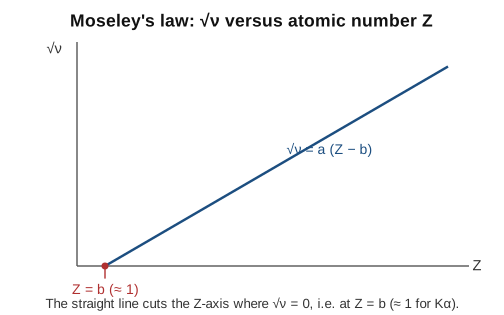
Start your 14-day free trial to unlock the full solution →Moseley measured the characteristic X-ray frequency of many target elements and found plotted against atomic number gives a straight line:
where depends only on the line concerned and is a screening constant ( for , since one K-shell electron remains and partly shields the nuclear charge).
Significance. Before this, elements were ordered by atomic MASS, which put a few elements in the wrong chemical family: cobalt (mass ) had to precede nickel (mass ); argon () had to precede potassium (); tellurium () had to precede iodine (). Moseley's measured values, ordered strictly by , placed every one of these correctly -- proving atomic number, not mass, is the periodic table's true ba …
Unlock everything free for 14 days
- Full step-by-step solutions
- Concept-first explanations
- Methods, shortcuts & mistakes
- PYQ mapping + timed mock tests
Full access for 14 days. No credit card required.