Q.The position of –Br in the compound CH3CH=CHC(Br)(CH3)2 can be classified as ____________.
🔒You're viewing a preview — the full solution, concept, methods & PYQ mapping are locked.
🔒 Start your 14-day free trial to unlock the full solution →Concept understanding — Alcohol Oxidation
Alcohol Oxidation: The Intuition First
Imagine you have a molecule of ethanol — the alcohol in your hand sanitizer or a drink. It has a carbon atom bonded to an –OH group. Now picture that –OH group as a "handle" that can be transformed. Oxidation, in organic chemistry, doesn't always mean adding oxygen — it often means removing hydrogen from a carbon that already has a bond to oxygen. For alcohols, oxidation is like "stripping away" hydrogen atoms from the carbon that holds the –OH, turning the alcohol into a more oxidized functional group.
Think of it this way: a primary alcohol (R–CH₂–OH) has two hydrogens on the carbon with the –OH. If you remove one hydrogen and the hydrogen from the –OH, you get an aldehyde (R–CHO). Remove both hydrogens (and the –OH hydrogen), and you get a carboxylic acid (R–COOH). A secondary alcohol (R–CHOH–R') has only one hydrogen on that carbon — remove it, and you get a ketone (R–CO–R'). A tertiary alcohol has no hydrogen on that carbon — so it cannot be oxidized without breaking the carbon skeleton.
That's the core intuition: oxidation of an alcohol is about removing hydrogens from the carbon bearing the –OH group. The more hydrogens you can remove, the more oxidized the product.
The Precise Statement
Alcohol oxidation is the process in which an alcohol loses hydrogen atoms (dehydrogenation) from the carbon bonded to the –OH group, increasing the number of C–O bonds (or decreasing C–H bonds). The outcome depends on the class of the alcohol:
| Alcohol Class | Structure | Product after oxidation | Reagent example |
|---|---|---|---|
| Primary (1°) | R–CH₂–OH | Aldehyde (R–CHO) then Carboxylic acid (R–COOH) | PCC (stops at aldehyde); K₂Cr₂O₇/H⁺ (goes to acid) |
| Secondary (2°) | R–CHOH–R' | Ketone (R–CO–R') | K₂Cr₂O₇/H⁺, CrO₃, etc. |
| Tertiary (3°) | R₃C–OH | No reaction (under normal conditions) | — |
A common mistake: students think "oxidation" always adds oxygen. For alcohols, it's removal of hydrogen from the carbon with the –OH. The oxygen from the –OH stays — it's the hydrogens that leave.
Why Does Tertiary Alcohol Not Oxidize?
Look at the carbon with the –OH in a tertiary alcohol: it has three carbon groups attached and no hydrogen. To form a C=O bond, you'd need to remove a hydrogen from that carbon — but there is none. The only way to oxidize a tertiary alcohol is to break a C–C bond (strong and difficult), which is not typical oxidation. So in standard organic chemistry, tertiary alcohols are inert to mild oxidizing agents.
A Real-World Analogy
Think of the alcohol carbon as a "parking spot" with a certain number of hydrogen "cars." Primary alcohol has two cars parked. Oxidation is like towing away one car (→ aldehyde) or both cars (→ carboxylic acid). Secondary alcohol has one car — tow it away, and you get a ketone. Tertiary alcohol has zero cars — nothing to tow, so no reaction.
Key Reagents to Remember (for exams)
- PCC (pyridinium chlorochromate): oxidizes 1° alcohols to aldehydes only — stops there.
- K₂Cr₂O₇ / H₂SO₄ (acidified potassium dichromate): oxidizes 1° alcohols all the way to carboxylic acids; 2° alcohols to ketones. (Not to be confused with Jones reagent, which is specifically CrO₃ dissolved in dilute aqueous H₂SO₄, often used in acetone — a related but distinct oxidant with the same general 1°→acid / 2°→ketone outcome.) …
Why this formula?
Alcohol Oxidation: Why the Reactions Work the Way They Do
Alcohol oxidation is a fundamental reaction in organic chemistry, and understanding why it proceeds as it does is crucial for Indian board exams (Class 12, JEE, NEET). Let's break it down step-by-step.
1. The Core Idea: Loss of Hydrogen
Oxidation in organic chemistry means loss of hydrogen (or gain of oxygen). For alcohols, this happens at the carbon bearing the –OH group.
- Primary alcohol (R−CH2OH): Has two hydrogens on the carbon attached to –OH.
- Secondary alcohol (R2CHOH): Has one hydrogen on that carbon.
- Tertiary alcohol (R3COH): Has zero hydrogens on that carbon.
Key insight: The number of hydrogens on the carbon with –OH determines if and how far oxidation can go.
2. Why Primary Alcohols Give Aldehydes (Then Carboxylic Acids)
Step 1: Aldehyde formation
When a primary alcohol (R−CH2OH) is oxidized, the first product is an aldehyde (R−CHO).
Why? The oxidizing agent (like K2Cr2O7 / H2SO4 or PCC) removes two hydrogens:
- One from the –OH group
- One from the carbon atom
The carbon–oxygen bond becomes a double bond (C=O), forming the aldehyde.
R−CH2OH[O]R−CHO+H2O
But why stop here? The aldehyde still has one hydrogen on the carbonyl carbon. If a strong oxidant is present, it can remove that hydrogen too.
Step 2: Carboxylic acid formation
With excess strong oxidant (e.g., K2Cr2O7 / H2SO4, heat), the aldehyde is further oxidized to a carboxylic acid (R−COOH).
R−CHO[O]R−COOH
Why does this happen? The aldehyde's carbonyl carbon is electrophilic (partially positive). Water (from the reaction medium) adds to it, forming a gem-diol intermediate. The oxidant then removes two more hydrogens, giving the acid.
Exam tip: To stop at the aldehyde, use a mild oxidant like PCC (pyridinium chlorochromate) in anhydrous conditions — no water means no gem-diol formation.
3. Why Secondary Alcohols Give Ketones (and Stop)
A secondary alcohol (R2CHOH) has only one hydrogen on the carbon with –OH. Oxidation removes:
- One hydrogen from –OH
- One hydrogen from the carbon
This forms a ketone (R2C=O).
R2CHOH[O]R2C=O+H2O
Why does it stop here? The ketone has no hydrogen on the carbonyl carbon. Without that hydrogen, further oxidation (under normal conditions) is impossible — you'd need to break a C−C bond, which requires much harsher conditions.
Key result: Secondary alcohols cannot be oxidized further than ketones under standard conditions.
4. Why Tertiary Alcohols Do NOT Oxidize
A tertiary alcohol (R3COH) has zero hydrogens on the carbon bearing –OH.
What happens if you try? The oxidant cannot remove any hydrogen from that carbon. The only possible reaction would be breaking a C−C bond, which doesn't happen under normal oxidation conditions.
Result: Tertiary alcohols are resistant to oxidation under mild to moderate conditions. They require strong heating with powerful oxidants (like K2Cr2O7 / H2SO4, heat) to break carbon–carbon bonds — this is destructive oxidation, not useful for synthesis.
5. The "Why" in One Table
| Alcohol Type | Hydrogens on C–OH | Product | Why? |
|---|---|---|---|
| Primary (1∘) | 2 | Aldehyde → Carboxylic acid | Two hydrogens available; aldehyde still has one more |
Concept: Allylic Halide Classification — the question is about classifying the position of a bromine atom relative to a C=C double bond. The compound is CH3CH=CHC(Br)(CH3)2.
Step 1: Identify the carbon bearing the –Br. It is the carbon attached to two methyl groups and the alkene chain: C(Br)(CH3)2.
Step 2: Check the relationship of this carbon to the double bond. The double bond is between the second and third carbons: CH3CH=CH−. The bromine-bearing carbon is directly attached to the CH of the double bond (the allylic position). …
The key is to identify the carbon bearing the bromine and check its immediate neighbours. The bromine is attached to a carbon that is one bond away from a C=C double bond, making it an allylic halide. The correct option is (i).
Why this is about “allyl” vs “vinyl” vs “aryl”
In organic chemistry, the classification of a halide (or any substituent) depends on the hybridisation and bonding of the carbon it’s attached to, and its relationship to a double bond or aromatic ring.
- Vinyl halide: halogen directly on a sp2 carbon of a C=C bond.
- Allyl halide: halogen on a carbon adjacent to a C=C bond (i.e., one sp3 carbon away from the double bond).
- Aryl halide: halogen directly on a carbon of an aromatic ring.
- Secondary/primary/tertiary: refers to the number of carbon atoms attached to the halogen-bearing carbon (ignoring the double bond’s influence).
The given compound is CH3CH=CHC(Br)(CH3)2. Let’s decode its structure step by step.
1. Draw the full structure
The formula CH3CH=CHC(Br)(CH3)2 means:
- Start with a three-carbon chain: CH3−CH=CH−
- Then a carbon that has a bromine and two methyl groups: −C(Br)(CH3)2
So the carbon skeleton is:
CH3−CH=CH−C(CH3)2
with a Br attached to the fourth carbon (the one with two methyls).
Numbering from the left:
- CH3− (C1)
- =CH− (C2, sp2)
- −CH= (C3, sp2)
- −C(Br)(CH3)2 (C4, sp3)
The double bond is between C2 and C3.
2. Locate the bromine
The bromine is on C4. Now ask: what is the relationship of C4 to the double bond?
- C4 is not one of the sp2 carbons of the double bond (those are C2 and C3).
- C4 is directly attached to C3, which is an sp2 carbon of the double bond.
That is the defining feature of an allylic position: the halogen is on a carbon adjacent to a C=C bond.
A quick way: if the carbon with the halogen is one bond away from a C=C, it’s allylic. If it’s on the C=C itself, it’s vinylic. If it’s on an aromatic ring, it’s aryl.
3. Eliminate the other options
- Vinyl: would require Br directly on C2 or C3 (the sp2 carbons). Not the case.
- Aryl: would require an aromatic ring. There is no benzene ring here. …
Concept: Classification of Alkyl Halides Based on the Carbon–Halogen Bond
The type of halide (allyl, vinyl, aryl, etc.) depends on which carbon the halogen is attached to, and what that carbon is bonded to.
Method: Identify the Halogen-Bearing Carbon and Its Neighbourhood
Step 1 -- Identify the structure
The given compound is CH3CH=CHC(Br)(CH3)2: a but-2-ene backbone (C1=CH3, C2=CH, C3=CH, double bond between C2-C3) with a fourth carbon (C4) attached to C3, bearing Br and two methyl groups.
Step 2 -- Identify the halogen-bearing carbon and count its neighbours
C4 (the Br-bearing carbon) is bonded to:
- C3 (the alkene carbon)
- a methyl group
- a second methyl group
- Br
That's three carbon neighbours and one Br -- C4 is a tertiary carbon, with zero hydrogens.
Step 3 -- Check the relationship to the double bond
C4 itself is not part of the C=C double bond (the double bond is between C2 and C3) -- it is one bond away, directly attached to C3, one of the alkene carbons.
Step 4 -- Apply the classification rules
- Vinyl halide: halogen directly ON an sp² carbon of the C=C bond -- not the case here (Br is on C4, not C2 or C3).
- Allylic halide: halogen on an sp³ carbon directly ADJACENT to a C=C bond -- this matches C4 exactly. …
Here is the breakdown of the common mistakes students make on this classification problem, along with the correct reasoning.
The Correct Answer
The correct classification is (i) Allyl.
Why it is Allyl (The Concept)
To classify a halogen (or any substituent), you must look at the carbon atom to which it is directly attached.
- Identify the Halogen-bearing Carbon: In the compound CH3CH=CHC(Br)(CH3)2, the bromine is attached to the carbon that also has two methyl groups ((CH3)2) and the alkene CH carbon — four bonds in all (Br, two CH3, one C), so it carries no hydrogen.
- Identify the Adjacent Carbon: Look at the carbon atom next to the one bearing the Br. That adjacent carbon is part of a double bond (CH=CH).
- Definition of Allyl: An allyl group is defined as CH2=CH−CH2−X. The key is that the halogen (X) is on a carbon that is adjacent to a carbon-carbon double bond (C=C−C−X). This is exactly the case here.
Common Mistakes & How to Avoid Them
Mistake 1: Confusing "Allyl" with "Vinyl"
- The Error: Students see the double bond (CH=CH) and immediately classify the Br as Vinyl.
- Why it's Wrong: A Vinyl halide is CH2=CH−X. Here, the halogen is attached directly to one of the doubly-bonded carbons. In our compound, the Br is not on the double bond; it is one carbon away.
- How to Avoid: Draw the structure. Ask: "Is the halogen directly on the C=C bond?"
- Yes → Vinyl (or Aryl if it's a benzene ring).
- No, but it's next to it → Allyl.
Mistake 2: Misidentifying the "Secondary" Carbon
- The Error: Students see the carbon with Br is attached to two other carbons (the CH from the chain and two CH3 groups) and classify it as Secondary (2°) .
- Why it's Wrong: The Br-bearing carbon is bonded to: (1) the CH of the double bond, (2) a CH3, (3) another CH3, and (4) Br -- three carbon neighbours, making it a tertiary carbon (not secondary). But the question asks for the classification of the position (Allyl, Aryl, Vinyl), not the degree (primary, secondary, tertiary) -- a different axis of classification entirely. …
Showing the 12 most recent of 23 on this concept.
- AP EAPCET 2026Set eng-2026-05-14-AN1 markMCQQ.In which of the following sets, reactant and reagent are correctly matched to get corresponding carboxylic acid I. CH3CH2CH2CH2OH ------ CrO3+H2SO4 II. CH3CH2CH2CH2Br ------ CO2,H3O+ III. C6H5−CH2−CH3 ------ KMnO4/OH−,H3O+ Correct answer is (A) I only (B) I, II only (C) I, III only (D) II only
›Reveal solutionSolution
I and III are correctly matched reagent→carboxylic-acid conversions; II is missing the required Grignard-formation step (alkyl halides don't react with CO2 directly), so only I and III qualify.
Concept and Intuition
There are several distinct routes to carboxylic acids, each needing its correct reagent:
- Primary alcohol → acid: strong oxidants like acidified CrO3 (or KMnO4) oxidise −CH2OH all the way through the aldehyde to −COOH.
- Alkyl halide → acid (via Grignard route): R−XMg,dry etherR−MgXCO2R−COOMgXH3O+R−COOH. The halide must first be converted to the Grignard reagent — it cannot react with CO2 directly.
- Alkylbenzene → benzoic acid: hot alkaline KMnO4 oxidises any benzylic side chain (as long as it has at least one benzylic hydrogen) completely down to a single −COOH attached to the ring, regardless of the original chain length.
Step-by-Step Solution
- I: CH3CH2CH2CH2OHCrO3/H2SO4CH3CH2CH2COOH — correct oxidation of a 1° alcohol to the acid. True. …
- AP EAPCET 2026Set eng-2026-05-13-AN1 markMCQQ.Match the following List – I (Transformation) / List – II (Reagent) A. Hexan-1-ol → Hexanal / I.(i) CrO2Cl2/CS2(ii) H2O B. p-Fluorotoluene → p-Fluorobenzaldehyde / II. DIBAL-H C. Cyclohexanone → Cyclohexanol / III. PCC D. Ethanenitrile → Ethanal / IV. NaBH4 (V. Pd−BaSO4) The correct answer is (A) A-III, B-IV, C-I, D-II (B) A-III, B-I, C-IV, D-II (C) A-IV, B-III, C-II, D-I (D) A-IV, B-I, C-II, D-III
›Reveal solutionSolution
This tests recognising four standard "stop at the right oxidation/reduction level" reagents in organic chemistry: PCC, the Étard reaction reagent, NaBH4, and DIBAL-H. The match is A-III, B-I, C-IV, D-II.
Concept and Intuition
Each transformation here requires a reagent chosen specifically because it stops the reaction at an intermediate oxidation level rather than going all the way (e.g., alcohol → aldehyde, not all the way to acid; nitrile → aldehyde, not all the way to amine). Recognising which reagent is famous for stopping at each particular level is the key skill.
Step-by-Step Solution
- A. Hexan-1-ol → Hexanal: oxidising a primary alcohol only as far as the aldehyde (not the acid) is the signature use of PCC (pyridinium chlorochromate), a mild, non-aqueous chromium(VI) oxidant — list item III. So A-III.
- B. p-Fluorotoluene → p-Fluorobenzaldehyde: converting an aromatic methyl group directly to −CHO is the Étard reaction: treatment with CrO2Cl2 (chromyl chloride) in CS2 forms a complex that is then hydrolysed with H2O to release the aldehyde — list item I. So B-I.
- C. Cyclohexanone → Cyclohexanol: reducing a ketone to a secondary alcohol is done cleanly with NaBH4 (sodium borohydride), a mild hydride reducing agent that reduces aldehydes/ketones but not esters/nitriles — list item IV. So C-IV. …
- AP EAPCET 2026Set eng-2026-05-18-FN1 markMCQQ.When vapours of an alcohol X are passed over heated copper at 573 K, gives an alkene. What is X? (A) CH3CH2CH2CH2OH (B) (CH3)2CH−CH2OH (C) (CH3)3C−OH (D) CH3CH(OH)CH2CH3
›Reveal solutionSolution
This tests the copper-catalyst alcohol test: only a tertiary alcohol dehydrates to an alkene at 573 K over Cu, so X must be (CH3)3C−OH.
Concept and Intuition
When alcohol vapour is passed over copper catalyst heated to about 573 K, the outcome depends on the alcohol's class because copper favours dehydrogenation (removal of H2) for alcohols that have an α-hydrogen available for oxidation to a carbonyl, while a tertiary alcohol (no α-H on the carbinol carbon) cannot dehydrogenate this way and instead undergoes dehydration (loss of water) directly on the hot metal surface, giving an alkene.
- 1° alcohol Cu, 573K aldehyde (−2H)
- 2° alcohol Cu, 573K ketone (−2H)
- 3° alcohol Cu, 573K alkene (−H2O)
Step-by-Step Solution
- Classify each option: (A) CH3CH2CH2CH2OH is a primary alcohol (1-butanol); (B) (CH3)2CHCH2OH is a primary alcohol (isobutanol/2-methyl-1-propanol); (C) (CH3)3C−OH is a tertiary alcohol (tert-butanol); (D) CH3CH(OH)CH2CH3 is a secondary alcohol (2-butanol).
- Since the question states the product is an alkene, X must be the alcohol that dehydrates rather than dehydrogenates on hot copper — that requires a tertiary alcohol (no α-hydrogen for the dehydrogenation pathway).
- Only option (C), (CH3)3C−OH, is tertiary. It gives 2-methylpropene (isobutylene) as the alkene product. …
- AP EAPCET 2026Set eng-2026-05-18-AN1 markMCQQ.An alkyl halide A (C4H9Br) reacts with aqueous NaOH and gives corresponding alcohol (B). Reaction of B with reagent C gives a carboxylic acid D. What are C and D? (A) [Ag(NH3)2]+; [FIGURE] (skeletal structure of a straight-chain carboxylic acid, CH3CH2CH2COOH, butanoic acid) (B) PCC; [FIGURE] (skeletal structure of a branched carboxylic acid, (CH3)2CHCOOH, 2-methylpropanoic acid) (C) dil. KMnO4, 273K; [FIGURE] (skeletal structure of a branched carboxylic acid, (CH3)2CHCOOH, 2-methylpropanoic acid) (D) CrO3−H2SO4; [FIGURE] (skeletal structure of a straight-chain carboxylic acid, CH3CH2CH2COOH, butanoic acid)
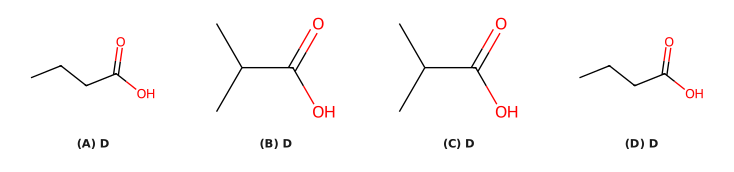
›Reveal solutionSolution
Only a strong oxidant like Jones reagent (CrO3−H2SO4) drives a primary alcohol all the way to a carboxylic acid in one step; PCC stops at the aldehyde and Tollens'/cold dilute KMnO4 don't fit this transformation, so the self-consistent option is CrO3−H2SO4 giving butanoic acid.
Concept and Intuition
Oxidation of a primary alcohol can stop at the aldehyde or go all the way to the carboxylic acid, depending on the reagent:
- PCC (pyridinium chlorochromate), a mild anhydrous oxidant, stops cleanly at the aldehyde — it cannot be the reagent that produces an acid D directly from alcohol B.
- Tollens' reagent ([Ag(NH3)2]+) oxidises aldehydes to acids (it's a test/oxidant for the –CHO group); it does not act on an alcohol directly, so it can't convert B (an alcohol) to D (an acid) in one step as described.
- Cold, dilute KMnO4 at 273 K is the classic reagent for syn-dihydroxylation of alkenes, not for oxidising an alcohol fully to an acid.
- CrO3−H2SO4 (Jones reagent), an aqueous strong oxidant, oxidises a primary alcohol straight through to the carboxylic acid without isolating the aldehyde — this is exactly the transformation B → D described.
Step-by-Step Solution
- A = C4H9Br reacts with aqueous NaOH via nucleophilic substitution to give the corresponding alcohol B (a butanol isomer).
- B is oxidised by reagent C to give carboxylic acid D — this requires an oxidant capable of full oxidation (alcohol → acid), which is CrO3−H2SO4. …
- AP EAPCET 2025Set eng-2025-05-21-FN1 markMCQQ.What are x and y in the following reaction sequence? (dil = dilute) C2H2x333KCH3CHO(i) dil NaOH(ii) ΔCH3−CH=CH−CHO CH3−CH=CH−CH2OHyCH3−CH=CH−CHO (y is the upward arrow feeding into the same product) (A) H2O/H2SO4; KMnO4/H+ (B) H2O/H2SO4; PCC (C) H2O/H2SO4,Hg2+; KMnO4/H+ (D) H2O/H2SO4,Hg2+; PCC
›Reveal solutionSolution
This tests the Kucherov (mercury-catalysed) hydration of an alkyne and the chemoselective PCC oxidation of an allylic alcohol; the answer is (D).
Concept and Intuition
Alkynes do not hydrate with plain dilute acid the way alkenes do — the triple bond needs a π-acid catalyst, classically Hg2+, to polarise it enough for water to add (Markovnikov addition, giving the more substituted enol which tautomerises to the ketone/aldehyde). Separately, when you must convert a primary alcohol to an aldehyde and STOP there — especially when the molecule also carries a C=C double bond you must not disturb — you reach for a chromium(VI) reagent used in a non-aqueous, non-acidic medium (PCC), not aqueous acidic KMnO4, which is a much stronger, less selective oxidant.
Step-by-Step Solution
- C2H2 is converted to CH3CHO at 333K. Only Kucherov's reaction does this: H2O/H2SO4 with Hg2+ as catalyst adds water Markovnikov-fashion to give the enol CH2=CHOH, which tautomerises instantly to acetaldehyde. So x=H2O/H2SO4,Hg2+.
- Acetaldehyde undergoes base-catalysed aldol condensation ((i) dil. NaOH, (ii) Δ) to give crotonaldehyde, CH3−CH=CH−CHO — this confirms the top row and is consistent regardless of which option we pick, since all four options agree on this part.
- The same crotonaldehyde must also be reachable from crotyl alcohol, CH3−CH=CH−CH2OH, by oxidation with reagent y. We need an oxidant that (a) stops at the aldehyde (doesn't push on to the acid) and (b) leaves the isolated C=C bond alone. …
- AP EAPCET 2025Set eng-2025-05-21-AN1 markMCQQ.In the following sequence of reactions, what is the end product (D)? C2H5BrKCNAH3O+BLiAlH4CCu573KD (A) Acetaldehyde (B) Acetone (C) Propionaldehyde (D) Propanol-1
›Reveal solutionSolution
A four-step chain: alkyl bromide → nitrile → carboxylic acid → 1° alcohol → aldehyde (Cu, 573 K dehydrogenation). Final product D is propionaldehyde.
Concept and Intuition
This question strings together four classic reactions: (i) nucleophilic substitution of an alkyl halide by cyanide to build a one-carbon-longer nitrile, (ii) acid hydrolysis of a nitrile all the way to a carboxylic acid, (iii) LiAlH4's strong reducing power taking a carboxylic acid all the way down to a primary alcohol, and (iv) the signature test for distinguishing 1°/2°/3° alcohols — passing vapour over hot copper: 1° alcohols dehydrogenate to aldehydes, 2° to ketones, 3° undergo dehydration to alkenes.
Step-by-Step Solution
- C2H5Br+KCN→C2H5CN (A = propanenitrile/ethyl cyanide) — CN− displaces Br−, adding one carbon.
- C2H5CNH3O+C2H5COOH (B = propanoic acid) — acidic hydrolysis of the nitrile via the amide intermediate to the carboxylic acid.
- C2H5COOHLiAlH4C2H5CH2OH=CH3CH2CH2OH (C = propan-1-ol) — LiAlH4 reduces the carboxylic acid fully to the primary alcohol. …
- AP EAPCET 2025Set ap-2025-05-19-AN1 markMCQQ.Which of the following reagents will oxidise glucose to gluconic acid? I) Br2/H2O II) HNO3 III) [Ag(NH3)2]+/OH− (A) I, II only (B) I, III only (C) II, III only (D) I, II, III
›Reveal solutionSolution
Bromine water and Tollens' reagent are mild, selective oxidants that stop at the aldehyde, converting glucose to gluconic acid; nitric acid is stronger and over-oxidises the terminal CH₂OH too, giving saccharic acid instead.
Concept and Intuition
Glucose's open-chain form has a reactive aldehyde (−CHO) at C1 and a primary alcohol (−CH2OH) at C6. Whether an oxidant stops at the aldehyde (giving a mono-carboxylic acid, gluconic acid) or also attacks the terminal alcohol (giving a di-carboxylic acid, saccharic acid) depends entirely on the oxidant's strength/selectivity.
Step-by-Step Solution
- Br2/H2O — a mild, selective oxidant that oxidises only −CHO→−COOH, giving gluconic acid. ✓
- [Ag(NH3)2]+/OH− (Tollens' reagent) — the classic silver-mirror test; also selectively oxidises only the aldehyde to give (ammonium) gluconate/gluconic acid. ✓ …
- AP EAPCET 2025Set ap-2025-05-19-FN1 markMCQQ.What is Z in the given reaction sequence ? C3H6(1) B2H6(2) H2O,H2O2,OH−XPCCYNH2OHZ (A) CH3−C(=N−OH)−CH3 (B) CH3CH2CH=N−OH (C) CH3−CH2−CH2−NH2 (D) CH3−CH2−NH−CH3
›Reveal solutionSolution
Hydroboration–oxidation gives the anti-Markovnikov alcohol, PCC stops oxidation at
the aldehyde, and hydroxylamine converts that aldehyde to its oxime — giving propanal
oxime as Z.
Concept and Intuition
Three distinct named reactions are chained here:
- Hydroboration–oxidation (B2H6 then H2O2/OH−) adds H and OH across a double bond with anti-Markovnikov regiochemistry (boron adds to the less hindered/less substituted carbon), and overall retention of the alkene skeleton as an alcohol.
- PCC (pyridinium chlorochromate) is a mild, non-aqueous oxidant that oxidises primary alcohols only as far as the aldehyde (unlike KMnO4/acidic dichromate, which would over-oxidise to the carboxylic acid).
- Hydroxylamine (NH2OH) is a classic carbonyl-condensation reagent: it reacts with an aldehyde/ketone carbonyl, losing water, to form the corresponding oxime (C=N−OH).
Step-by-Step Solution
- C3H6 (propene, CH3CH=CH2) undergoes hydroboration: BH3 (from B2H6) adds boron to the terminal (less substituted) carbon.
- Oxidative work-up (H2O2/OH−) replaces −BH2 with −OH, with retention of position, giving the anti-Markovnikov alcohol: X=CH3CH2CH2OH (1-propanol).
- PCC oxidises the primary alcohol X only to the aldehyde stage (does not go further to the acid): Y=CH3CH2CHO (propanal). …
- AP EAPCET 2024Set ap-2024-05-16-FN1 markMCQQ.The number of σ bonds, π-bonds and lone pairs of electrons present in the product Z in the given reaction sequence are respectively (CH3)2CH-CHBr2ZnΔXH+/H2SO4ΔYCu573KZ (A) 9, 1, 0 (B) 9, 0, 2 (C) 8, 2, 1 (D) 9, 1, 2
›Reveal solutionSolution
The reaction sequence ends in a carbonyl compound; a C=O group carries 1 π-bond and the oxygen carries 2 lone pairs, and the product has 9 σ-bonds — giving 9, 1, 2, option (D).
The final step (Cu, 573 K / dehydrogenation of an alcohol, or Kucherov-type hydration of an alkyne) delivers a carbonyl compound as product Z. Counting for the carbonyl product CH3-CO-CH3 (propanone):
- σ-bonds: 2 (C-C) + 6 (C-H) + 1 (the σ of C=O) = 9
- π-bonds: 1 (the π of C=O)
- lone pairs: 2 (both on the carbonyl oxygen)
This gives σ=9, π=1, lone pairs=2. …
- AP EAPCET 2024Set ap-2024-05-17-AN1 markMCQQ.A ketone 'X' gives CHI3 when reacted with NaOI. Product of X on reaction with NaBH4 followed by treatment with H2O is (A) C6H5CH2CH2CH2OH (B) C6H5CH(OH)CH2CH3 (C) C6H5CH2CH(OH)CH3 (D) C6H5CH2CH2CH3
›Reveal solutionSolution
This tests recognizing a methyl ketone from its positive iodoform test, then predicting the alcohol formed on mild (NaBH4) reduction.
Concept and Intuition
The iodoform test (yellow CHI3 precipitate with NaOI) is specific to methyl ketones (R−CO−CH3) among ketones. NaBH4 is a mild, selective reducing agent that reduces the ketone carbonyl to a secondary alcohol without disturbing the aromatic ring.
Step-by-Step Solution
- Since X gives a positive iodoform test, X must contain the CH3−CO− group directly bonded to the carbonyl carbon.
- Matching this requirement against the given product options, X is phenylacetone (1-phenylpropan-2-one): C6H5−CH2−CO−CH3. …
- AP EAPCET 2024Set ap-2024-05-17-FN1 markMCQQ.What are X and Z in the following reaction sequence? CH3CH2CH2OH(i) X(ii) SOCl2YC6H6anhy. AlCl3Z (A) CrO3/H2SO4 ; Propiophenone (B) CrO3/H2SO4 ; Acetophenone (C) PCC ; Propiophenone (D) PCC ; Acetophenone
›Reveal solutionSolution
Oxidizing n-propanol all the way to propanoic acid needs CrO3/H2SO4
(not the milder PCC, which stops at the aldehyde); SOCl2 then gives the
acid chloride, which does a Friedel-Crafts acylation on benzene to give propiophenone.
Concept and Intuition
Oxidizing a primary alcohol can stop at the aldehyde stage or go all the way to the
carboxylic acid, depending on the oxidant:
- PCC (pyridinium chlorochromate) is a mild oxidant that stops cleanly at the aldehyde — it cannot go further to the acid.
- CrO3/H2SO4 (Jones reagent) or hot acidic KMnO4 are strong oxidants that carry a primary alcohol all the way to the carboxylic acid.
Since the next step is SOCl2 (which converts a carboxylic acid, not an
aldehyde, into an acid chloride), the first reagent X must be the strong oxidant that
reaches the acid stage — i.e. CrO3/H2SO4, not PCC.
Step-by-Step Solution
- CH3CH2CH2OH (n-propanol) + (i) CrO3/H2SO4 (strong oxidant): oxidizes the primary alcohol fully to propanoic acid (CH3CH2COOH).
- (ii) SOCl2: converts the carboxylic acid to the corresponding acid chloride, Y = propanoyl chloride (CH3CH2COCl), releasing SO2 and HCl.
- Y + C6H6/anhydrous AlCl3 (Friedel-Crafts acylation): …
- AP EAPCET 2024Set eng-2024-05-19-AN1 markMCQQ.What are X and Y respectively in the following reaction sequence? Isopentane KMnO4 X dehydration Y (Major) (A) X=(CH3)2C(OH)CH2CH3 (2-methylbutan-2-ol) ; Y=(CH3)2C=CHCH3 (2-methylbut-2-ene) (B) X=CH3CH(CH3)CH(OH)CH3 (3-methylbutan-2-ol) ; Y=(CH3)2C=CHCH3 (2-methylbut-2-ene) (C) X=(CH3)2C(OH)CH2CH3 (2-methylbutan-2-ol) ; Y=CH2=C(CH3)CH2CH3 (2-methylbut-1-ene) (D) X=CH3CH(CH3)CH(OH)CH3 (3-methylbutan-2-ol) ; Y=CH3CH(CH3)CH=CH2 (3-methylbut-1-ene)
›Reveal solutionSolution
This tests regioselective oxidation of a branched alkane at its tertiary carbon followed by Zaitsev-rule dehydration of the resulting alcohol. The answer is (A).
Concept and Intuition
Oxidation of alkanes by strong oxidants like KMnO4 occurs preferentially at C-H bonds that are more easily broken -- tertiary C-H bonds (weaker bond, more stable resulting radical/cation-like transition state) are oxidized in preference to secondary or primary ones. Isopentane (2-methylbutane) has exactly one tertiary hydrogen (on C2), so oxidation there gives the tertiary alcohol 2-methylbutan-2-ol. Subsequent acid-catalyzed dehydration of an alcohol follows Zaitsev's rule: the more substituted (more stable) alkene is the major product.
Step-by-Step Solution
- Isopentane structure: CH3−CH(CH3)−CH2−CH3 (2-methylbutane), with a tertiary C-H at C2.
- KMnO4 oxidation targets this tertiary C-H, converting C2 into a C-OH center: product X=(CH3)2C(OH)CH2CH3, i.e., 2-methylbutan-2-ol.
- Dehydration of 2-methylbutan-2-ol can, in principle, give two alkenes: 2-methylbut-2-ene (trisubstituted, more stable) or 2-methylbut-1-ene (disubstituted, less stable). …
🎓Unlock everything free for 14 days
- ✓Full step-by-step solutions
- ✓Concept-first explanations
- ✓Methods, shortcuts & mistakes
- ✓PYQ mapping + timed mock tests
Full access for 14 days. No credit card required.