Q.Assertion: It is difficult to replace chlorine by –OH in chlorobenzene in comparison to that in chloroethane.
Reason: Chlorine-carbon (C–Cl) bond in chlorobenzene has a partial double bond character due to resonance.
🔒You're viewing a preview — the full solution, concept, methods & PYQ mapping are locked.
🔒 Start your 14-day free trial to unlock the full solution →Concept understanding — Inductive Effect on Acidity
Inductive Effect on Acidity – From Intuition to Precision
Imagine you are holding a rope tied to a heavy box. If you pull the rope, the box moves toward you. Now imagine the rope is made of rubber bands — the pull still reaches the box, but it gets weaker the farther away you are. That is exactly how the inductive effect works inside a molecule.
The Core Intuition
An acid donates a proton (H+). After it does, the remaining part (the conjugate base) carries a negative charge. The stability of that negative charge determines how willing the molecule is to give up the proton. More stable conjugate base → stronger acid.
Now, some atoms or groups are electron-withdrawing — they pull electron density toward themselves through the sigma bonds. If such a group is attached near the acidic proton, it pulls some electron density away from the negative charge on the conjugate base. That spreads out (delocalises) the negative charge, making the conjugate base more stable. The acid becomes stronger.
Conversely, electron-donating groups push electron density toward the negative charge, concentrating it and making the conjugate base less stable. The acid becomes weaker.
The inductive effect operates through sigma bonds only. It does not involve pi bonds or resonance. It is a permanent, through-bond polarisation.
The Precise Statement
Inductive effect on acidity: The acidity of a compound increases with the presence of electron-withdrawing groups (EWGs) near the acidic site, and decreases with electron-donating groups (EDGs). The effect is strongest when the group is closest to the acidic proton, and diminishes rapidly with distance.
Mathematically, for a series of substituted carboxylic acids:
R-COOHwhere R = substituent
The acid dissociation constant Ka changes as:
- If R is electron-withdrawing (e.g., −Cl, −NO2, −CF3): Ka increases → stronger acid.
- If R is electron-donating (e.g., −CH3, −C2H5): Ka decreases → weaker acid.
Why Distance Matters
The inductive effect falls off with distance because sigma bonds are localised. Each bond attenuates the effect by roughly a factor of 2–3. For example, compare:
| Compound | pKa | Explanation |
|---|---|---|
| CH3COOH | 4.76 | Reference (no EWG) |
| ClCH2COOH | 2.86 | Cl withdraws through one bond |
| Cl2CHCOOH | 1.29 | Two Cl atoms, stronger withdrawal |
| Cl3CCOOH | 0.65 | Three Cl atoms, strongest withdrawal |
| CH3CH2COOH | 4.87 | Ethyl group is electron-donating (slightly weaker acid) |
Notice: ClCH2COOH is about 100 times stronger than acetic acid (ΔpKa≈1.9). But if the Cl is moved further away:
| Compound | pKa |
|---|---|
| ClCH2CH2COOH | 4.08 |
| ClCH2CH2CH2COOH | 4.52 |
The effect fades as the chlorine moves farther from the carboxyl group. …
Why this formula?
Inductive Effect on Acidity: Why It Works
The inductive effect is a through-bond electron displacement caused by differences in electronegativity. When we ask why it affects acidity, we must first understand what acidity means at the molecular level.
The Core Idea: Stabilising the Conjugate Base
Acidity is governed by the equilibrium:
HA⇌H++A−
The stronger the acid, the more it favours the right side. This happens when the conjugate base A− is more stable. The inductive effect directly influences this stability.
Why Electron-Withdrawing Groups (EWG) Increase Acidity
Consider a carboxylic acid with an electronegative atom (like Cl) attached to the carbon chain:
Cl−CH2−COOH
- The inductive pull: The Cl atom is more electronegative than carbon. It pulls electron density toward itself through the sigma bonds.
- Effect on the O–H bond: This electron withdrawal travels along the carbon chain, reducing electron density around the O–H bond. The bond becomes more polarised, making the H⁺ easier to remove.
- Stabilising the conjugate base: After losing H⁺, the negative charge on the carboxylate ion (RCOO−) is delocalised by resonance. But the inductive effect further stabilises this negative charge by pulling electron density away from the oxygen atoms. This makes the conjugate base less reactive (more stable), shifting equilibrium toward dissociation.
Key insight: The inductive effect doesn't just weaken the O–H bond — it stabilises the anion that forms after deprotonation.
The Quantitative Relationship: Hammett Equation
For substituted benzoic acids, the effect is quantified by the Hammett equation:
log(Ka0Ka)=σρ
Where:
- Ka = acid dissociation constant of substituted acid
- Ka0 = acid dissociation constant of unsubstituted benzoic acid
- σ = substituent constant (measures inductive + resonance effect)
- ρ = reaction constant (sensitivity of the reaction to substituent effects)
Why This Formula Holds
The derivation comes from linear free-energy relationships:
- Free energy change: For any acid dissociation:
ΔG∘=−RTlnKa
- Effect of substituent: A substituent changes ΔG∘ by an amount proportional to its electronic effect:
Δ(ΔG∘)=−RTln(Ka0Ka)
-
Separability assumption: The total effect of a substituent on any reaction can be factored into:
- A substituent-specific term (σ) — how strongly it pulls/pushes electrons
- A reaction-specific term (ρ) — how sensitive the reaction is to electronic effects
-
Empirical validation: Hammett found that for meta and para substituted benzoic acids, plotting log(Ka/Ka0) against σ gives a straight line. This confirms the additive nature of inductive effects.
The Inductive Effect Constant (σI) …
Concept: Inductive effect and resonance in aryl halides vs. alkyl halides.
Reasoning:
- In chlorobenzene, the lone pair on chlorine participates in resonance with the benzene ring, giving the C–Cl bond partial double bond character. This makes the bond stronger and shorter than a typical single bond.
- In chloroethane, the C–Cl bond is a pure single bond with no such resonance stabilization. …
The key idea is that resonance in chlorobenzene gives the C–Cl bond partial double-bond character, making it stronger and harder to break than the single C–Cl bond in chloroethane. Both the assertion and the reason are correct, and the reason correctly explains the assertion.
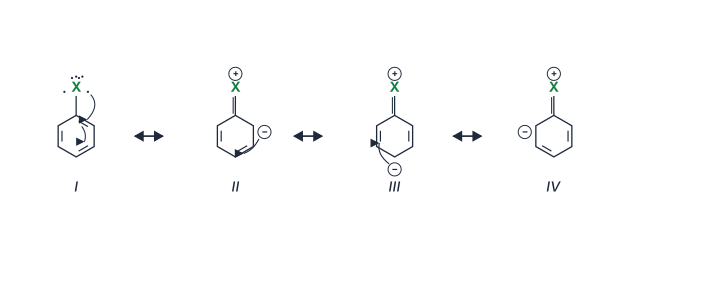
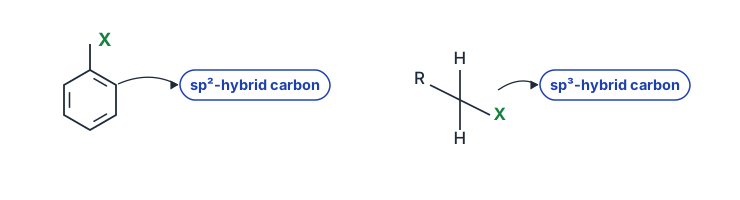
The question tests your understanding of how resonance affects bond strength and reactivity. In chlorobenzene, the chlorine atom donates its lone pairs into the benzene ring, creating resonance structures where the C–Cl bond has double-bond character. This makes the bond stronger and shorter, so replacing chlorine with a nucleophile like –OH becomes difficult. In chloroethane, there is no such resonance — the C–Cl bond is a pure single bond, weaker and more easily broken.
Let’s break it down step by step.
-
Resonance in chlorobenzene
The lone pairs on chlorine can delocalise into the aromatic ring. This gives resonance structures where the carbon attached to chlorine has a partial positive charge and the C–Cl bond is a double bond.
The resonance hybrid shows a C–Cl bond order between 1 and 2, i.e., partial double-bond character.
-
Effect on bond strength
A double bond is stronger and shorter than a single bond. The partial double-bond character in chlorobenzene means the C–Cl bond is harder to break. In chloroethane, the C–Cl bond is a pure single bond — weaker and more reactive toward nucleophilic substitution.
-
Nucleophilic substitution comparison …
Method: Resonance Effect Analysis for Nucleophilic Substitution Reactivity
Step 1: Identify the structural difference
- Chlorobenzene: Chlorine attached to an sp2 hybridised carbon of benzene ring.
- Chloroethane: Chlorine attached to an sp3 hybridised carbon of an alkyl chain.
Step 2: Analyse resonance in chlorobenzene
In chlorobenzene, the lone pair on chlorine participates in resonance with the benzene ring:
ClX−—CX6HX5⟷ClX+=CX6HX5X−
This resonance leads to:
- Partial double bond character in the C–Cl bond
- Bond length is shorter than a typical C–Cl single bond
- Bond is stronger and harder to break
Step 3: Compare with chloroethane
In chloroethane, no such resonance exists. The C–Cl bond is a pure single bond with no partial double bond character.
Step 4: Relate to nucleophilic substitution
For replacement of –Cl by –OH (nucleophilic substitution):
- Chlorobenzene: Stronger C–Cl bond resists cleavage; also, the partial positive charge on carbon is delocalised, making it less electrophilic → difficult substitution …
Here are the common mistakes students make on this exact question, along with how to avoid each.
Mistake 1: Thinking the Reason is Wrong
- What students do: They see "partial double bond character" and think, "No, that's not right — it's just inductive effect."
- Why it’s wrong: The reason is correct. In chlorobenzene, the lone pairs on chlorine resonate with the benzene ring, giving the C–Cl bond partial double bond character. This is a real, exam-tested fact.
- How to avoid: Memorise the resonance structures of chlorobenzene. Draw them: the lone pair from Cl moves into the ring, creating a double bond between C and Cl in one canonical form. That’s the partial double bond character.
Mistake 2: Confusing “Difficult to replace” with “Reaction doesn’t happen”
- What students do: They think “Chlorobenzene does undergo nucleophilic substitution under extreme conditions, so the assertion is false.”
- Why it’s wrong: The assertion says “difficult to replace” — not impossible. It is indeed much harder than in chloroethane. The assertion is correct.
- How to avoid: Read the exact wording. “Difficult” means slower, harsher conditions needed — not “never happens.” Compare rates: chlorobenzene requires high temperature/pressure; chloroethane reacts easily.
Mistake 3: Mixing up Inductive Effect and Resonance
- What students do: They think the C–Cl bond in chlorobenzene is stronger only because of the –I effect of chlorine.
- Why it’s wrong: The –I effect is present, but the main reason for the bond’s strength and low reactivity is resonance (partial double bond character). The –I effect alone would weaken the bond (by pulling electron density), not strengthen it.
- How to avoid: Remember:
- Inductive effect is through sigma bonds — it withdraws electrons, making C slightly positive.
- Resonance involves pi bonds — it donates electrons from Cl into the ring, creating double bond character. …
Showing the 12 most recent of 14 on this concept.
- AP EAPCET 2026Set eng-2026-05-12-AN1 markMCQQ.Match the following List – I (compound) | List – II (pKa) A. C6H5COOH | I. 3.41 B. p−CH3O−C6H4COOH | II. 4.19 C. p−O2N−C6H4COOH | III. 4.46 Correct answer is (A) A – II , B – I , C – III (B) A – II , B – III , C – I (C) A – I , B – II , C – III (D) A – III , B – II , C – I
›Reveal solutionSolution
Ranking pKa by substituent electronics: −NO2 (EWG) lowers pKa below benzoic acid's, −OCH3 (net EDG at para) raises it above — giving A-II, B-III, C-I.
Concept and Intuition
For substituted benzoic acids, acid strength (and hence pKa) tracks how well the ring substituent stabilises (or destabilises) the negative charge on the conjugate-base carboxylate. Electron-withdrawing groups (like −NO2) stabilise the anion, increasing acidity (lower pKa); electron-donating groups (like para −OCH3, whose resonance-donation dominates its inductive withdrawal at that position) destabilise the anion slightly, decreasing acidity (higher pKa) relative to unsubstituted benzoic acid.
Step-by-Step Solution
- A. C6H5COOH (no substituent) is the reference acid: pKa ≈4.19 → matches II.
- C. p-O2N-C6H4COOH: −NO2 is a strong electron-withdrawing group (both inductively and by resonance at para), stabilising the carboxylate anion strongly, so this is the strongest acid of the three, i.e. the lowest pKa: 3.41 → matches I. …
- AP EAPCET 2026Set eng-2026-05-15-AN1 markMCQQ.Observe the following set of reactions I. C6H5COOHConc. HNO3Conc. H2SO4Y (X = C6H5COOH) II. C6H5CH2COOH(i) Br2/Red Phosphorus(ii) H2OB (A = C6H5CH2COOH) Correct answer regarding the pKa of X, Y and A, B is (A) Y<X; B<A (B) Y>X; B>A (C) Y>X; B<A (D) Y<X; B>A
›Reveal solutionSolution
Both transformations install an electron-withdrawing group near the carboxylic acid, which stabilises the conjugate base and increases acidity (lowers pKa): Y<X and B<A.
Concept and Intuition
pKa decreases (acidity increases) whenever an electron-withdrawing group is introduced close to a −COOH group, because it stabilises the resulting carboxylate anion through the inductive effect. Distance and number of such groups matter — closer substituents have a bigger effect — but even a single EWG anywhere on the ring or chain will make the acid stronger than the parent.
Step-by-Step Solution
- Reaction I: X = C6H5COOH (benzoic acid). Nitration with conc. HNO3/conc. H2SO4 substitutes a ring hydrogen with NO2; since −COOH is a meta-director, Y = m-nitrobenzoic acid. The electron-withdrawing NO2 group (even at the meta position) pulls electron density away, stabilising the carboxylate and making Y a stronger acid than X. So pKa(Y)<pKa(X), i.e. Y<X.
- Reaction II: A = C6H5CH2COOH (phenylacetic acid). The Hell-Volhard-Zelinsky (HVZ) reaction — Br2 with a catalytic amount of red phosphorus, followed by hydrolysis with water — replaces the α-hydrogen (the CH2 adjacent to −COOH) with bromine, giving B = 2-bromo-2-phenylacetic acid (C6H5CHBrCOOH). …
- AP EAPCET 2026Set ap-2026-05-19-FN1 markMCQQ.Consider the following compounds I: benzoic acid, C6H5−CO2H II: p-nitrophenol, a benzene ring bearing -OH and −NO2 in the para positions III: phenol, C6H5−OH IV: p-nitrobenzoic acid, a benzene ring bearing −CO2H and −NO2 in the para positions V: p-cresol, a benzene ring bearing -OH and −CH3 in the para positions The correct order of their acidic strength is (A) IV > I > II > III > V (B) IV > II > I > III > V (C) III > II > IV > V > I (D) II > IV > III > V > I
›Reveal solutionSolution
Ranking acidity requires comparing functional group (carboxylic acid vs phenol) first, then substituent effects (EWG strengthens, EDG weakens); the order is IV > I > II > III > V.
Concept and Intuition
Carboxylic acids are inherently far more acidic than phenols because the carboxylate anion is stabilised by resonance across two equivalent C–O bonds, whereas the phenoxide ion delocalises charge onto a less electronegativity-matched ring system. Within each class, an electron-withdrawing substituent (like −NO2) further stabilises the conjugate base and increases acidity, while an electron-donating group (like −CH3) destabilises the conjugate base and decreases acidity.
Step-by-Step Solution
- Separate into carboxylic acids (I, IV) and phenols (II, III, V). All carboxylic acids are more acidic than all these phenols.
- Among carboxylic acids: p-nitrobenzoic acid (IV, EWG NO2) is more acidic than plain benzoic acid (I). So IV > I. …
- AP EAPCET 2026Set ap-2026-05-20-FN1 markMCQQ.Which of the following has lowest pKa value? (A) C6H5COOH (benzoic acid) (B) C6H5CH2COOH (phenylacetic acid) (C) 4−O2N−C6H4−COOH (4-nitrobenzoic acid) (D) 4−CH3O−C6H4−COOH (4-methoxybenzoic acid)
›Reveal solutionSolution
Among the four acids, 4-nitrobenzoic acid has the lowest pKₐ (is the strongest acid) because the powerful electron-withdrawing −NO2 group at the para position strongly stabilises the carboxylate conjugate base via both induction and resonance.
Concept and Intuition
Acid strength of a carboxylic acid is governed by how well its conjugate base (carboxylate anion) is stabilised. Electron-withdrawing groups (EWGs) on the ring pull electron density away from the −COO−, spreading out (delocalising) the negative charge and stabilising the anion — this lowers pKₐ (increases acidity). Electron-donating groups (EDGs) do the opposite, destabilising the anion and raising pKₐ (decreasing acidity). At the para position specifically, resonance donation/withdrawal is transmitted efficiently through the ring to the carboxylate.
Step-by-Step Solution
- Benzoic acid (C6H5COOH): the baseline reference, pKₐ ≈ 4.2.
- Phenylacetic acid (C6H5CH2COOH): the extra CH2 spacer insulates the ring from the carboxyl group, so the phenyl ring's (mild) inductive withdrawal is felt less — this acid is slightly WEAKER (higher pKₐ) than benzoic acid.
- 4-Nitrobenzoic acid (4−O2N−C6H4−COOH): the nitro group is a strong EWG both inductively and by resonance (it can pull electron density directly through the conjugated ring from the para position, delocalising the negative charge of the carboxylate into the nitro group). This makes it a much STRONGER acid — the LOWEST pKₐ among the four. …
- AP EAPCET 2025Set eng-2025-05-21-AN1 markMCQQ.The most acidic carboxylic acid is (A) C6H5CO2H (benzoic acid, drawn as a benzene ring with a −CO2H substituent) (B) C6H5CH2CO2H (phenylacetic acid, drawn as a benzene ring with a −CH2CO2H substituent) (C) HCOOH (D) CH3COOH
›Reveal solutionSolution
Among benzoic acid, phenylacetic acid, formic acid and acetic acid, formic acid is the strongest (most acidic) since it has no electron-donating alkyl/aryl group to destabilise its conjugate base.
Concept and Intuition
Carboxylic acid strength tracks the stability of the carboxylate anion formed on deprotonation. Any electron-donating group (+I effect, e.g. an alkyl group) attached to the −COOH carbon pushes electron density onto the already-negative carboxylate, destabilising it and weakening the acid. Formic acid is the unique case where the group attached is just a hydrogen atom — no +I donor at all — so its carboxylate is the least destabilised, making HCOOH noticeably more acidic than acetic acid. Aromatic acids (benzoic, phenylacetic) sit in between: the phenyl ring is mildly electron-withdrawing by induction but resonance/conjugation effects are modest, and phenylacetic acid's −CH2− spacer partially insulates the ring's effect from the carboxyl, making it slightly weaker than benzoic acid.
Step-by-Step Solution
- List approximate pKa values (lower pKa = stronger acid): HCOOH≈3.75; benzoic acid ≈4.20; phenylacetic acid ≈4.31; CH3COOH≈4.76.
- Compare acetic vs formic: the CH3 group in acetic acid is +I (electron donating), destabilising the carboxylate and making it weaker than formic acid, which has only an H there. …
- AP EAPCET 2025Set eng-2025-05-26-FN1 markMCQQ.The carboxylic acid with highest pKa and lowest pKa values of the following respectively are I) benzoic acid (C6H4(COOH)(I), para-iodobenzoic acid) II) para-cyanobenzoic acid (C6H4(COOH)(CN)) III) para-methylbenzoic acid (C6H4(COOH)(CH3)) IV) para-nitrobenzoic acid (C6H4(COOH)(NO2)) (A) I, II (B) I, IV (C) III, II (D) III, IV
›Reveal solutionSolution
This tests how substituents affect the acidity of benzoic acid via inductive/resonance electron withdrawal or donation. The strongest electron-withdrawing group gives the lowest pKa (strongest acid); the electron-donating group gives the highest pKa (weakest acid). Answer: III, IV.
Concept and Intuition
The acidity of a substituted benzoic acid depends on how well the ring substituent stabilises (or destabilises) the resulting carboxylate anion, ArCOO−.
- An electron-withdrawing group (EWG) pulls electron density away from the carboxylate, spreading out (stabilising) the negative charge. This makes the conjugate base more stable, so the acid ionises more readily ⇒ stronger acid ⇒ lower pKa.
- An electron-donating group (EDG) pushes electron density toward the carboxylate, concentrating (destabilising) the negative charge. This makes the acid ionise less readily ⇒ weaker acid ⇒ higher pKa.
Step-by-Step Solution
- Classify each substituent:
- I) −I (para-iodo): halogens are net electron-withdrawing by induction (despite weak +M donation from lone pairs) — mildly acid-strengthening.
- II) −CN (para-cyano): strong −I and −M withdrawing (conjugated nitrile) — strongly acid-strengthening.
- III) −CH3 (para-methyl): alkyl groups are weakly electron-donating (+I, hyperconjugation) — acid-weakening.
- IV) −NO2 (para-nitro): the strongest −I and −M withdrawing group of the four (fully conjugated, highly electronegative) — most acid-strengthening.
- Rank electron-withdrawing power (acid strength, lowest pKa to highest): NO2>CN>I>CH3. …
- AP EAPCET 2022Set ap-2022-07-11-AN1 markMCQQ.Find the strongest carboxylic acid from the following (A) Benzoic acid (C6H5COOH) (B) Cl2CCOOH (C) F3CCOOH (D) Br3COOH
›Reveal solutionSolution
Comparing an aromatic acid with three trihalo/dihalo-substituted acetic acids, the strongest acid is trifluoroacetic acid, because fluorine's high electronegativity gives it the strongest -I (inductive electron-withdrawing) effect.
Concept and Intuition
The acidity of a carboxylic acid depends on how well the conjugate base (carboxylate anion) is stabilised. Electron-withdrawing groups near the -COOH (via the inductive effect) pull electron density away, stabilising the negative charge on the carboxylate and increasing acid strength. Benzoic acid has only a mild inductive/resonance effect from the phenyl ring, making it much weaker than the halogenated acetic acids. Among the halogens, electronegativity decreases down the group (F>Cl>Br), so per-atom, fluorine withdraws electron density most strongly through the sigma-bond framework.
Step-by-Step Solution
- Benzoic acid: only the phenyl ring's weak inductive/resonance effect on -COOH; the weakest acid of the four (pKa around 4.2).
- Dichloroacetic acid (Cl2CHCOOH): two chlorine atoms provide a substantial -I effect, but fewer/less electronegative than trihalomethyl analogues.
- Tribromoacetic acid (Br3CCOOH): three halogens give a strong -I effect, but bromine is less electronegative than fluorine, so the effect per atom is weaker than fluorine's. …
- AP EAPCET 2022Set ap-2022-07-12-FN1 markMCQQ.Assertion (A):- H2SO4 acts as a base in the presence of perchloric acid. Reason (R):- Ortho phosphoric acid is a weaker acid than H2SO4. [Assume equal concentration in all the cases] (A) Both A and R are correct and R is the correct explanation of A (B) Both A and R are wrong (C) A is wrong but R is correct (D) Both A and R are correct, but R is not the correct explanation of A
›Reveal solutionSolution
Both statements are individually true, but the reason given doesn't actually explain the assertion — hence (D).
Concept and Intuition
Acid-base behaviour is relative: a substance can act as an acid towards a weaker acid/base but as a base towards a stronger acid. HClO4 is one of the strongest known Brønsted acids (a "superacid" relative to H2SO4), so when the two are mixed, HClO4 protonates H2SO4 (forming H3SO4+ and ClO4−) — here H2SO4 is accepting a proton, i.e. acting as a base.
Step-by-Step Solution
- Check Assertion (A): Since HClO4 is a stronger acid than H2SO4, it can protonate H2SO4, making H2SO4 act as a base in that mixture. This is true.
- Check Reason (R): H3PO4 (orthophosphoric acid) is indeed a weaker acid than H2SO4 — this is also a true standalone fact. …
- AP EAPCET 2022Set eng-2022-07-06-FN1 markMCQQ.Arrange the following in increasing order of pKa values(a) 4-nitrobenzoic acid: benzene ring with COOH substituent and a para NO2 substituent(b) 4-methoxybenzoic acid: benzene ring with COOH substituent and a para OCH3 substituent(c) 4-nitrophenol: benzene ring with OH substituent and a para NO2 substituent(d) benzoic acid: benzene ring with only a COOH substituent (A) c < b < a < d (B) b < d < c < a (C) a < d < b < c (D) a < b < c < d
›Reveal solutionSolution
Comparing electron-withdrawing/donating substituent effects and the carboxylic-acid-vs-phenol acidity gap gives the increasing pKa order a < d < b < c.
Concept and Intuition
pKa tracks inversely with acid strength: a lower pKa means a stronger (more dissociated) acid. Two effects combine here:
- Substituent electronic effect on the benzoic-acid series: an electron-withdrawing group (like −NO2) stabilizes the carboxylate conjugate base, increasing acidity (lower pKa) relative to plain benzoic acid; an electron-donating group (like −OCH3) destabilizes the carboxylate (relative to H), decreasing acidity (higher pKa).
- Functional group identity: carboxylic acids are intrinsically far more acidic than phenols, because the carboxylate anion is resonance-stabilized symmetrically over two oxygens, while phenoxide delocalizes charge into the (less stabilizing) aromatic ring. So even a nitro-activated phenol remains a much weaker acid (higher pKa) than any of the benzoic acid derivatives here.
Putting these together (approximate literature pKa values):
- (a) 4-nitrobenzoic acid: ≈3.4 (EWG −NO2 boosts acidity of the –COOH)
- (d) benzoic acid: ≈4.2 (reference/parent)
- (b) 4-methoxybenzoic acid: ≈4.5 (EDG −OCH3 reduces acidity of the –COOH)
- (c) 4-nitrophenol: ≈7.2 (phenol is intrinsically much weaker acid, even with the activating nitro group)
Increasing pKa (weakest-acid-last order): a < d < b < c.
Step-by-Step Solution …
- AP EAPCET 2022Set eng-2022-07-07-AN1 markMCQQ.The decreasing order of acidic nature of the following compounds is I: phenylacetylene, C6H5−C≡CH (a benzene ring bearing a terminal alkyne −C≡CH group) II: 4-nitrophenylacetylene, 4-O2N-C6H4-C≡CH (a benzene ring bearing a terminal alkyne group with a −NO2 group para to it) III: 4-aminophenylacetylene, 4-H2N-C6H4-C≡CH (a benzene ring bearing a terminal alkyne group with a −NH2 group para to it) (A) III > II > I (B) II > III > I (C) II > I > III (D) I > III > II
›Reveal solutionSolution
A para −NO2 group withdraws electron density (by resonance and induction), stabilising the acetylide anion and increasing acidity; a para −NH2 group donates electron density, decreasing acidity. So II (nitro) > I (plain) > III (amino).
Concept and Intuition
Removing the terminal alkyne proton gives an aryl-acetylide anion, Ar−C≡C−. Any factor that stabilises this negative charge increases the acidity of the C–H bond (lower pKa, stronger acid). A −NO2 group at the para position is a strong electron-withdrawing group (by both resonance delocalisation into the ring and induction), so it stabilises the anion and raises acidity. Conversely, a −NH2 group at the para position is a strong electron donor (lone pair conjugates into the ring), which destabilises the negative charge (pushes electron density toward an already negative centre) and lowers acidity relative to unsubstituted phenylacetylene.
Step-by-Step Solution
- Unsubstituted phenylacetylene (I) is the baseline acidity. …
- AP EAPCET 2022Set eng-2022-07-08-FN1 markMCQQ.Arrange the following in increasing order of their acidic strength(a) CH3COOH(b) Ph-CH2-COOH(c) Br-CH2-COOH(d) O2N-CH2-COOH (A) a < c < d < b (B) a < c < b < d (C) d < c < a < b (D) a < b < c < d
›Reveal solutionSolution
This tests how the –I (inductive, electron-withdrawing) effect of a substituent on
the α-carbon changes carboxylic-acid strength. Increasing –I strength gives
increasing acidity: acetic < phenylacetic < bromoacetic < nitroacetic acid.
Concept and Intuition
A carboxylic acid ionises as RCOOH⇌RCOO−+H+. Whatever
stabilises the conjugate base RCOO− makes the acid stronger (lower pKa).
An electron-withdrawing group (EWG) attached near the −COOH pulls electron density
away through the sigma-bond framework (the inductive effect), which spreads out
(delocalises) the negative charge on the carboxylate oxygen and stabilises it. The
closer and stronger the EWG, the bigger this stabilisation, and the stronger the acid.
Conversely, an electron-donating or only weakly-withdrawing group leaves the negative
charge more concentrated on oxygen — less stable anion, weaker acid.
Step-by-Step Solution
- Identify the substituent replacing one H of the CH3 group in each acid:
- (a) CH3COOH — no substituent (reference acid).
- (b) Ph-CH2COOH — phenyl group, a mild net electron-withdrawing group by induction (much weaker than a halogen or NO2).
- (c) Br-CH2COOH — bromine, a fairly strong –I halogen substituent.
- (d) O2N-CH2COOH — nitro group, one of the strongest –I groups known.
- Rank the inductive (–I) strength of the substituents:
NO2>Br>C6H5>(no substituent)
- Stronger –I substituent ⇒ better anion stabilisation ⇒ stronger acid. So acidic strength increases in the same order as –I strength: a (no EWG)<b (Ph)<c (Br)<d (NO2) …
- Identify the substituent replacing one H of the CH3 group in each acid:
- AP EAPCET 2021Set ap-2021-09-06-AN1 markMCQQ.Which of this order, for the property mentioned is not correct? (A) Cl2>Br2>F2>I2 [Bond dissociation enthalpy] (B) HI>HBr>HCl>HF [Acidic strength] (C) HOI>HOBr>HOCl [Acidic strength] (D) HClO4>HClO3>HClO2>HClO [Acidic strength]
›Reveal solutionSolution
This tests periodic trends of halogens/halogen compounds; the hypohalous acid acidity order in (C) is reversed — electronegativity of the halogen (not its size) governs HOX acidity, so HOCl is the strongest, not HOI.
Concept and Intuition
For the hypohalous acids HOX, acid strength depends on how well the halogen atom pulls electron density away from the O–H bond (inductive effect) and stabilizes the resulting OX− conjugate base. Since electronegativity decreases down the group (Cl>Br>I), HOCl withdraws electron density most strongly and is the most acidic; HOI is the least acidic. This is opposite to what one might guess by analogy with the hydrohalic acids HX, where acidity increases down the group (there, bond strength/size dominates, not electronegativity).
Step-by-Step Solution
- (A): Bond dissociation enthalpies (kJ/mol) are Cl2(242)>Br2(192)>F2(159)>I2(151) — matches the given order, so (A) is correctly matched.
- (B): For hydrohalic acids, the weaker the H–X bond, the more easily H+ dissociates; bond strength decreases HF>HCl>HBr>HI, so acid strength increases HI>HBr>HCl>HF — matches (B), correctly matched.
- (C): For hypohalous acids HOX, acidity depends on halogen electronegativity (inductive withdrawal from the O–H bond), which is Cl>Br>I. So real order is HOCl>HOBr>HOI — but option (C) states HOI>HOBr>HOCl, which is exactly reversed. …
🎓Unlock everything free for 14 days
- ✓Full step-by-step solutions
- ✓Concept-first explanations
- ✓Methods, shortcuts & mistakes
- ✓PYQ mapping + timed mock tests
Full access for 14 days. No credit card required.