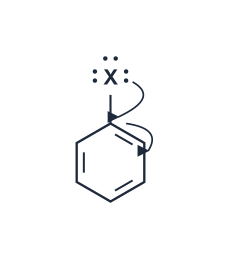
Q.Draw other resonance structures related to the following structure and find out whether the functional group present in the molecule is ortho, para directing or meta directing.
🔒You're viewing a preview — the full solution, concept, methods & PYQ mapping are locked.
🔒 Start your 14-day free trial to unlock the full solution →Concept understanding — Ortho Para Directing
The Intuition: Why Some Groups "Point" the Next Attack
Imagine you're trying to add a second substituent to a benzene ring that already has one group attached. The ring already has six hydrogens, but they aren't all equal anymore — the first group has changed the electron density at different positions. Some positions become more "attractive" to an incoming electrophile (a positive or electron-seeking species), while others become less attractive.
Ortho-para directing groups are substituents that make the next electrophile prefer to attack the positions next to the group (ortho, positions 2 and 6) or directly opposite it (para, position 4), rather than the meta position (position 3 and 5).
The terms come from Greek: ortho = straight/correct (adjacent), meta = after (one carbon away), para = beside/opposite (two carbons away, directly across).
The Precise Statement
Ortho-para directing groups are substituents that, when present on a benzene ring, cause the next electrophilic aromatic substitution (EAS) reaction to occur predominantly at the ortho and para positions relative to themselves. These groups are typically electron-donating (activating) or weakly deactivating (like halogens).
The Mechanism: How They Work
The key lies in the stability of the intermediate carbocation (the arenium ion / sigma complex) formed during the attack.
When an electrophile attacks benzene, the ring temporarily loses its aromaticity and becomes a positively charged carbocation. This intermediate is stabilised if the positive charge can be delocalised onto the substituent. Ortho-para directing groups are able to donate electron density into the ring, either through:
- Resonance effect (most important): The group has lone pairs or pi electrons that can be pushed into the ring, creating extra resonance structures where the positive charge is on the substituent (which is more stable).
- Inductive effect: The group is electron-donating through sigma bonds (e.g., alkyl groups like methyl).
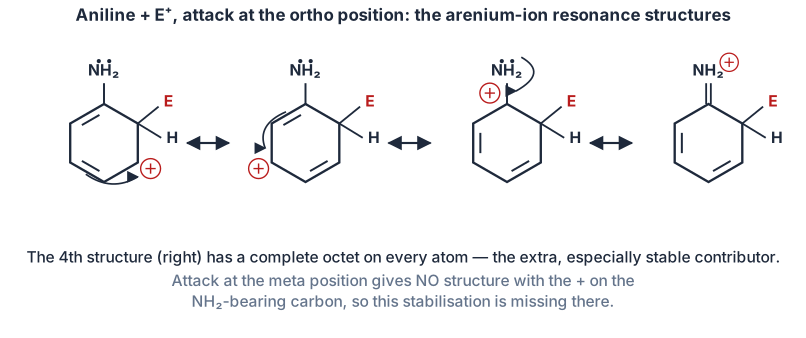
Let's see what happens when an electrophile attacks the ortho position of aniline (NH₂ group):
›Proof
Resonance stabilisation for ortho attack (aniline)
The NH₂ group donates its lone pair into the ring. When the electrophile attacks ortho, the positive charge can be delocalised onto the nitrogen atom (which is very happy to carry a positive charge because it's electronegative and has a lone pair). This gives an extra, highly stable resonance structure that is not available for meta attack.
For meta attack, the positive charge stays on the ring carbons — no extra stabilisation from the substituent. Hence ortho/para attack is favoured.
The Two Categories of Ortho-Para Directors
| Type | Examples | Effect | Why? |
|---|---|---|---|
| Strongly activating | -OH, -NH₂, -OCH₃, -NHR | Strong ortho-para directing | Strong resonance donation (lone pairs) |
| Moderately activating | -CH₃, -C₂H₅, -R (alkyl) | Ortho-para directing | Inductive electron donation (no lone pairs, but pushes electrons through sigma bonds) |
| Weakly deactivating | -F, -Cl, -Br, -I | Ortho-para directing (surprisingly!) | Halogens are electron-withdrawing inductively but electron-donating by resonance (lone pairs). The resonance effect wins for directing, but the inductive withdrawal makes the ring less reactive overall. |
Common mistake: Students think "deactivating" means "meta directing". Halogens are the exception — they deactivate the ring (slower reaction) but still direct ortho/para. The resonance donation of lone pairs is strong enough to stabilise the ortho/para intermediate, but the inductive withdrawal makes the ring less electron-rich overall. …
Why this formula?
Ortho-Para Directing: The Why Behind the Rule
Let’s build this from first principles. The question is: Why do certain groups on a benzene ring direct new substituents to the ortho and para positions, while others direct to the meta position?
The answer lies in resonance stabilization of the intermediate carbocation (the arenium ion / σ-complex) during electrophilic aromatic substitution (EAS).
1. The Core Mechanism: EAS Forms a Carbocation Intermediate
In EAS, the electrophile (E+) attacks the benzene ring. The ring temporarily loses aromaticity, forming a resonance-stabilized carbocation:
benzene+EX+[arenium ion]product
The arenium ion has three resonance forms. The stability of this intermediate determines how fast the reaction proceeds and where the electrophile attacks.
2. What Makes a Group Ortho-Para Directing?
A group is ortho-para directing if it donates electron density into the ring, especially at the ortho and para positions. This donation stabilizes the carbocation when the electrophile attacks those positions.
The Key: Resonance Structures of the Intermediate
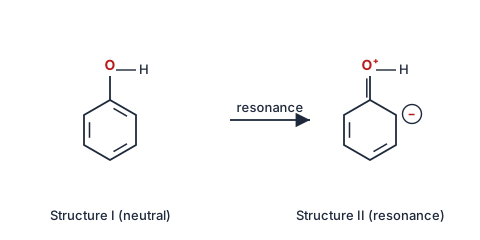
Consider an activating group like −OH (phenol). When the electrophile attacks the ortho position, one resonance form places the positive charge directly on the carbon bearing the −OH group. The oxygen’s lone pair can then donate into that empty p-orbital, creating an extra, highly stable resonance structure:
ortho attack: ...[resonance form with C+-OH][resonance form with O+=C]
This extra resonance contributor (with a positive charge on the electronegative oxygen) is not possible for meta attack. For meta attack, the positive charge never lands on the carbon attached to the −OH group — so no extra stabilization.
The donation itself, drawn for phenol:
Result: The ortho/para intermediates are more stable (lower energy) than the meta intermediate. Hence, the reaction is faster at ortho/para positions.
3. The Formula: Why Ortho and Para Specifically?
The resonance structures of the arenium ion reveal the pattern:
- For ortho attack: The positive charge can be delocalized to the carbon bearing the substituent (position 1).
- For para attack: The positive charge can also be delocalized to the carbon bearing the substituent (position 1).
- For meta attack: The positive charge never reaches the carbon with the substituent.
Mathematically, if the substituent is at position 1, the positions that can stabilize the positive charge via resonance are positions 2, 4, and 6 (ortho and para). Positions 3 and 5 (meta) cannot.
4. The Deactivating Ortho-Para Directors: The Halogen Exception
Halogens (−F,−Cl,−Br,−I) are deactivating (they withdraw electron density inductively) but ortho-para directing. Why?
- Inductive effect: Halogens are electronegative → pull electron density away from the ring → deactivate (slow down EAS).
- Resonance effect: Halogens have lone pairs → can donate into the ring via resonance → stabilize the ortho/para intermediates (just like −OH).
Drawn out for chlorobenzene: …
The key idea is ortho/para directing — halogens are deactivating but still ortho/para-directing because they can donate electron density through resonance, even though they withdraw inductively.
Reasoning:
- The lone pairs on the halogen (X) can delocalise into the ring, creating resonance structures where the negative charge appears at the ortho and para positions. …
A lone pair on the halogen delocalises into the ring, placing negative charge only at the ortho and para positions; the halogen is therefore an ortho/para director (though deactivating overall because of its −I effect).
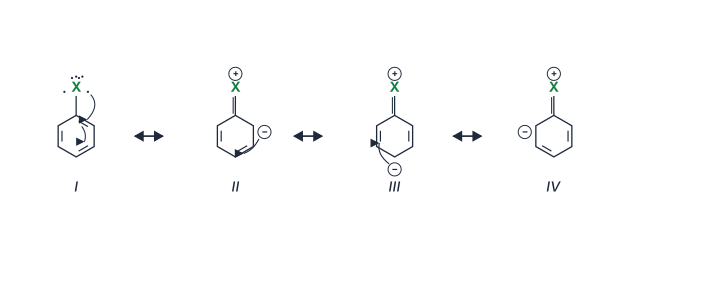
Resonance structures of halobenzene (C6H5−X¨:). In addition to the Kekulé forms, a lone pair on X can be donated into the π-system, giving three charge-separated contributors in which X carries a positive charge and a negative charge appears on the ring:
- X+ with the negative charge on one ortho carbon,
- X+ with the negative charge on the para carbon,
- X+ with the negative charge on the other ortho carbon.
In every contributor the negative charge appears only at the ortho and para carbons — never at a meta carbon, because conjugation cannot deliver charge to the meta position. …
Concept: Resonance Effects in Halobenzenes — Directing Nature of Halogens
Method: Resonance Structure Analysis for Directing Group Determination
Step 1: Identify the functional group and its electron effects
- The molecule is halobenzene (C6H5−X), where X is a halogen (F, Cl, Br, or I).
- Halogens have three lone pairs and are electronegative — they exert two opposing effects:
- -I effect (inductive withdrawal) — pulls electron density away from the ring
- +R effect (resonance donation) — pushes electron density into the ring via lone pair delocalisation
Step 2: Draw resonance structures showing lone pair delocalisation
- The curved arrow in the given structure shows a lone pair from X moving into the ring, forming a new pi-bond toward the ortho position.
- Tracking formal charge on X: before donating, X has 3 lone pairs (6 e⁻) + 1 bond (1 e⁻ owned) = 7 electrons owned, matching its 7 valence electrons -- neutral. After donating one lone pair into a new pi-bond, X has 2 lone pairs (4 e⁻) + 2 bonds (2 e⁻ owned) = 6 electrons owned -- X now carries a +1 formal charge.
- The extra electron pair X pushed into the ring displaces the ring's own pi-electrons around the ring in a cascade, ending up as an extra lone pair (negative formal charge) on the ortho or para ring carbon -- exactly the same pattern as the standard phenol/aniline resonance picture (O or N donates a lone pair into the ring; the heteroatom becomes positive, the ortho/para ring carbons become negative).
- This generates three charge-separated resonance structures in addition to the original (one for each ortho position, one for para; none for meta), exactly as drawn below:
- Structure I (original): C6H5−X¨: — lone pairs on X, neutral molecule.
- Structure II (ortho): X+ double-bonded to the ring, negative charge on one ortho carbon.
- Structure III (para): X+, negative charge on the para carbon.
- Structure IV (other ortho): X+, negative charge on the other ortho carbon.
Step 3: Identify where negative charge appears
- In the resonance forms, the negative charge (the extra electron density) appears only at:
- ortho positions (two equivalent positions)
- para position (one position)
- No resonance structure places extra negative charge at the meta position. …
Here are the common mistakes students make on this question, along with how to avoid each.
Mistake 1: Drawing resonance structures that break the octet rule for the halogen
- The error: Students often draw a structure where the halogen (X) forms a second bond to the ring but also keeps all three lone pairs, giving it 10 electrons in its valence shell.
- Why it's wrong: Halogens (F, Cl, Br, I) are in Group 17 and have only 7 valence electrons. In the original structure, they have 3 lone pairs (6 electrons) plus 1 bond (1 electron owned) = 7 electrons. When they donate a lone pair into the ring, they form a second bond and are left with 2 lone pairs (4 electrons) + 2 bonds (2 electrons owned) = 6 electrons owned -- a positive formal charge on X, not a negative one, and definitely not 10 electrons.
- How to avoid: Always count electrons. After drawing the arrow from a lone pair on X into the ring, remove one lone pair from X. Then check the formal charge: X now has 2 bonds and 2 lone pairs → formal charge = 7 − (4 + 2) = +1.
Mistake 2: Placing the positive charge on the ring carbon instead of the halogen
- The error: Students conclude that the ring carbon (ortho or para) ends up with the positive charge, and the halogen ends up negative or neutral.
- Why it's wrong: It's the opposite. The halogen is the atom that GAVE UP a lone pair, so it loses electron ownership and becomes positively charged (+1, worked out in Mistake 1). The ring carbon, on the other hand, RECEIVES the extra electron density that gets pushed around the ring's pi system -- it ends up with an extra lone pair and a negative formal charge, not positive. This is the same pattern as phenol's or aniline's resonance structures (O/N lone pair donation → negative charge on ortho/para ring carbons, positive charge on the donating atom) -- halobenzene behaves the same way, with the halogen playing the donor role.
- How to avoid: Follow electron ownership, not intuition. The atom that DONATES a lone pair loses an electron and becomes more positive; the atom/position that RECEIVES the extra electron pair becomes more negative. Halogen donates → halogen is positive. Ring carbon receives → ring carbon is negative.
Mistake 3: Claiming both the halogen and a ring carbon are simultaneously positive
- The error: Some explanations state the halogen carries +1 AND a ring carbon also carries +1 in the same resonance structure.
- Why it's wrong: The molecule started neutral overall, and resonance structures must conserve total charge. If the halogen is +1, there must be a compensating −1 somewhere -- on the ortho or para ring carbon, exactly where the extra electron pair ended up. Two positive charges with nothing negative to balance them violates charge conservation.
- How to avoid: After assigning formal charges in a resonance structure, always add them up and confirm they sum to the molecule's actual overall charge (here, zero).
Mistake 4: Forgetting that the halogen is an ortho/para director despite being deactivating
- The error: Students see that halogens are deactivating (they withdraw electron density inductively overall) and conclude they must be meta directors.
- Why it's wrong: Halogens are a unique case: they are deactivating overall (from the strong inductive electron withdrawal, since they're highly electronegative) but ortho/para directing (from resonance donation of a lone pair into the ring specifically at those positions). The resonance structures should show negative charge concentrating at ortho and para -- never meta -- which is exactly why an incoming electrophile prefers those positions even though the ring as a whole is less reactive than benzene.
- How to avoid: Memorise the rule: Most deactivating groups are meta directors -- except halogens, which are deactivating but ortho/para directing (because their DIRECTING effect comes from resonance, not from their overall inductive DEACTIVATING effect -- two separate effects, pointing in different directions on which aspect they control).
Mistake 5: Drawing only one resonance structure and stopping
- The error: The question asks for "other resonance structures" (plural). Students draw just one and think they are done.
- Why it's wrong: The lone pair on the halogen can delocalise toward either of the two ortho positions or the para position -- three distinct resonance contributors, each with the negative charge landing on a different ring carbon. …
- AP EAPCET 2026Set eng-2026-05-12-AN1 markMCQQ.Identify the set with only meta directing groups (A) −CH3 , −C(=O)−R , −NH−C(=O)−CH3 (B) −CN , −CO−R , −COOH (C) −OCH3 , −C2H5 , −NH2 (D) −NHR , −CHO , −NO2
›Reveal solutionSolution
Meta directors are electron-withdrawing groups that destabilise ortho/para carbocation intermediates by resonance; −CN, −CO−R, and −COOH are all meta directors, matching option (B) exactly.
Concept and Intuition
In electrophilic aromatic substitution, a substituent directs the incoming electrophile based on how it affects the stability of the arenium-ion intermediate at ortho/para vs meta positions. Groups with a lone pair or hyperconjugation that can donate electron density into the ring by resonance (−NH2, −NHR, −OCH3, −CH3, −C2H5, −NH−COCH3) are ortho/para directors (mostly activating, some like halogens deactivating but still o,p). Groups with a π-bond to a more electronegative atom directly on the ring (−CN, −CHO, −COR, −COOH, −NO2, −SO3H) withdraw electron density by resonance and destabilise the ortho/para arenium ions more than the meta one, making them meta directors (all deactivating).
Step-by-Step Solution
- Option (A): −CH3 (o,p, activating), −C(=O)R (meta), −NH−COCH3 (o,p, activating, via N lone pair) — mixed set, not all meta.
- Option (B): −CN (meta), −CO−R (meta), −COOH (meta) — all three are meta directors. …
- AP EAPCET 2025Set ap-2025-05-19-AN1 markMCQQ.Which of the following compounds is most reactive towards electrophilic substitution reactions? (A) Phenol, C6H5OH (benzene ring with an OH substituent) (B) Toluene, C6H5CH3 (benzene ring with a CH3 substituent) (C) Chlorobenzene, C6H5Cl (benzene ring with a Cl substituent) (D) Nitrobenzene, C6H5NO2 (benzene ring with a NO2 substituent)
›Reveal solutionSolution
Among OH, CH₃, Cl, NO₂ substituents, -OH is the strongest ring-activator by resonance, making phenol the most reactive towards electrophilic substitution.
Concept and Intuition
The rate of electrophilic aromatic substitution depends on how much electron density a substituent pushes into the ring. Groups with a lone pair adjacent to the ring (like -OH, -NH₂) donate strongly by resonance and are powerful activators; alkyl groups (-CH₃) donate weakly by hyperconjugation/induction; halogens (-Cl) are deactivating overall (though o,p-directing) because their strong -I effect outweighs weak resonance donation; -NO₂ is strongly electron-withdrawing (both -I and -M) and strongly deactivating.
Step-by-Step Solution
- Rank the activating strength: −OH (strong activator, resonance donor) >−CH3 (weak activator) >−Cl (weak deactivator, net) >−NO2 (strong deactivator).
- Phenol's OH group increases electron density at ortho/para positions the most, lowering the activation energy for electrophilic attack far more than a methyl group does. …
- AP EAPCET 2024Set eng-2024-05-21-AN1 markMCQQ.Number of deactivating groups of the following is −Cl,−SO3H,−OH,−NHC2H5,−COOCH3,−CH3 (A) 4 (B) 3 (C) 2 (D) 1
›Reveal solutionSolution
Of the six substituents, three are deactivating toward electrophilic aromatic substitution: −Cl, −SO3H, and −COOCH3.
Concept and Intuition
Groups that donate electron density into the benzene ring (by resonance or induction) activate it toward electrophilic substitution; groups that withdraw electron density deactivate it. Halogens are a special case: they withdraw inductively (deactivating overall) but still donate a lone pair by resonance (hence they remain o/p-directors despite being deactivating).
Step-by-Step Solution
- −Cl: strong −I effect dominates over weak +M donation → net deactivating (o/p-director).
- −SO3H: strongly electron-withdrawing (both −I and −M) → deactivating (m-director).
- −OH: lone pair strongly donated into ring by resonance → activating.
- −NHC2H5: amine lone pair strongly donated by resonance → activating (even stronger than −OH). …
- AP EAPCET 2023Set eng-2023-05-15-AN1 markMCQQ.Two statements are given below Statement I: Chlorobenzene on nitration gives 1-chloro-4-nitrobenzene as major product Statement II: Chlorobenzene undergoes nitration slowly than benzene Identify the correct answer (A) Statements I, II are correct (B) Statements I, II are incorrect (C) Statement I correct but statement II is incorrect (D) Statement II correct but statement I is incorrect
›Reveal solutionSolution
Chlorobenzene is an ortho/para director (so Statement I is correct) but it deactivates the ring, making nitration slower than benzene (so Statement II is also correct). Thus both statements are true.
Concept & Intuition: Ortho/Para Directing and Activation/Deactivation
When a substituent is already on a benzene ring, it influences two things:
- Where the next substituent goes (orientation).
- How fast the reaction happens (reactivity).
Chlorine is a fascinating case: it is ortho/para directing because it can donate electrons through resonance (lone pairs on chlorine can delocalize into the ring, stabilizing the intermediate carbocation at ortho/para positions). However, chlorine is also highly electronegative, so it withdraws electrons inductively (through sigma bonds), which deactivates the ring overall. The net effect: chlorobenzene reacts slower than benzene, but when it does react, the new group goes ortho or para.
Now let’s check each statement.
-
Statement I: Chlorobenzene on nitration gives 1-chloro-4-nitrobenzene as major product
- Nitration is an electrophilic aromatic substitution. The electrophile is the nitronium ion (NO2+).
- Chlorine’s resonance donation makes the ortho and para positions more electron-rich than the meta position.
- The para product (1-chloro-4-nitrobenzene) is often the major one because ortho substitution can be slightly hindered by the chlorine atom’s size.
- So Statement I is correct.
-
Statement II: Chlorobenzene undergoes nitration slower than benzene
- Benzene itself has no substituent; its reactivity is the baseline.
- Chlorine withdraws electron density inductively (due to high electronegativity), making the ring less electron-rich overall. …
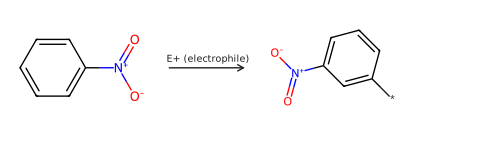
- AP EAPCET 2023Set eng-2023-05-16-FN1 markMCQQ.[FIGURE] (a benzene ring bearing a NO2 substituent reacting with an electrophile E+ to give a product benzene ring with NO2 and the electrophile E attached at the meta position relative to NO2) In the above reaction electrophile is substituted at meta position only, due to I. Electron density is more at ortho & para position II. Electron density is relatively less at ortho & para position III. Electron density is less at meta position IV. Electron density is relatively more at meta position correct answer is (A) I, III only (B) II, IV only (C) I only (D) III only
›Reveal solutionSolution
−NO2 withdraws electron density strongly from the ortho/para positions by resonance, so the meta position is comparatively electron-rich and that's where the electrophile attacks.
Concept and Intuition
In electrophilic aromatic substitution, the position attacked is the one with the most residual electron density (most nucleophilic carbon), not the one with the least. −NO2 is meta-directing precisely because its strong −M (resonance) and −I (inductive) effects pull electron density away from the ring, concentrating the depletion at the ortho and para carbons (where resonance structures place formal positive charge on the ring carbon). This leaves the meta carbon relatively less deactivated — i.e., comparatively electron-richer — so the electrophile bonds there.
Step-by-Step Solution
- Draw the resonance structures of nitrobenzene: positive charge on the ring appears at ortho and para carbons when −NO2's lone pair/π-system withdraws density.
- This means ortho/para carbons are the most electron-poor (statement I, claiming they have more electron density, is wrong; statement II, that they have relatively less, is right). …
- AP EAPCET 2022Set eng-2022-07-04-AN1 markMCQQ.Identify the ortho and para directing groups towards aromatic electrophilic substitution reactions from the following list -OH (I) -CN (II) -CO2H (III) -OCH3 (IV) -NHCOCH3 (V) -CHO (VI) (A) I, IV, V (B) II, III, VI (C) I, II, IV (D) IV, V, VI
›Reveal solutionSolution
Groups with a lone pair that can donate into the aromatic ring by resonance (–OH, –OCH3, –NHCOCH3) are ortho/para directors; groups with an electron-withdrawing π-system attached directly to the ring (–CN, –CO2H, –CHO) are meta directors.
Concept and Intuition
In electrophilic aromatic substitution, a substituent already on the ring determines where the next electrophile attacks by how it distributes electron density around the ring through resonance. Groups bonded to the ring via an atom bearing a lone pair (O, N) can donate that lone pair into the ring's π system, building up electron density specifically at the ortho and para positions, so they are ortho/para directors (and ring-activating). Groups bonded to the ring via a carbon that is itself part of an electron-withdrawing multiple bond (C≡N, C=O of an acid, C=O of an aldehyde) pull electron density away from the ring by resonance, leaving the meta position comparatively most electron-rich (least destabilized in the transition state), so they are meta directors (and ring-deactivating).
Step-by-Step Solution
- –OH (I): oxygen lone pair donates into the ring — ortho/para director, activating.
- –CN (II): the C≡N group withdraws electron density — meta director, deactivating.
- –CO2H (III): the carboxyl carbon is electron-poor (C=O), withdraws by resonance — meta director, deactivating.
- –OCH3 (IV): like –OH, oxygen lone pair donates into ring — ortho/para director, activating. …
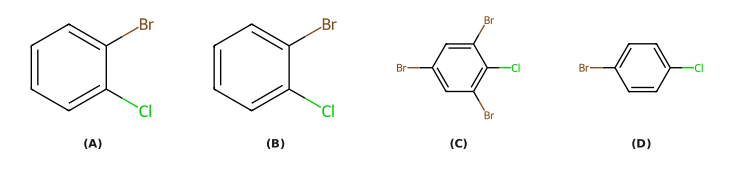
- AP EAPCET 2022Set eng-2022-07-05-FN1 markMCQQ.Identify the major product of the following reaction: chlorobenzene + Br2 Anhyd. FeCl3 ? (A) [FIGURE: 1-bromo-2-chlorobenzene — a benzene ring with Cl and Br substituents in the ortho (1,2) positions] (B) [FIGURE: 1-bromo-2-chlorobenzene — a benzene ring with Cl and Br substituents in the ortho (1,2) positions] (C) [FIGURE: 2,4,6-tribromochlorobenzene — a benzene ring with Cl at one carbon and Br at each of the other three alternating carbons] (D) [FIGURE: 1-bromo-4-chlorobenzene — a benzene ring with Br and Cl in the para (1,4) positions]
›Reveal solutionSolution
Chlorobenzene undergoes electrophilic aromatic substitution with Br₂/FeCl₃. The chlorine atom is an ortho/para director, so the major product is the para isomer (1-bromo-4-chlorobenzene) due to steric hindrance at the ortho positions. The correct option is (D).
Concept and Intuition
This problem tests your understanding of directing effects in electrophilic aromatic substitution (EAS). Chlorine (Cl) on a benzene ring is a unique substituent: it is deactivating (due to its strong inductive electron withdrawal) but ortho/para directing (because its lone pairs can donate electron density via resonance to the ortho and para positions). When we add a second substituent (here, Br), the incoming electrophile (Br⁺, generated by Br₂/FeCl₃) will preferentially attack the positions that are most electron-rich — the ortho and para positions relative to the Cl.
However, the ortho positions are sterically crowded (adjacent to the bulky Cl atom), so the para product is usually the major one. The reaction is a classic example of electrophilic bromination of a deactivated aromatic ring, catalyzed by FeCl₃ (a Lewis acid that polarizes Br₂).
Step-by-Step Reasoning
- Identify the catalyst’s role Anhydrous FeCl₃ acts as a Lewis acid. It coordinates with Br₂, polarizing the Br–Br bond and generating a stronger electrophile:
Br2+FeCl3→Brδ+⋯FeCl3Brδ−
This effectively creates a Br⁺ species that can attack the benzene ring.
-
Analyze the directing effect of Cl
Chlorine has two opposing effects:
- Inductive withdrawal (due to high electronegativity) makes the ring less reactive overall (deactivating).
- Resonance donation (lone pairs on Cl can delocalize into the ring) increases electron density at the ortho and para positions. The resonance structures show that the ortho and para carbons carry partial negative charge, making them the only sites for electrophilic attack.
-
Consider steric hindrance
The ortho positions are adjacent to the Cl atom. The Cl atom is relatively large, so an incoming Br atom at the ortho position would experience steric repulsion. The para position is farther away and much less hindered. Therefore, the para product is kinetically favored (major product).
-
Evaluate the options
- (A) and (B) both show ortho products (1-bromo-2-chlorobenzene). They are essentially identical drawings; these are minor products. …
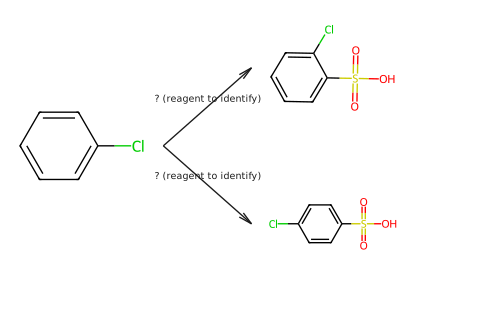
- AP EAPCET 2021Set eng-2021-08-20-AN1 markMCQQ.Identify the best suitable reagent for the following reaction. [FIGURE] (chlorobenzene — a benzene ring with Cl at C1 — reacts with a reagent "?" to give a mixture of ortho-chlorobenzenesulfonic acid (Cl at C1, SO3H at C2) and para-chlorobenzenesulfonic acid (Cl at C1, SO3H at C4)) (A) Concentrated Sulphuric acid (B) Dilute Sulphuric acid (10 %) (C) Concentrated Sulphuric acid & Concentrated Nitric acid (D) Concentrated Acetic acid (fuming)
›Reveal solutionSolution
Converting chlorobenzene into its ortho/para sulfonic acids is a classic electrophilic
aromatic sulfonation, carried out with concentrated H2SO4.
Concept and Intuition
Sulfonation replaces a ring hydrogen with −SO3H via electrophilic attack of SO3 (generated
in situ from concentrated/fuming sulfuric acid). Chlorine on the ring is a weak deactivator but
still an ortho/para director (due to lone-pair donation by resonance, despite its inductive
electron withdrawal), so the two products are exactly the ortho- and para-substituted sulfonic
acids shown.
Step-by-Step Solution
- Identify the transformation: Ar–H→Ar–SO3H — a sulfonic-acid group has been installed on the ring. This is sulfonation, not nitration or any other substitution.
- Sulfonation requires a strong source of electrophilic SO3, which concentrated (or fuming) sulfuric acid provides.
- Dilute (10%) sulfuric acid (option B) is far too weak to sulfonate an aromatic ring.
- A mixture of concentrated H2SO4 and concentrated HNO3 (option C) is the nitrating …
🎓Unlock everything free for 14 days
- ✓Full step-by-step solutions
- ✓Concept-first explanations
- ✓Methods, shortcuts & mistakes
- ✓PYQ mapping + timed mock tests
Full access for 14 days. No credit card required.